






DIA, TMT, or Label-Free: How to Choose for Plant Proteomics
For comparative plant proteomics, the practical choice is usually among DDA-based label-free quantification, DIA-based label-free quantification, and isobaric labeling with TMT or iTRAQ. These routes differ not only in data acquisition or labeling chemistry, but also in how well they fit plant tissue availability, experimental scale, group structure, and the need for consistent cross-sample quantification.
None of these quantitation routes replaces matched sample preparation. In plant comparative proteomics, tissue type, stress timing, extraction recovery, and biological replicate independence still determine whether abundance differences are interpretable, regardless of whether quantification uses DDA-LFQ, DIA-LFQ, or isobaric labeling.
Method selection should therefore begin with the biological comparison, plant material, replicate structure, and expected quantitative readout—not with the instrument name or the assumption that a more complex workflow is automatically better.
What DDA-LFQ, DIA-LFQ, and TMT/iTRAQ Do
All three routes support relative protein abundance comparison after extraction, digestion, and LC-MS/MS. DDA and DIA describe how peptide ions are acquired, whereas label-free and TMT/iTRAQ describe how samples are quantified. Both DDA and DIA can support label-free quantification.
DDA-based label-free quantification compares peptide or protein signals across individually acquired LC-MS/MS runs without adding isobaric tags. Plant DDA-LFQ data may be processed using MaxQuant or Proteome Discoverer. Because each sample is analyzed separately, the workflow remains practical for exploratory comparisons and projects in which tissue feasibility or group structure still needs to be evaluated.
DIA-based label-free quantification records fragment-ion data across predefined mass windows and extracts quantitative signals consistently across samples. DIA data can be analyzed using experimental spectral libraries, predicted libraries, or library-free workflows, depending on the acquisition design and software pipeline. Spectronaut and DIA-NN are commonly used for DIA data processing.
TMT and iTRAQ use isobaric tags to combine several samples into one multiplexed acquisition set. Reporter-ion intensities support quantitative comparison within a plex, making these approaches useful when groups and channels can be planned before labeling.
None of these approaches proves causal regulation, field performance, or marker validity by itself. Each produces protein-level abundance evidence that must be interpreted alongside the experimental design and supported by follow-up studies when stronger claims are required.
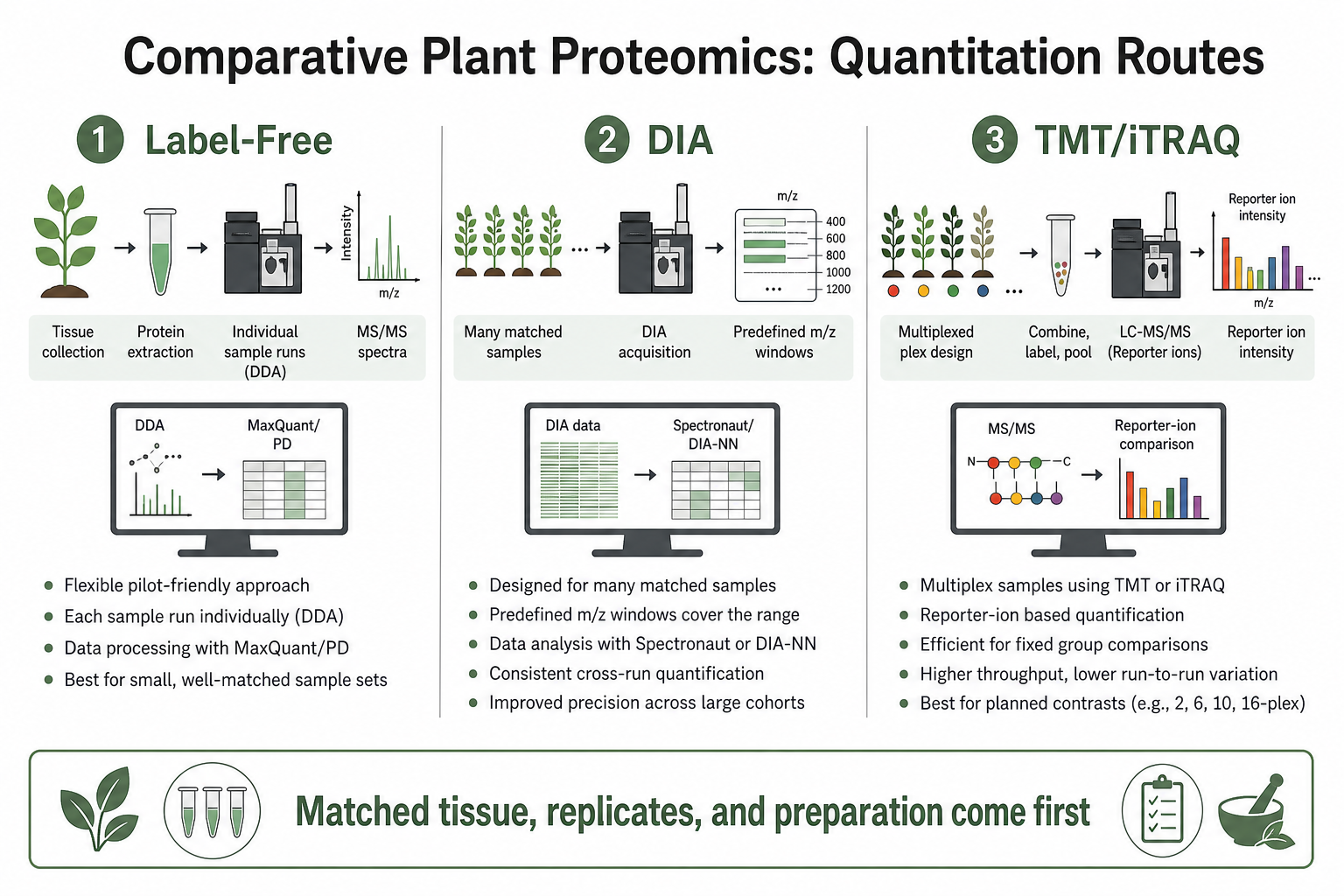
Figure 1. DDA-based label-free quantification, DIA-based label-free quantification, and TMT/iTRAQ use different acquisition and quantitation structures for comparative plant proteomics
When DDA-Based Label-Free Quantification Fits Plant Proteomics
DDA-LFQ is often a practical starting route when the project is still testing whether a selected plant tissue, stress window, treatment, or genotype contrast produces an interpretable proteomic difference.
It may fit initial comparisons such as drought-treated versus control leaves, resistant versus susceptible genotypes under one pathogen challenge, or a short treatment time course with a limited number of independent biological replicates. Its main advantage in these projects is workflow flexibility rather than an assumption that it is only suitable for small sample sets.
Because samples are analyzed individually, a successful pilot can later be expanded. However, additional samples must follow the same biological definition, harvest timing, handling procedure, and batch plan. Label-free analysis cannot correct differences created by inconsistent plant growth, collection, freezing, or extraction.
DDA-LFQ may also be considered when available plant material or expected protein recovery is uncertain. It avoids the additional labeling step required for TMT or iTRAQ, although adequate and comparable protein recovery is still necessary.
Its limitations become more important as study size and analytical batches increase. Stochastic precursor selection can contribute to missing values, while run order and batch variation require careful control in larger comparisons.
When DIA-Based Label-Free Quantification Fits Better
DIA-LFQ is often selected when a plant study prioritizes consistent peptide measurement across a defined sample set. This can be valuable in multi-genotype panels, developmental series, matched stress time courses, or treatment studies containing enough samples for missing values and run-to-run consistency to become major concerns.
Unlike DDA, DIA repeatedly records fragment data across systematic isolation windows. This can improve quantitative completeness across matched samples, but it does not remove variability caused by plant tissue composition or inconsistent sample preparation.
Complex plant matrices such as leaf, root, seed, and other storage-compound-rich tissues may contain pigments, polysaccharides, phenolics, lipids, or highly abundant proteins that affect extraction and detectable proteome depth. DIA can support more uniform measurement after preparation has been standardized, but it cannot compensate for unequal protein recovery or unmatched sample histories.
DIA can also be used in smaller studies when quantitative consistency is a major priority. Its value should therefore be judged by the study objective and data-quality requirements rather than by a fixed sample-number threshold.
Instrument options such as Orbitrap Exploris 480, timsTOF Pro, and Orbitrap Astral can be discussed after the sample structure and expected analysis depth are defined.
When TMT or iTRAQ Labeling Is Worth Considering
TMT and iTRAQ are most useful when the comparative design is already fixed and several samples can be balanced within a multiplexed plex.
A suitable plant project may include predefined stress and control groups across several genotypes, or multiple treatment time points collected under one protocol. Samples within a plex share the same multiplexed acquisition structure, which can support efficient within-plex comparison.
This route requires sufficiently consistent protein input across samples before labeling. Uneven recovery from difficult tissues, uncertain group membership, or samples collected under incompatible conditions can weaken the design before LC-MS/MS begins.
Projects containing more samples than one plex can accommodate require an explicit multi-plex strategy. Reference or bridge samples, channel balance, and plex-to-plex batch effects must be considered before labeling.
TMT and iTRAQ also have method-specific limitations. Reporter-ion interference and ratio compression may reduce the apparent magnitude of abundance differences, while labeling does not correct poor extraction, degradation, contamination, or repeated freeze–thaw damage.
Plant-Specific Factors That Affect Every Quantitation Route
Plant proteomics method selection cannot be separated from plant biology and tissue composition.
Tissue Composition and Protein Recovery
Leaf, root, seed, bark, pollen, and other plant materials can differ substantially in protein abundance, water content, storage compounds, pigments, polysaccharides, phenolics, and extraction difficulty. The same tissue mass does not necessarily yield comparable protein input across species or tissue types.
Material requirements should therefore be reviewed according to species, tissue composition, expected protein recovery, and whether labeling or enrichment is planned. Fixed tissue amounts should not be treated as universal requirements.
Stress Timing and Developmental Stage
Early drought, salt, heat, or pathogen sampling may capture signaling responses, whereas later sampling may reflect metabolic remodeling, tissue damage, or adaptation. Developmental stage, circadian timing, and harvest position can also influence the detected proteome.
Samples assigned to one quantitative group should represent the same defined biological stage. No acquisition or labeling strategy can separate treatment effects from unmatched stress severity or developmental status after collection.
Biological Replication
Independent plants, pots, plots, or biological preparations should enter the analysis separately when the research claim concerns treatment, genotype, or stress response.
Repeated leaves or technical preparations from one plant do not replace independent biological replicates. Pooling may be appropriate for specific experimental reasons, but it changes the unit of biological inference and should be planned before collection.
Matched Handling and Batch Control
Delay to freezing, storage temperature, thaw history, extraction batch, digestion batch, and LC-MS/MS run order can all introduce technical variation.
Plant stress and control samples should be distributed across preparation and acquisition batches rather than processed as separate blocks whenever the design allows. Randomization and suitable quality-control samples become increasingly important as the project expands.
Depending on the confirmed service scope and species annotation availability, plant proteomics reporting may include protein identification, relative quantification, differential analysis, and supported functional annotations such as GO, KEGG, or PPI-related analysis.
A Practical Decision Path
First, define the comparison in one sentence. For example:
-
Tolerant versus sensitive wheat leaves collected at the same defined drought stage
-
Salinity-treated versus control roots at one matched time point
-
Several genotypes compared across a fixed developmental series
Second, assess whether the design is exploratory or already fixed. DDA-LFQ often provides flexibility for initial feasibility testing. DIA-LFQ becomes attractive when consistent measurement across a defined cohort is a major priority. TMT or iTRAQ requires a stable group and channel plan before labeling.
Third, review plant material and protein recovery. Difficult or limited material may require a preparation assessment before a labeling strategy is selected. Consistent recovery across samples is especially important for multiplexed workflows.
Finally, match the route to the required evidence. Protein identification, relative quantification, pathway interpretation, interaction analysis, and PTM analysis are related but distinct project scopes. The acquisition mode should be selected according to the main biological question rather than used as a substitute for a clearly defined deliverable.
If these considerations point in different directions, species, tissue type, group structure, storage history, and expected readout should be reviewed together before sample processing.
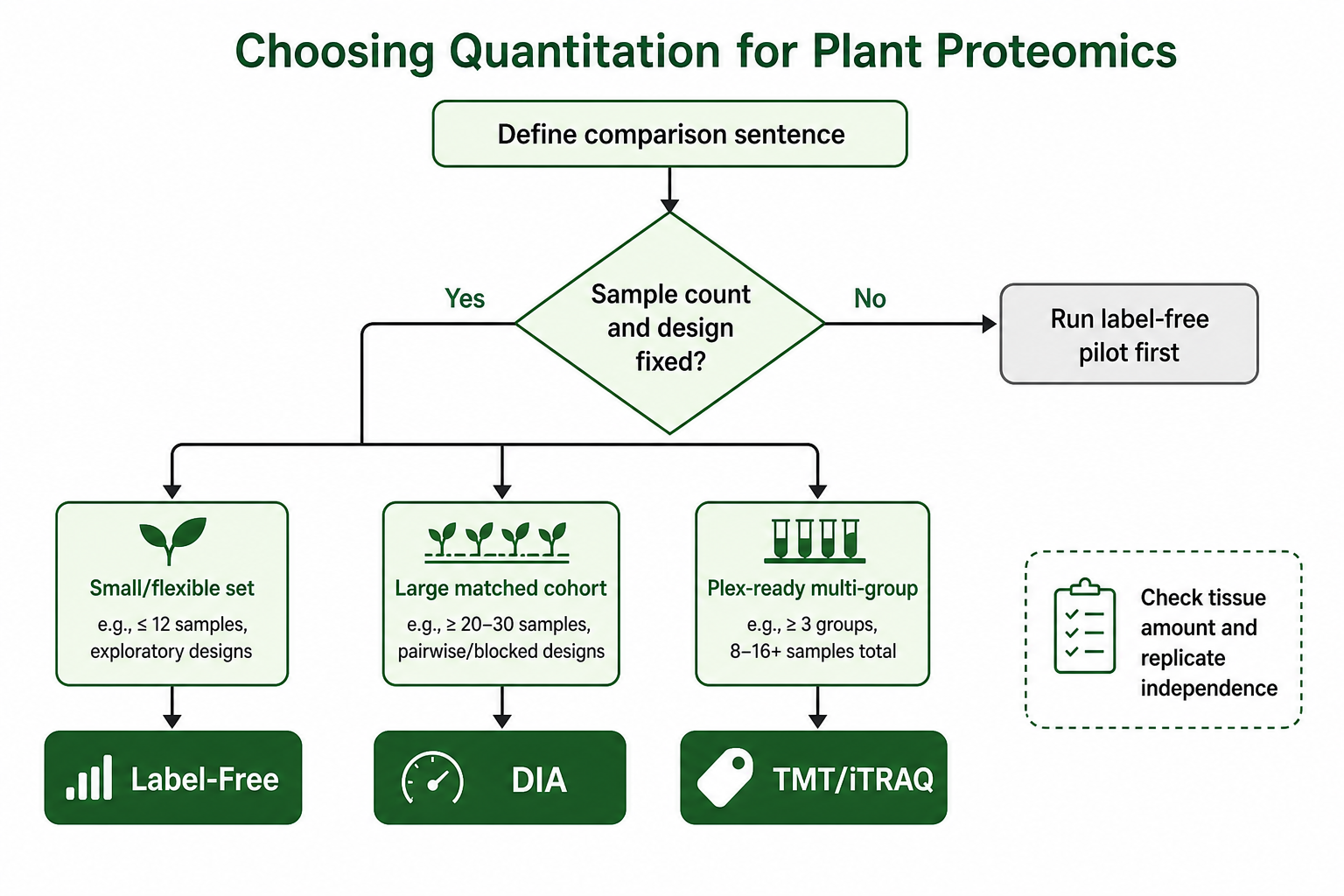
Figure 2. Define the biological comparison, plant material, replicate structure, and required evidence before selecting a quantitative proteomics route
Related Services
Quantitative Proteomics Service
Plant Phosphoproteomics Analysis Service
Frequently Asked Questions
1. Is label-free quantification the same as DDA or DIA?
No. Label-free describes a quantitation strategy, while DDA and DIA describe acquisition modes. Both DDA and DIA can support label-free quantification.
2. Can a DDA-LFQ pilot be followed by a DIA-LFQ study?
Yes, but the main quantitative comparison should use a consistent acquisition and processing strategy. A DDA-LFQ pilot may help evaluate tissue preparation or biological contrast before a separately planned DIA-LFQ cohort is analyzed. Results from the two stages should not automatically be treated as one directly comparable quantitative dataset.
3. Can different plant tissues be included in one quantitative comparison?
They can be analyzed within one project, but tissue identity is usually a major biological variable. Leaf, root, seed, and other tissues should not be treated as interchangeable replicates of one group. The comparison structure should distinguish tissue effects from treatment or genotype effects.
4. What should be considered when a TMT study requires multiple plexes?
Channel balance, reference or bridge samples, preparation batches, and plex-to-plex variation should be planned before labeling. Otherwise, inter-plex differences may complicate interpretation of the biological comparison.
5. Do plant PTM studies follow the same method-selection logic?
Only partly. PTM proteomics also requires modification-specific enrichment, adequate starting protein, and a design suited to site-level analysis. A quantitation strategy suitable for global proteomics may need to be reconsidered when phosphorylation, acetylation, ubiquitination, glycosylation, or another PTM is the primary target.
Conclusion
DDA-LFQ, DIA-LFQ, and TMT/iTRAQ can all support comparative plant proteomics, but they address different project constraints. DDA-LFQ offers flexibility for exploratory comparisons, DIA-LFQ supports consistent measurement across defined sample sets, and TMT/iTRAQ enables multiplexed comparison when protein input and group structure are suitable.
The final choice should follow the biological comparison, plant tissue characteristics, biological replication, preparation consistency, and required evidence—not a fixed sample-number rule or platform preference.
Contact MtoZ Biolabs with the species, tissue type, comparison design, biological replicate structure, storage history, and expected readout to evaluate which quantitative proteomics route best matches the project.
How to order?




