



A 4D label-free quantitative proteomics workflow measures relative protein change from unlabeled peptide ions after liquid chromatography, trapped ion mobility spectrometry (TIMS), and Parallel Accumulation-Serial Fragmentation (PASEF) (Meier et al. 2018). The four recorded dimensions are chromatographic retention time, mass-to-charge ratio (m/z), ion mobility, and signal intensity. Ion mobility is an extra gas-phase separation. It is not a labeling chemistry, not a data-independent acquisition (DIA) synonym, and not a fourth quantitative algorithm. Samples remain independently injected. Comparability is still reconstructed after acquisition by alignment and normalization. The valid claim is relative change of the same protein inside one chromatographic and mobility plan. Ordinary 4D intensities are not molar concentrations.
Researchers who already have defined samples, comparison groups, or a specific project objective can also review the MtoZ Biolabs 4D Label-free Quantitative Proteomics Analysis Service for project-specific feasibility and analysis planning.
When a 4D Label-Free Workflow Is the Execution Path
This workflow fits when the study needs unlabeled relative discovery, the contrast can stay under one nanoLC and TIMS plan, and extra ion-mobility selectivity is expected to help resolve co-eluting peptides. It is the wrong execution path when the cohort must share one pooled isobaric injection, when the endpoint is a calibrated peptide amount, or when a TIMS-PASEF instrument is not part of the acquisition plan.
Labeling, ion mobility, and acquisition remain separate decisions. Unlabeled means isotopic or isobaric tags were not added. TIMS adds collision cross section (CCS) information as an ion property. Data-dependent PASEF (ddaPASEF) and data-independent PASEF (diaPASEF) name how precursors are fragmented on that platform (Meier et al. 2020). 4D does not equal DIA.
Researchers can refer to What Is Label-Free Quantification in Proteomics? for the unlabeled comparison that still has to survive independent runs.
4D label-free quantification is unlabeled LFQ with TIMS-PASEF as extra separation and sampling, not a method that cancels run-to-run comparability.
From Extracted Protein to a Clean Peptide Digest
Extraction and digestion determine whether later 4D features still represent the intended groups. Errors at this stage cannot be removed by ion mobility or pathway software.
Proteins are extracted from cells, tissues, microorganisms, or biofluids under conditions compatible with digestion and nanoLC. A colorimetric reading such as bicinchoninic acid (BCA) matches protein input across samples. It does not identify which proteins changed. Detergents, salts, and polymers that survive cleanup can suppress ionization or damage chromatography and TIMS performance.
Digestion is usually trypsin, sometimes with Lys-C. Filter-aided or in-solution digestion can both feed this workflow when peptides are recovered cleanly. C18 cleanup removes residual contaminants. The useful statement is that extraction, digestion, and peptide load stayed matched across the contrast. Naming a lysis buffer does not define a 4D method.
LC, TIMS, and PASEF Acquisition
Peptides are separated by reversed-phase nanoLC, ionized, and accumulated in a TIMS tunnel. Ions of different mobility elute from that tunnel at different times, which adds a CCS-related coordinate to each feature. PASEF uses the trapped packet: ions accumulate while a previous mobility packet is fragmented, then are released serially for MS/MS (Meier et al. 2018). The point of that cycle is more efficient use of the ion population, not a guaranteed protein count.
ddaPASEF selects precursors for fragmentation with ion-mobility information in the duty cycle. Quantitative values in that route usually come from MS1 features after identification, as in other unlabeled DDA-LFQ work, with mobility as an extra matching constraint. diaPASEF fragments scheduled windows that also have a mobility dimension. Quantitative values then come from extracted fragment chromatograms and typically need a spectral library or a library-free model. Both routes can be unlabeled. They are not interchangeable processing files.
In MtoZ 4D label-free offerings, the service is typically acquired as TIMS-PASEF on unlabeled digests for global relative discovery. Project-level choice between ddaPASEF and diaPASEF is an acquisition decision, not a claim that 4D is defined by DIA. Service configuration is not an academic rule that other laboratories must copy.
A later column change, TIMS calibration drift, or long interruption can create a new analytical block. Ordinary LFQ normalization does not merge that block into the original 4D matrix.
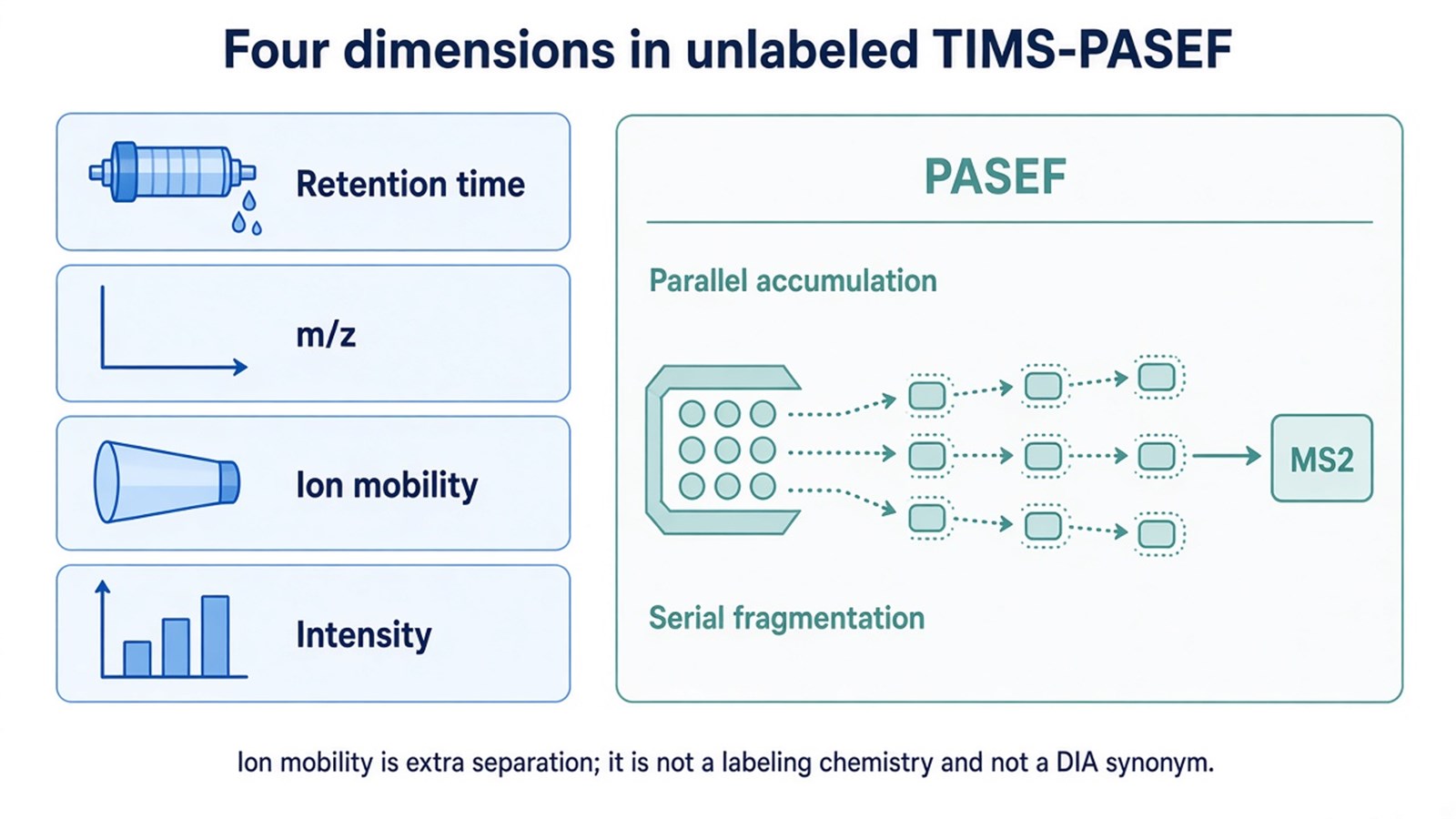
Figure 1. 4D label-free data record retention time, m/z, ion mobility, and intensity; PASEF fragments mobility-separated ion packets from unlabeled peptides.
Identification, Quantification, and Control Points
Peptide identities come from fragment spectra searched against a protein database. Protein values are summarized from the quantitative features that match those peptides. Mobility can reduce matching of co-eluting species that share m/z. It does not prove that two different proteins with similar intensity have similar copy numbers.
Software choice follows the acquisition file. MaxQuant-style MS1 LFQ is a common path for ddaPASEF. Spectronaut, DIA-NN, or related extractors are common paths for diaPASEF. Naming a package does not standardize laboratories. The search database version, mobility matching, and the stated normalization belong with the protein table. Exporting identifications from one tool and intensities from another, without a shared 4D feature map, breaks that trail.
Fold-change cutoffs, p-value thresholds, volcano plots, and pathway maps are analysis choices after the matrix exists. They are not steps that define the 4D workflow. A noisy unlabeled matrix still yields a pathway figure.
Unlabeled 4D files still carry missing values, run-order confounding, and ion suppression. Ion mobility can reduce some precursor overlap. It does not make independent injections immune to column aging.
Researchers can refer to Issues and Resolutions in Label-Free Quantitative Mass Spectrometry for those unlabeled failure modes.
Workflow stage |
What has to stay matched |
Control that can help |
Control that does not |
|---|---|---|---|
Extraction and digestion |
Protein input, lysis, enzyme |
Load matching, one digest protocol |
Treating BCA as protein ID |
LC and TIMS |
Gradient, column, mobility calibration |
One LC-TIMS plan, QC injections |
Merging a new column by ordinary normalization |
PASEF acquisition |
Window or precursor method across the cohort |
Keep ddaPASEF or diaPASEF as one plan |
Calling 4D a DIA method by default |
Quantification |
Feature map, library or LFQ settings |
One processing trail |
Using a pathway map as a technical repair |
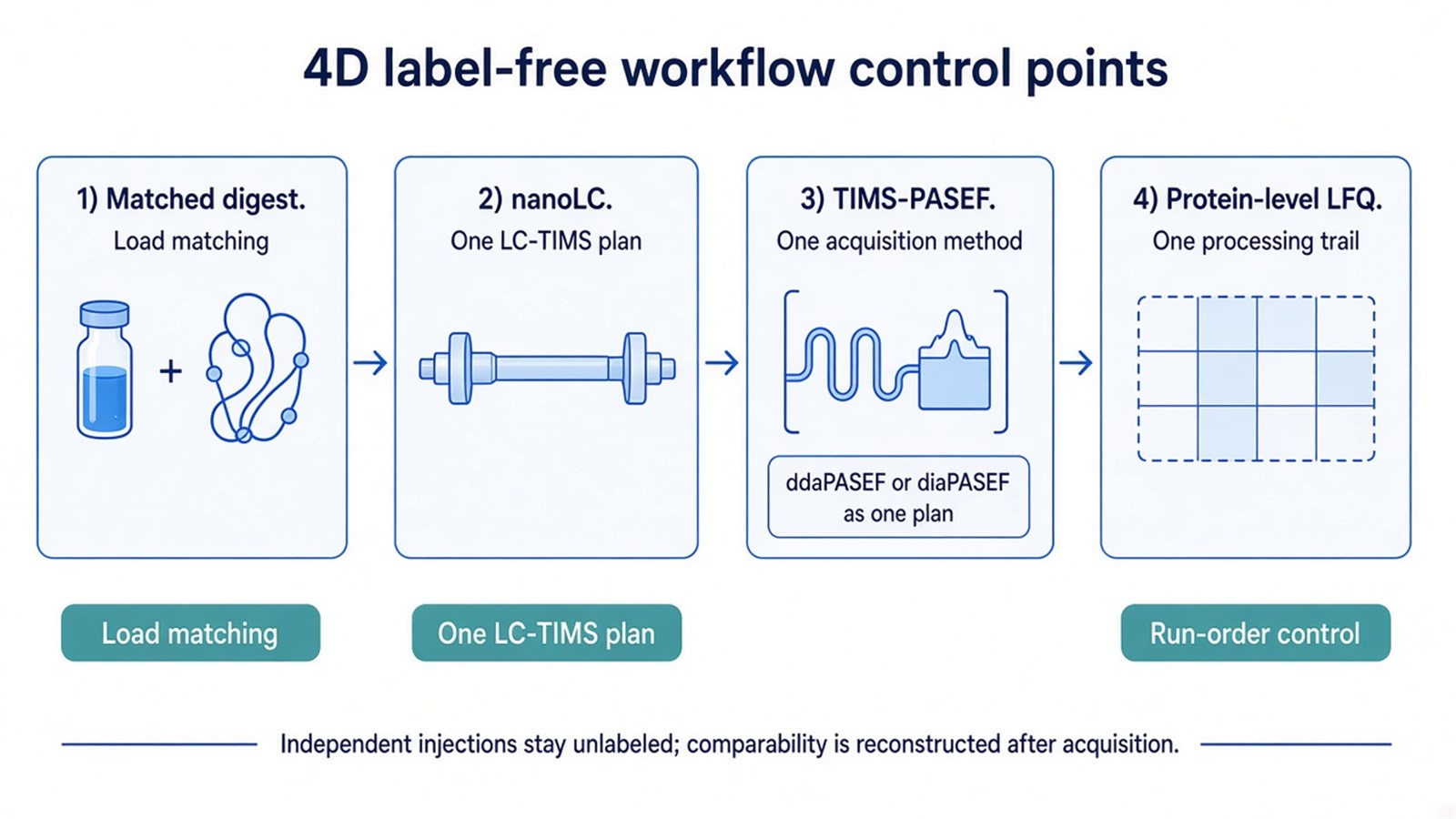
Figure 2. A 4D label-free workflow stays unlabeled and independent at injection; load matching, one LC-TIMS plan, and run-order control decide whether protein values remain comparable.
What a 4D Label-Free Result Can Support
After identification, feature integration, and protein summarization, a 4D LFQ value can support a relative statement: protein A is higher or lower in group 1 than in group 2 inside this study. Peptide support, mobility matching, missingness, and the stated acquisition mode belong next to that statement. Ordinary 4D intensities should not rank different proteins by copy number, infer a diagnostic cutoff, or transfer a ratio from one TIMS method or processing pipeline to another study as a calibrated quantity.
PTM site quantification is a narrower experiment. Global 4D protein tables do not replace enrichment workflows for phosphorylation or other modifications. Targeted monitoring of a short peptide list is a different assay.
A 4D label-free table supports relative change of one protein inside one LC-TIMS plan, not a proteome-wide concentration certificate.
Frequently Asked Questions
1. Does 4D label-free quantification mean DIA?
No. 4D names retention time, m/z, ion mobility, and intensity. ddaPASEF and diaPASEF are both possible on a TIMS-PASEF platform. DIA is an acquisition class, not the fourth dimension.
2. Does unlabeled 4D analysis avoid batch effects because no TMT kit is used?
No. Independent injections still carry loading, chromatography, and mobility-calibration history. Randomizing group order and keeping one analytical block matter as they do in other unlabeled work. The absence of a plex is not a batch-effect waiver.
3. Can 4D LFQ report absolute protein amounts?
Not from ordinary extracted intensities. Absolute or copy-number claims need spike-in standards, a calibration model, or a targeted quantitative assay.
4. Is a 4D workflow the same as conventional LC-MS LFQ with a faster scanner?
No. TIMS adds a mobility coordinate and PASEF changes how ions are accumulated and fragmented. The scientific claim remains unlabeled relative quantification. The extra dimension is useful only when that mobility information is acquired, calibrated, and used in matching.
Once the comparison design, unlabeled sample set, and TIMS-PASEF acquisition plan are defined, the project can be evaluated as a 4D label-free workflow. Researchers can review the MtoZ Biolabs 4D Label-free Quantitative Proteomics Analysis Service for project-specific sample evaluation, feasibility assessment, and workflow planning.
