






Comparison of 4D Label-Free Quantitative Proteomics and TMT Quantitative Proteomics
In proteomics research, quantitative analysis is central to elucidating biological differences and underlying mechanisms. Currently, two of the most widely used quantitative strategies are 4D Label-Free quantitative proteomics and TMT quantitative proteomics using isobaric labeling. With continued advances in mass spectrometry, particularly the emergence of 4D proteomics integrating ion mobility (IM), DIA acquisition, and deep learning-assisted data analysis, the performance of Label-Free quantification has improved substantially, prompting a reassessment of its differences from TMT in terms of sensitivity, throughput, and cost.
Label-Free Quantification
Label-Free quantification does not rely on chemical or isotopic labeling. Instead, each sample is analyzed in a separate mass spectrometry run, and relative quantification is achieved based on signal intensity, such as MS1 peak area, or spectral counting.
1. The Main Bottlenecks of Earlier Studies Were as Follows:
(1) Pronounced batch effects and limited comparability across batches.
(2) Insufficient sensitivity for low-abundance proteins.
2. With the Development of 4D Proteomics Platforms (Such as Bruker TimsTOF Pro Combined With the DIA-NN Algorithm), 4D Label-Free Quantitative Proteomics Has Advanced Substantially:
(1) Ion mobility separation: significantly reduces background interference.
(2) DIA acquisition combined with deep learning: mitigates the missing identification problem associated with DDA.
(3) Cross-batch iRT correction: improves quantitative consistency.
3. Applicable Scenarios
(1) Large sample sizes (>50), particularly when samples cannot be labeled and processed together.
(2) Studies requiring exceptionally high proteome coverage and broad dynamic range, such as exosome or biofluid research;
(3) Basic research projects with limited budgets that still require deep quantitative proteomic data.
TMT Quantitative Proteomics
TMT quantitatively analyzes multiple samples by chemically labeling peptides from each sample, pooling them, and analyzing them together in a single workflow. Each tag contains a distinct isotopic composition, and quantification is achieved based on reporter ion intensity during mass spectrometric detection.
1. Key Advantages
(1) Multiplexed analysis of multiple samples (6-plex, 10-plex, and 18-plex), reducing instrument time.
(2) Low within-batch variation, making it well suited for studies that are sensitive to subtle fold changes, such as pharmacodynamic evaluation.
2. Limitations of TMT Quantitative Proteomics
(1) High cost, including reagent expenses and increased workflow requirements.
(2) Ratio compression, particularly in highly complex samples.
(3) The requirement that samples be amenable to pooled processing, which limits applicability to certain sample types, such as extremely low-abundance samples.
3. Applicable Scenarios
(1) Moderate sample sizes (6-48) with very high demands for precise relative quantification.
(2) Projects in clinical cohorts or drug development that require strict batch consistency.
(3) Studies involving small fold changes and stringent requirements for statistical significance.
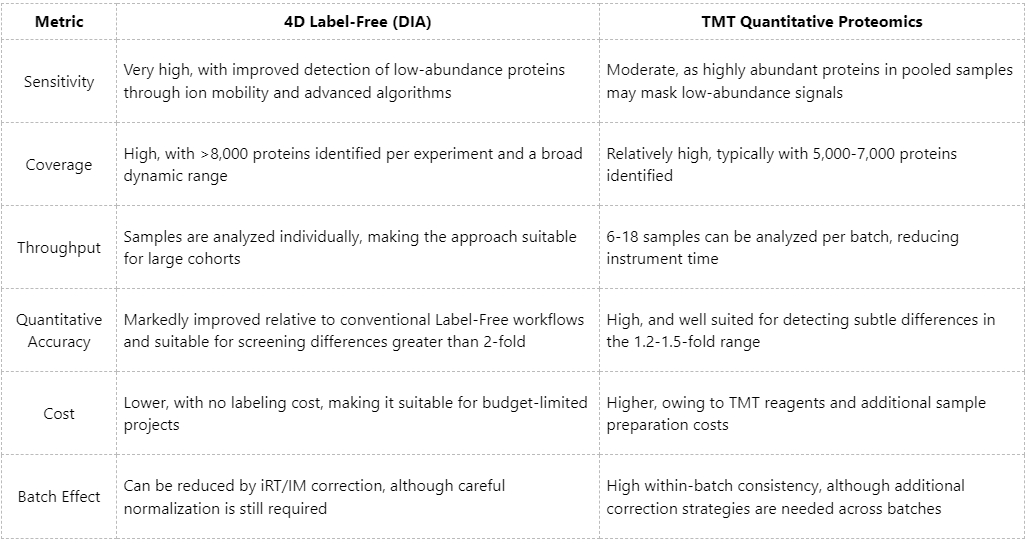
Overview of Performance Comparison
How to Choose?
1. Project Objectives
(1) Exploratory studies involving large-scale screening: 4D Label-Free offers better cost-effectiveness and broader proteome coverage.
(2) Validation studies requiring precise comparison of small differences: TMT quantification is generally more suitable.
2. Sample Characteristics
(1) Low-abundance or complex matrices, such as serum and exosomes: 4D Label-Free performs particularly well when combined with IM separation.
(2) Homogeneous sample types, such as cell lines and animal tissues: both strategies are applicable, and budget often determines priority.
3. Budget and Timeline
(1) Limited budget and large sample numbers: 4D Label-Free quantitative proteomics.
(2) Time-critical projects requiring high sensitivity to subtle differences: TMT quantitative proteomics.
MtoZ Biolabs’ Platform Advantages
MtoZ Biolabs offers two major platforms, Bruker timsTOF Pro 4D-DIA Label-Free and Thermo Orbitrap + TMT 18-plex, to help clients select the most appropriate strategy for different research needs:
- Deep coverage: more than 9,000 proteins can be identified in a single experiment, making the platform well suited for biomarker discovery.
- Accurate quantification: an optimized TMT workflow can significantly reduce ratio compression.
- Large-cohort consistency: proprietary batch correction algorithms support the analysis of hundred-sample-scale clinical studies.
- One-stop service: from experimental design and sample preprocessing to mass spectrometry analysis and bioinformatics report delivery, the entire workflow is streamlined to accelerate research progress.
In quantitative proteomics, both 4D Label-Free quantitative proteomics and TMT quantitative proteomics offer distinct advantages, and the optimal choice depends on project objectives, sample characteristics, and budget. With the continued maturation of 4D mass spectrometry and AI-assisted data processing, Label-Free quantification has increasingly approached TMT in sensitivity and data consistency, especially in large-scale biomarker screening projects. TMT, however, remains the gold standard for highly precise quantification of subtle differences. MtoZ Biolabs provides personalized consultation and optimized study design for each project, helping maximize the scientific value of every sample.
MtoZ Biolabs, an integrated chromatography and mass spectrometry (MS) services provider.
Related Services
How to order?




