






Bottom-Up Proteomics: Workflow, LC-MS/MS Principles, and Applications in Protein Analysis
Introduction
Protein analysis in discovery research, biomarker programs, and biologics characterization often depends on breaking complex protein mixtures into peptides before mass spectrometry can assign identity with confidence. A cell lysate, serum sample, or purified protein preparation may contain thousands of proteins across a wide dynamic range. Intact protein measurement alone cannot resolve that complexity at scale. Bottom-up proteomics addresses this challenge by digesting proteins into peptides and using LC-MS/MS to identify and quantify peptide evidence that supports protein-level conclusions.
Bottom-up proteomics is the most widely used proteomics strategy for protein identification, modification mapping, and large-scale comparative analysis. The workflow combines protein extraction, enzymatic digestion, peptide separation by liquid chromatography, tandem mass spectrometry acquisition, database searching or spectral library matching, and protein inference from peptide-spectrum matches. For protein analysis, bottom-up proteomics provides the peptide-level evidence needed to identify proteins, compare samples, localize post-translational modifications, and support pathway interpretation.
Bottom-up proteomics is not the only proteomics strategy. Top-down and middle-down approaches analyze larger protein fragments or intact proteins under specialized conditions. Within most routine protein analysis programs, however, bottom-up workflows remain the standard route because they balance sensitivity, throughput, and software support. Understanding the workflow, LC-MS/MS principles, and application fit helps teams design studies that produce usable protein evidence rather than raw spectral files alone.
What Bottom-Up Proteomics Means in Protein Analysis
In protein analysis workflows, bottom-up proteomics answers a practical question: which proteins are present, how confidently are they identified, and what peptide-level changes support the biological or quality comparison under review?
The strategy begins with protein digestion, most often with trypsin, to generate peptides suited to LC-MS/MS analysis. Peptides are separated online by reversed-phase liquid chromatography and selected for fragmentation in the mass spectrometer. Resulting MS/MS spectra are matched to predicted peptide sequences from a protein database or against a spectral library. Identified peptides are then grouped into protein inference results with false discovery rate controls and review criteria matched to the study design.
Recovered outputs may include peptide-spectrum match tables, protein identification lists, sequence coverage information, modification site assignments, quantitative comparisons across samples, and QC metrics on identification depth and reproducibility. Project scope should define whether the priority is discovery identification, targeted protein confirmation, PTM mapping, or sample-to-sample comparison.
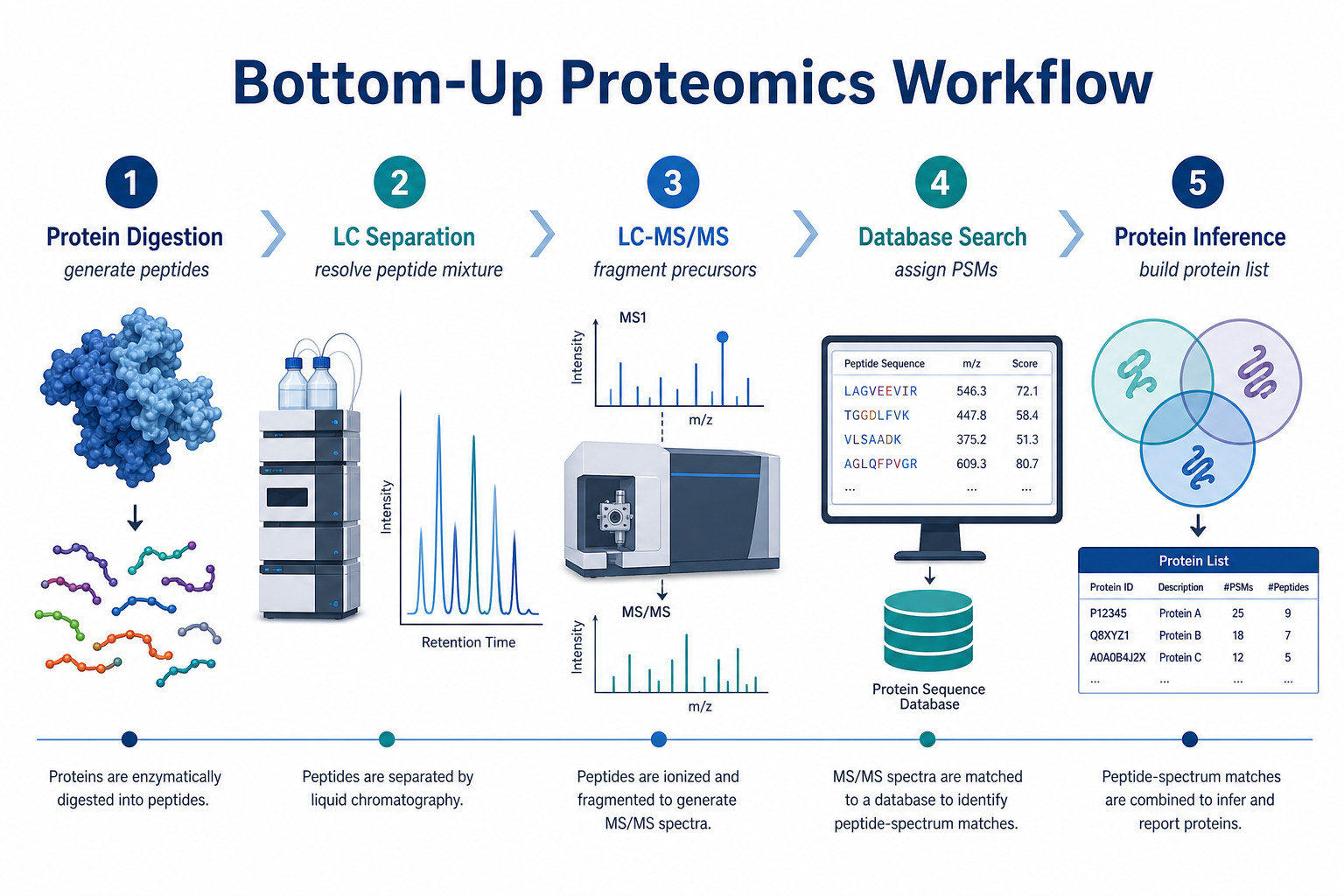
Figure 1. Bottom-up proteomics for protein analysis moves from protein digestion through LC-MS/MS acquisition, peptide identification, and protein inference.
LC-MS/MS Principles in Bottom-Up Proteomics
The analytical core of bottom-up proteomics is peptide separation coupled to tandem mass spectrometry. Each stage affects identification confidence, modification detection, and quantitative reproducibility.
Peptide separation by liquid chromatography
Reversed-phase LC separates peptides by hydrophobicity before they enter the mass spectrometer. Gradient length, column chemistry, and flow rate influence how many peptides are sampled and how cleanly precursors are isolated. Longer gradients often improve identification depth in complex mixtures, while targeted projects may use shorter methods when only a defined peptide panel is required.
Precursor selection and fragmentation
In tandem mass spectrometry, peptide precursors are isolated and fragmented to generate product ions. Common fragmentation modes produce b-type and y-type ions that support sequence assignment. The quality of fragmentation strongly affects whether a peptide can be identified confidently, especially for modified peptides or low-abundance targets in complex backgrounds.
Data-dependent and data-independent acquisition
Data-dependent acquisition selects precursors dynamically during the LC run for MS/MS analysis and is widely used in discovery protein identification. Data-independent acquisition fragments peptides in a systematic manner across defined mass windows and is often paired with spectral libraries for more reproducible quantitation. Acquisition choice should match the study goal, sample complexity, and whether the project prioritizes deep identification or consistent quantitative comparison.
Database searching and protein inference
Experimental spectra are matched against in silico peptide predictions from a protein sequence database. Search parameters include enzyme specificity, precursor and fragment tolerances, fixed and variable modifications, and false discovery rate thresholds. Identified peptides are grouped into proteins using inference rules that account for shared peptides across protein families. Reporting should distinguish high-confidence identifications from tentative assignments when evidence is limited.
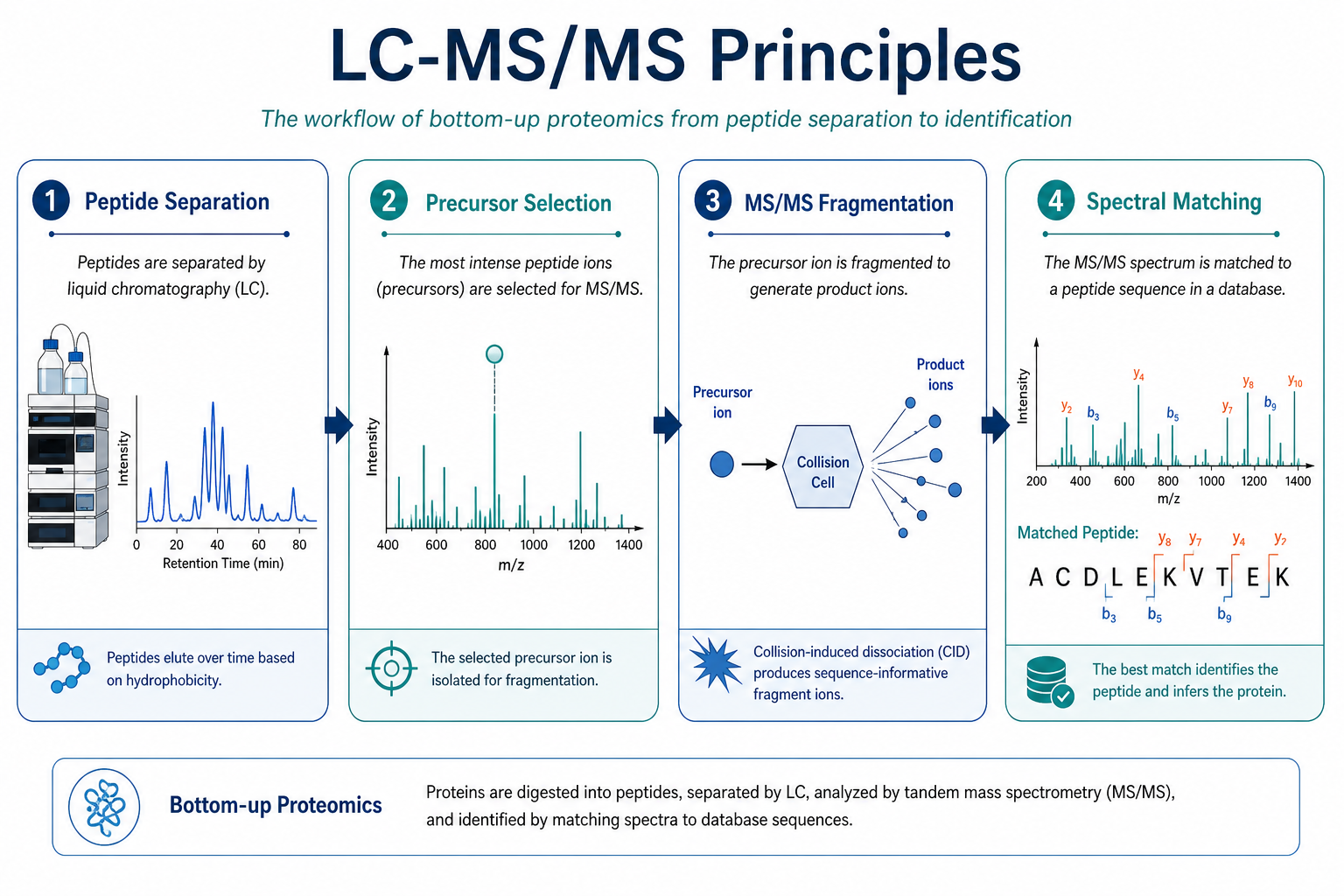
Figure 2. LC-MS/MS in bottom-up proteomics combines peptide separation, precursor fragmentation, spectral matching, and protein inference to support protein analysis.
Standard Bottom-Up Proteomics Workflow
A robust bottom-up proteomics project for protein analysis follows a defined sequence of steps from sample design through biological interpretation.
Project scoping defines whether the goal is protein identification, quantitative comparison, modification mapping, or targeted confirmation. Sample preparation includes protein extraction, lysis, reduction and alkylation when needed, and enzymatic digestion with appropriate cleanup. Peptide cleanup and loading prepare the digest for stable chromatography and efficient ionization. LC-MS/MS acquisition selects gradient length, acquisition mode, and replicate depth suited to sample complexity. Peptide identification applies database search or spectral library matching with project-specific modification settings. Protein inference groups peptides into protein-level results with false discovery rate control. Quantitative analysis, when included, compares peptide or protein abundance across conditions using label-free, isobaric labeling, or targeted approaches. Expert review validates critical identifications, modification calls, and QC metrics before reporting. Biological interpretation connects protein evidence to the experimental question and planned validation steps.
Sample complexity and dynamic range strongly affect workflow design. Highly complex lysates may require fractionation, longer gradients, or enrichment for modified peptides before satisfactory identification depth is achieved.
Related Services
Protein analysis programs using bottom-up proteomics often pair core identification with adjacent proteomics and protein characterization services. Relevant options include:
Protein Identification Service
Label-Free Quantitative Proteomics Service, MS Based
Mass Spectrometry-Based Protein Identification Service
Researchers planning bottom-up proteomics for protein analysis can consult MtoZ Biolabs to review sample type, acquisition strategy, and reporting depth before the study begins.
Sample and Study Design Considerations
Bottom-up proteomics performance depends as much on study design as on instrument platform. Common starting materials include:
- Cell or tissue lysate. High complexity and broad dynamic range may require fractionation or enrichment.
- Serum or plasma. Abundant proteins can mask lower-abundance targets without depletion or enrichment.
- Purified protein or immunoprecipitated complex. Lower complexity often supports deeper peptide coverage.
- Biologics or recombinant protein sample. Reference sequence availability supports efficient database searching.
- PTM-focused sample. Enrichment may be required for phosphorylation, ubiquitination, glycosylation, or other modifications.
- Multi-condition comparison set. Replicate design and consistent digestion are critical for quantitative interpretation.
These considerations support planning but do not replace project-specific feasibility review before large-scale acquisition begins.
Workflow and Acquisition Strategy Comparison
Bottom-up proteomics projects may use different acquisition and quantitation strategies depending on sample type and reporting needs.
|
Strategy |
Typical Use in Protein Analysis |
Main Technical Strength |
Main Technical Limitation |
|---|---|---|---|
|
Discovery DDA LC-MS/MS |
Broad protein identification in complex lysates |
Flexible precursor selection for deep ID |
Lower reproducibility for quantitation |
|
DIA or SWATH-style acquisition |
Reproducible quantitative comparisons |
Consistent querying across runs |
Depends on library quality |
|
Label-free quantitation |
Multi-sample comparison without labeling |
Simple sample handling |
Sensitive to run variability |
|
Isobaric labeling such as TMT or iTRAQ |
Multi-plex sample comparison |
Efficient group comparison in one experiment |
Ratio compression can affect quantitation |
|
Targeted MRM or PRM |
Verification of selected proteins or peptides |
High specificity for predefined targets |
Limited to predefined analyte panel |
|
Modified peptide enrichment |
PTM site mapping |
Improved low-abundance modification detection |
Additional sample handling steps |
Core Technical Advantages and Current Limitations
Core Technical Advantages
Scalable protein identification in complex mixtures.
Bottom-up proteomics can analyze thousands of peptides and hundreds to thousands of proteins in a single study when workflow design is appropriate.
Strong software and database support.
Established search engines, false discovery rate controls, and protein inference tools support routine protein analysis.
Compatibility with quantitation and PTM workflows.
The same peptide-centric framework can support abundance comparison and modification site mapping.
Flexible fit across research and biologics contexts.
Bottom-up workflows can be adapted to discovery proteomics, targeted confirmation, and protein characterization projects.
Current Limitations
Protein inference is not direct intact-protein measurement.
Peptide evidence must be grouped into protein conclusions using statistical rules.
Dynamic range remains challenging.
Low-abundance proteins in complex biofluids may be missed without enrichment or deeper fractionation.
Modified peptide analysis increases complexity.
PTM searches require careful parameter design and manual review for confident localization.
Quantitative accuracy depends on study design.
Poor replicate planning or inconsistent sample handling can weaken comparative conclusions.
Bottom-up proteomics is most valuable when acquisition mode, search strategy, and validation standard are matched to the protein analysis goal.
Applications in Protein Analysis
Bottom-up proteomics supports multiple protein analysis applications across basic research, translational studies, and biologics support. Laboratories use it to identify proteins in complex samples, compare expression or abundance between conditions, map modification sites, verify purified proteins, and generate peptide-level evidence for follow-up validation.
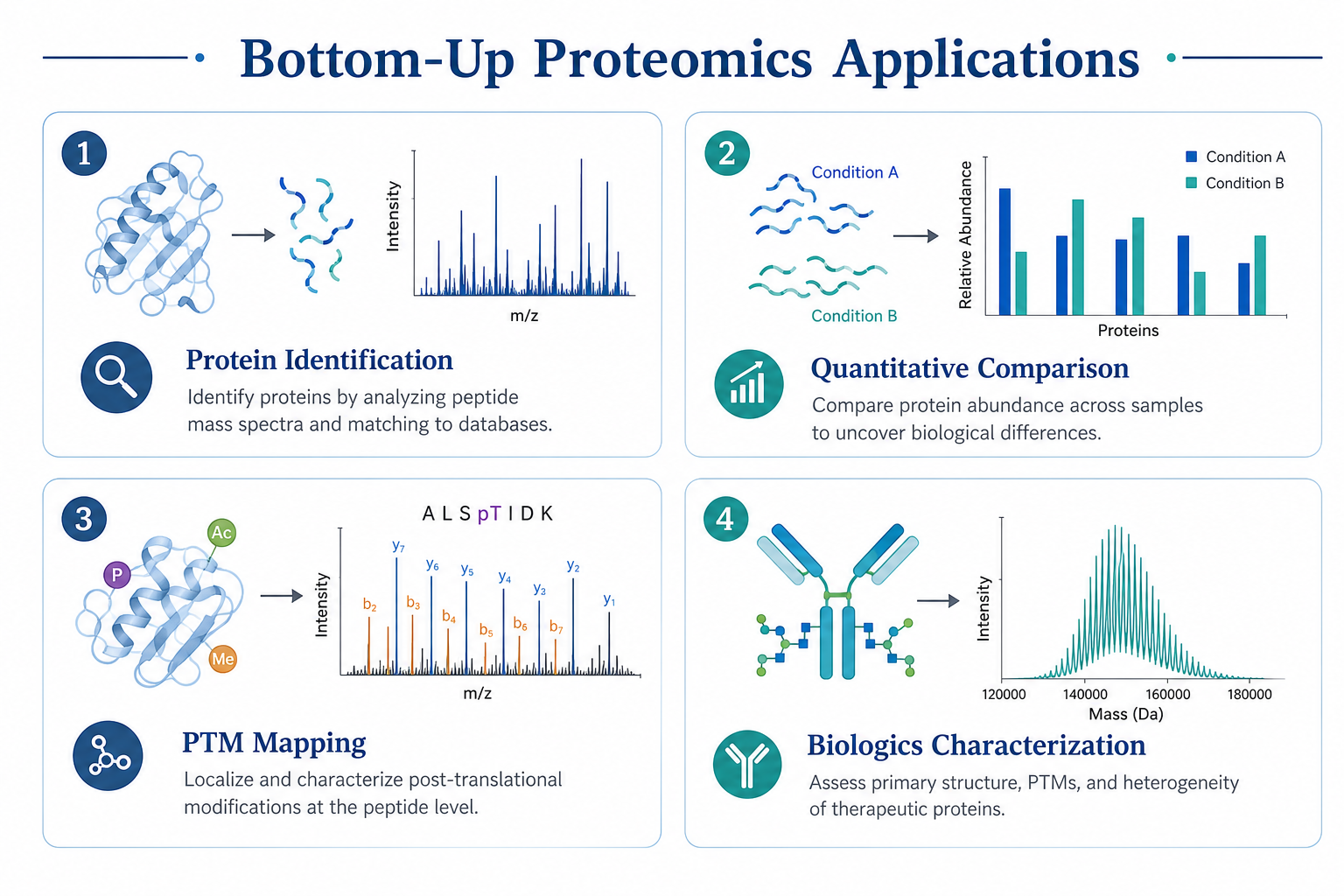
Figure 3. Bottom-up proteomics supports protein identification, quantitative comparison, PTM mapping, and biologics characterization workflows.
|
Application Area |
What Bottom-Up Proteomics Provides |
Complementary Evidence Often Still Needed |
|---|---|---|
|
Discovery protein identification |
Protein lists and peptide evidence from complex samples |
Functional validation of key targets |
|
Biomarker candidate screening |
Quantitative protein differences across cohorts |
Orthogonal validation in larger sample sets |
|
PTM site mapping |
Localized modification assignments on peptides |
Biological perturbation or pathway validation |
|
Purified protein characterization |
Peptide coverage and identity confirmation |
Higher-order structure or activity assays |
|
Biologics comparability support |
Peptide-level evidence for product comparison |
Functional and higher-order analytics |
|
Interaction or pull-down analysis |
Identification of bound proteins in enriched samples |
Independent interaction validation |
These applications show why bottom-up proteomics remains the default entry point for many protein analysis programs. It provides scalable peptide evidence that can be extended into quantitation, modification analysis, and targeted follow-up.
Expected Deliverables and Validation
A useful bottom-up proteomics report should include more than a protein name list. Common deliverables include:
- peptide-spectrum match tables with scores and modifications
- protein identification summary with inference rules described
- false discovery rate or equivalent QC metrics
- quantitative comparison tables when quantitation is in scope
- modification summaries for PTM-focused projects
- QC notes on identification depth, replicate overlap, and sample limitations
Validation should match the biological or analytical claim. Discovery studies may require replicate overlap and conservative false discovery controls. Biomarker nomination may require orthogonal confirmation in additional sample sets. Biologics or protein QC projects may require manual review of critical peptides and predefined acceptance criteria. Useful validation steps may include replicate LC-MS/MS runs, targeted PRM or MRM follow-up, western blot or immunoassay confirmation, and functional assays for proteins central to the study conclusion.
Researchers should treat protein inference from shared or low-scoring peptides cautiously, especially when the conclusion depends on a small number of peptide observations.
Future Outlook
Bottom-up proteomics continues to benefit from higher-resolution mass spectrometers, improved DIA workflows, better modification search tools, and machine learning-supported rescoring of peptide assignments. Laboratories are increasingly combining deep identification with more reproducible quantitative strategies and integrating proteomics results with transcriptomics or functional data for richer biological interpretation. Expert review remains important because peptide-centric evidence still requires careful judgment in complex matrices and in projects with high documentation standards.
For many teams, outsourcing bottom-up proteomics provides access to optimized digestion workflows, acquisition methods, and reporting formats suited to discovery, biomarker review, or protein characterization without building full internal capacity.
Frequently Asked Questions
1. What is bottom-up proteomics?
Bottom-up proteomics is a workflow that digests proteins into peptides, analyzes them by LC-MS/MS, and identifies proteins based on matched peptide evidence.
2. Why is bottom-up proteomics widely used for protein analysis?
It offers a practical balance of sensitivity, throughput, and software support for identifying and comparing proteins in complex samples.
3. How does LC-MS/MS support bottom-up proteomics?
LC separates peptides before mass spectrometry, and tandem MS fragmentation generates sequence-specific product ions that support peptide identification.
4. What is the difference between DDA and DIA in bottom-up proteomics?
DDA selects precursors dynamically for fragmentation during discovery runs. DIA systematically fragments peptides across defined windows and is often used for more reproducible quantitative comparisons.
5. What deliverables should a bottom-up proteomics project provide?
Typical deliverables include PSM tables, protein identification summaries, QC metrics, and when applicable, quantitative or modification mapping results with clear interpretation notes.
Conclusion
Bottom-up proteomics is the standard peptide-centric route for large-scale protein analysis. By combining protein digestion, LC separation, tandem mass spectrometry, database searching, and protein inference, the workflow supports identification, quantitation, modification mapping, and comparative review across diverse sample types. LC-MS/MS principles such as precursor selection, fragmentation quality, acquisition mode, and search strategy directly determine whether the resulting protein evidence is fit for the intended decision. Reliable outcomes depend on matching workflow design to sample complexity, defining validation standards early, and reviewing peptide evidence carefully before biological conclusions are drawn. Researchers planning bottom-up proteomics for protein analysis can contact MtoZ Biolabs to review sample type, acquisition strategy, and the reporting depth required for the next study phase.
How to order?




