



SWATH-MS (Sequential Window Acquisition of All Theoretical Fragment Ion Spectra) is a data-independent acquisition method used to quantify plasma proteins from fragment-ion chromatograms. Plasma is a complex and research-relevant biofluid. It carries proteins secreted by the liver, proteins leaked or shed from tissues, and proteins of the coagulation and immune systems, and it is widely sampled in biomarker research because collection can be repeated. Two analytical constraints remain. Protein abundances in plasma span a very wide dynamic range, on the order of ten orders of magnitude, and a small number of high-abundance proteins, including albumin and immunoglobulins, account for most of the protein mass (Anderson and Anderson 2002). That range still limits detection of lower-abundance signals. SWATH-MS does not remove the range. It changes how fragment evidence is collected across it.
The method divides a precursor m/z range into sequential windows, fragments the ions that fall in each window, and records a digital fragment archive that can be queried again (Gillet et al. 2012). In plasma, that strategy is used when consistent relative quantification across many samples matters more than the stochastic precursor selection of data-dependent acquisition (DDA). It is not, by itself, an early-diagnosis assay or a precision-medicine test.
Researchers who already have defined samples, comparison groups, or a specific project objective can also review the MtoZ Biolabs SWATH Based Protein Quantitative Service for project-specific feasibility and analysis planning.
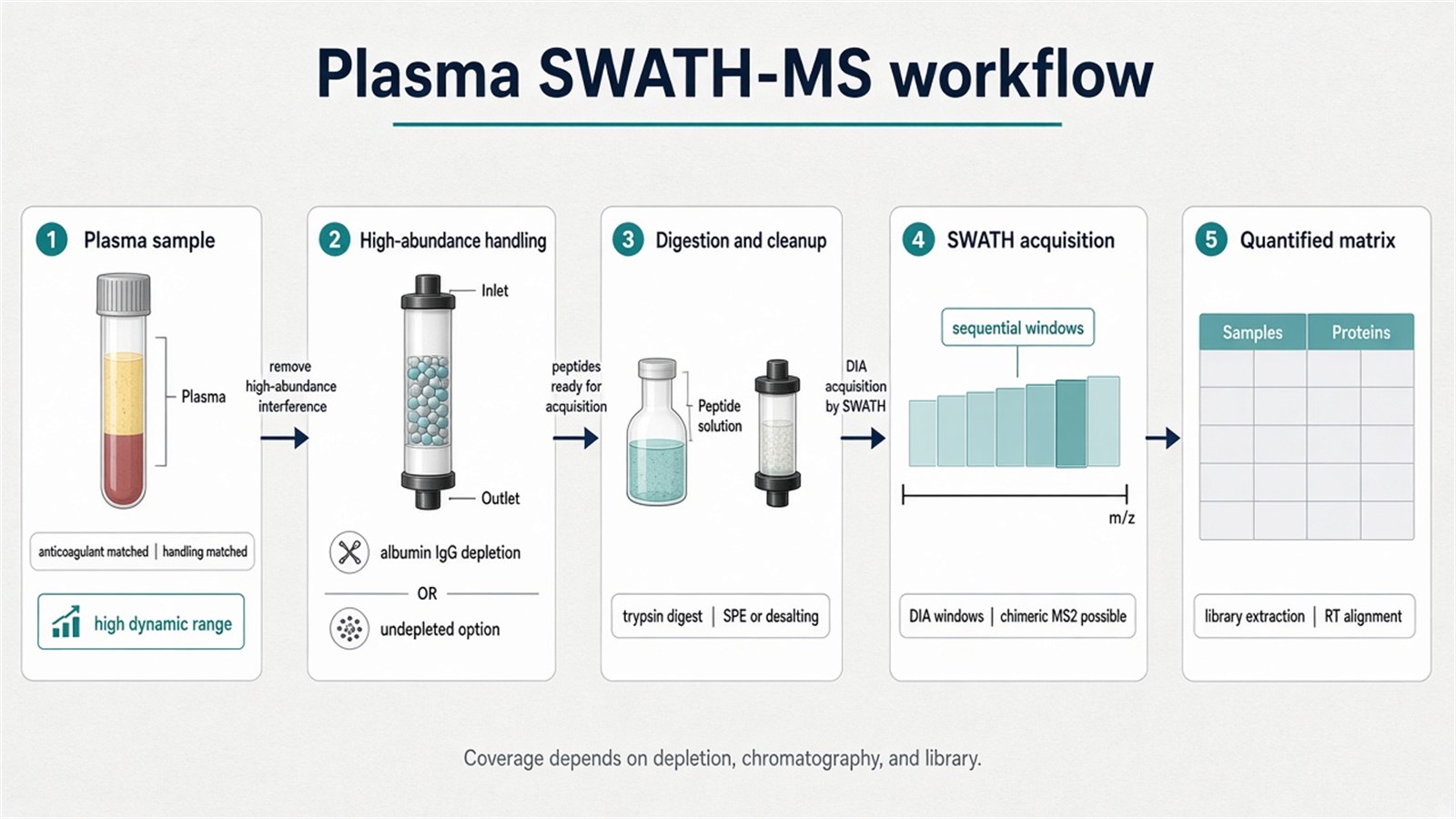
Figure 1. Plasma SWATH-MS typically proceeds from matched plasma handling through high-abundance options, digestion and cleanup, and fixed SWATH windows to a library-extracted quantified matrix.
SWATH-MS is a windowed fragment archive for relative quantification. Coverage still depends on depletion, chromatography, and the library used to read that archive.
Overview of SWATH-MS Technology
SWATH-MS is a mass spectrometry technique within data-independent acquisition (DIA). DDA selects a limited set of precursors in each cycle and therefore tends to fragment abundant plasma peptides repeatedly while missing others from run to run. SWATH-MS instead steps across the scan range in fixed-width windows and fragments the ions inside each window together. The result is a high-coverage fragment record that can be re-extracted when the library or the question changes.
The acquisition is systematic relative to DDA precursor picking. It is not free of interference. Peptides that share a window produce chimeric fragment spectra, so identification and quantification depend on a spectral library, a predicted library, or a library-free extraction, plus retention-time alignment. Plasma, with its wide concentration span, makes those window interferences more consequential than in a simpler digest. SWATH-MS is well suited to plasma when the study needs the same peptide set to be queried across samples. It does not convert every low-abundance tissue protein into a quantified feature.
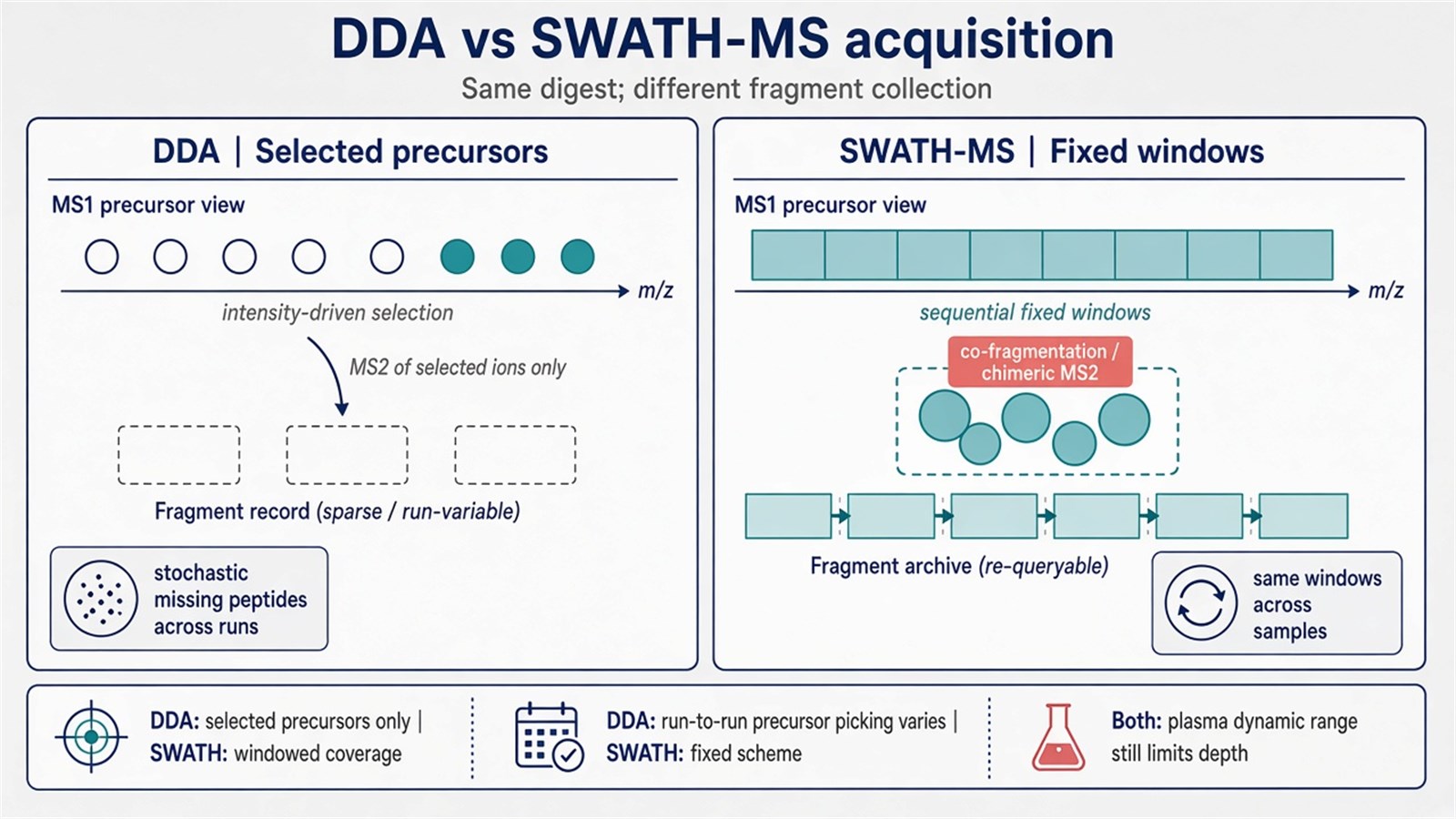
Figure 2. DDA fragments intensity-selected precursors; SWATH-MS fragments ions inside fixed m/z windows. The windowed archive reduces stochastic selection and still contains co-fragmentation, while plasma dynamic range remains a shared depth limit.
Key Advantages of SWATH-MS in Plasma Proteomics
1. A wider sampled fragment record, with a remaining dynamic-range limit
DDA-MS favors peptides that are intense enough to be selected, so high-abundance plasma proteins occupy much of the identification list. SWATH-MS records fragment ions across the declared windows and can improve the chance of quantifying peptides that DDA would skip in some runs. Detection of lower-abundance proteins still depends on sample pretreatment, including depletion of high-abundance proteins, chromatographic depth, and the library. Published plasma SWATH studies have quantified hundreds of proteins under defined cohort conditions, and deeper depleted workflows can extend that set (Liu et al. 2015). A protein count from one study is not a specification for every plasma project. MtoZ Biolabs can apply plasma-oriented preparation, including high-abundance handling and peptide cleanup, when the design calls for a deeper slice of the proteome. That preparation increases the chance of seeing lower-abundance candidates. It does not guarantee biomarker detection.
2. Reproducibility that suits multi-sample studies
Large cohorts need the same proteins to be measured across samples and batches. Because the window scheme is fixed, SWATH-MS is less sensitive than DDA to run-to-run changes in which precursors are picked, and multi-laboratory work has shown that the qualitative and quantitative performance can be reproduced when methods are controlled (Collins et al. 2017). That is a practical advantage for chronic-disease and oncology cohort research. It is not automatic superiority over every labeled method. Isobaric tagging can be more precise inside one multiplex and is limited by plex size and ratio compression. Protein-level coefficients of variation in plasma SWATH data vary with abundance, depletion, and batch. A CV threshold has to be calculated for the study. It should not be assumed from the method name.
3. Reanalysis of an archived fragment record
Because SWATH-MS stores fragment information across the windows, a dataset can be queried again. Updated spectral libraries can be applied to archived files, selected pathways can be re-quantified if the peptides were acquired, and cohorts can be compared when retention time, window scheme, and preprocessing are compatible. This matters when plasma cannot be recollected. Reanalysis does not create peptides that were never fragmented, and files from different window schemes or instruments are not automatically one matrix. MtoZ Biolabs can retain raw files with the project record so a later library or contrast can be applied to the same acquisition, within those compatibility limits.
4. Label-free quantification without a fixed sample number
Relative to isobaric methods such as tandem mass tags (TMT) or iTRAQ, SWATH-MS does not require chemical labels and does not cap the cohort at the number of channels in one kit. Additional plasma samples can be injected later if batch design and QC allow it. The method also accepts the same biofluid types that other LC-MS/MS plasma workflows accept, provided anticoagulant and handling stay matched. Instrument time, batch effects, and library quality still limit throughput. The economic advantage is the absence of labeling reagents and plex closure, not an absence of analytical cost. Epidemiology and preclinical drug-development studies often use this pattern when the sample list may grow and relative, unlabeled quantification is enough.
When cohort size, labeling, and missing-value tolerance make the choice less straightforward, researchers can refer to DIA vs. DDA in Label-Free Quantitative Proteomics: A Comparative Analysis for a more detailed strategy-selection framework.
Application of Plasma Protein SWATH-MS
1. Biomarker screening
SWATH-MS can support label-free quantification of the proteins represented in the library across a clinical or model cohort in tumor, cardiovascular, and diabetes research. Differential lists and annotation are then built from that matrix. The scale is set by sample number, depth, and filters. Screening produces candidates. It does not validate a biomarker.
2. Disease subtyping and mechanistic investigation
Reproducible quantification can be used to compare plasma profiles across declared subtypes, such as diabetes subtypes or breast-cancer subgroups, when the groups are balanced and collected under one protocol. The comparison can suggest circulating protein patterns that deserve mechanistic follow-up. A plasma subtype signature is not itself the intracellular mechanism of the disease.
3. Drug-response monitoring
In preclinical and clinical research, SWATH-MS can describe how selected pathway proteins in plasma change with treatment, because many targets are queried from one windowed acquisition. That pattern can support pharmacodynamic hypotheses. Companion-diagnostic claims and personalized efficacy prediction require a qualified assay and a clinical study. They are outside a discovery SWATH matrix.
4. Cohort-scale proteomic profiling
Applying one label-free SWATH method across a cohort can provide a plasma protein baseline for later integration with transcriptomic or metabolomic data, if identifiers and sample matching are explicit. Multi-omics integration inherits every bias of the plasma preparation. It does not repair missing low-abundance proteins.
Key Considerations in Plasma SWATH-MS Experiments
Sample preprocessing should state whether high-abundance proteins are depleted, which depletion reagents are used, and how protein or peptide load is matched. Commercial depletion kits that remove a declared abundant set are one option. Undepleted SWATH keeps the native abundance structure and usually quantifies a shallower set.
Cross-batch consistency needs a retention-time standard, such as indexed retention-time (iRT) peptides, or another internal standard strategy, plus a run order that does not confound biology with batch. Spectral libraries can be built from deep plasma DDA runs or generated as prediction-based libraries in tools such as DIA-NN. An experimental library is specific to the instrument and the depleted or undepleted matrix. A predicted library can extend peptide queries and still requires score control in chimeric windows.
Quality review should include identification rates, missing-value patterns, peak-shape filters, and peptide-level reproducibility before a differential protein is interpreted. MtoZ Biolabs applies project-defined QC to plasma SWATH datasets so that stability and traceability can be reviewed with the quantitative table.
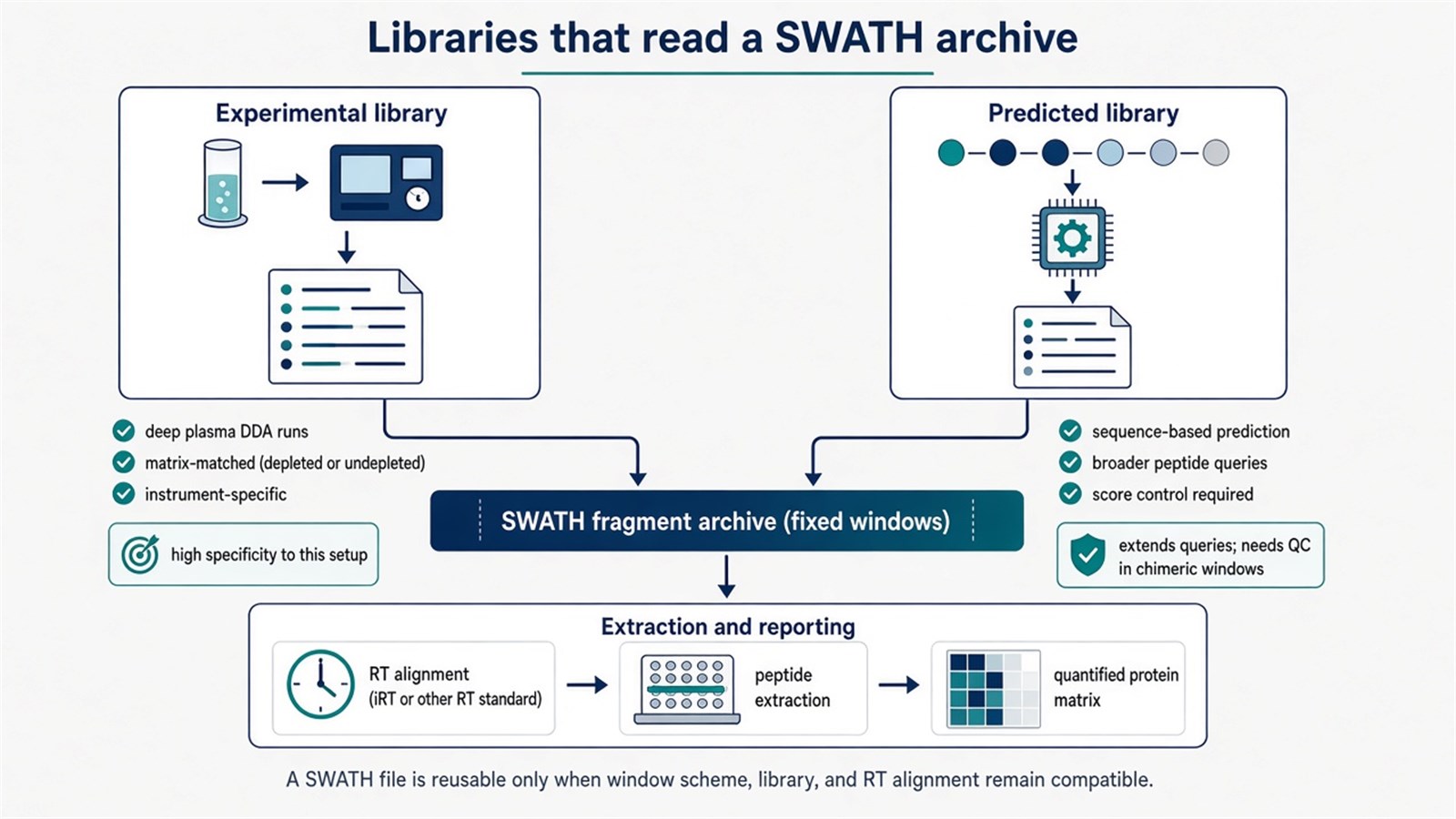
Figure 3. Plasma SWATH-MS quantification is read with an experimental or predicted library against a fixed-window fragment archive; reusable extraction still requires compatible windows, library, and retention-time alignment.
A SWATH file is only as reusable as the window scheme, library, and retention-time alignment used to extract it.
Depletion chemistry and plasma-versus-serum handling sit upstream of the acquisition mode. For that matrix logic, see Plasma Proteome Profiling.
Experimental Limits and Design Boundaries
SWATH-MS does not quantify the full plasma dynamic range, does not identify proteins absent from the queried library unless a library-free method is validated for that file, and does not outperform TMT on every precision metric. Window interference can inflate or distort fragment chromatograms. Batch effects remain in large cohorts. Reanalysis across projects fails when windows, gradients, or species databases differ.
Diagnostic cutoffs, companion diagnostics, and guaranteed low-abundance biomarker recovery sit outside ordinary research SWATH reporting. Once depletion, library type, and the cohort contrast are defined, the project can be scoped as plasma SWATH-MS. Researchers can review the MtoZ Biolabs SWATH Based Protein Quantitative Service for project-specific sample evaluation, feasibility assessment, and workflow planning.
Frequently Asked Questions
1. Is SWATH-MS the same as all DIA methods?
SWATH-MS is a DIA implementation that steps through sequential precursor windows. Other DIA methods also fragment windows or ranges. The window boundaries and the extraction software still have to be named.
2. Does SWATH-MS remove the need to deplete high-abundance plasma proteins?
No. Windowed acquisition records more fragment information than stochastic DDA. Albumin and other abundant proteins still dominate ion current unless depletion or another separation is declared.
3. Are SWATH-MS coefficients of variation always below a fixed percentage?
No. Reproducibility is a reported strength under controlled methods. The CV of each protein depends on abundance, preparation, and batch, and it should be calculated for the dataset.
4. Can archived SWATH files be reanalyzed with a new library?
Yes, when the new library, retention-time reference, and window scheme are compatible with the acquisition. A new library cannot recover peptides that were not fragmented.
5. Is SWATH-MS always preferable to TMT for plasma cohorts?
No. SWATH-MS fits open or growing sample sets and unlabeled relative quantification. TMT fits a closed set that can share one labeled plex. Precision, cost, and missing values should be compared for that design.
Reference
- Gillet L.C., Navarro P., Tate S., et al. (2012). Targeted data extraction of the MS/MS spectra generated by data-independent acquisition: a new concept for consistent and accurate proteome analysis. Mol. Cell. Proteomics, 11, O111.016717. https://doi.org/10.1074/mcp.M111.016717
- Anderson N.L., Anderson N.G. (2002). The human plasma proteome: history, character, and diagnostic prospects. Mol. Cell. Proteomics, 1, 845-867. https://doi.org/10.1074/mcp.R200007-MCP200
- Liu Y., Buil A., Collins B.C., et al. (2015). Quantitative variability of 342 plasma proteins in a human twin population. Mol. Syst. Biol., 11, 786. https://doi.org/10.15252/msb.20145728
- Collins B.C., Hunter C.L., Liu Y., et al. (2017). Multi-laboratory assessment of reproducibility, qualitative and quantitative performance of SWATH-mass spectrometry. Nat. Commun., 8, 291. https://doi.org/10.1038/s41467-017-00249-5
