






Antioxidant Peptides Screening Service
-
Blood or other biological fluids
-
Animal and plant tissues
-
Cell pellets or lysates
-
Microbial cultures
-
Purified proteins
-
LC-MS/MS raw data and processed files in Excel or CSV format.
-
Experimental and screening reports in PDF format summarizing results and interpretations.
-
Annotated peptide sequence lists with structural and activity information.
-
Optional graphical outputs such as spectra, chromatograms, and activity curves in TIFF or PNG format.
-
Additional formats can be provided upon request to meet specific analysis or publication requirements.
MtoZ Biolabs provides comprehensive Antioxidant Peptides Screening Services utilizing advanced molecular display technologies and LC-MS/MS-based peptide identification. Our platform enables rapid and accurate discovery of peptides with antioxidant activity from both natural and synthetic libraries, supporting research in pharmaceuticals, nutrition, and functional food development.
What Is Antioxidant Peptide?
Antioxidant peptides are short bioactive sequences capable of protecting cells and tissues from oxidative stress. Their antioxidant activity mainly arises from three mechanisms:
🔸Free radical scavenging
🔸Inhibition of lipid peroxidation
🔸Chelation with metal ions
By neutralizing free radicals and preventing oxidative chain reactions, these peptides help maintain cellular integrity and functionality. They are increasingly recognized for their ability to delay lipid oxidation in food systems and to protect biological systems from oxidative damage, contributing to overall health maintenance and disease prevention.
Antioxidant Peptides Screening Service at MtoZ Biolabs
Antioxidant peptide screening integrates biochemical, high-throughput, and computational techniques to efficiently identify peptides with strong radical scavenging and metal chelating capabilities.
💠High-Throughput Screening of Peptide Libraries
Evaluate large natural or synthetic peptide libraries to identify sequences with high radical scavenging ability.
💠Molecular Display Screening
Employing phage, yeast, bacterial, and cell surface display to identify peptides that interact with oxidant molecules or related enzymes.
💠Mechanism of Action Studies
Determine whether antioxidant peptides act through radical neutralization, enzyme regulation, or metal ion chelation.
💠Sequence Identification and Structural Analysis
Characterize peptide sequences and modifications to correlate structural motifs with activity.
💠Computational Prediction and Optimization
Use bioinformatics modeling to predict antioxidant potential and guide peptide refinement for improved stability and potency.
Why Choose MtoZ Biolabs
✔️High sensitivity LC-MS/MS analysis ensuring accurate peptide identification and quantification.
✔️Multiple biochemical assays for reliable antioxidant activity evaluation.
✔️Customizable workflows suited to diverse research and application needs.
✔️Strong bioinformatics support linking peptide structure to antioxidant performance.
✔️Experienced scientific team ensuring data quality, reproducibility, and timely delivery.
Applications of Antioxidant Peptides Screening Service
1. Pharmaceutical Research: Identification of antioxidant peptides for drug development targeting oxidative stress-related diseases.
2. Food and Nutrition Science: Discovery of natural antioxidants for functional food and nutraceutical formulations.
3. Cosmetic Industry: Screening of peptides that protect skin from oxidative aging and UV-induced damage.
4. Biomedical Research: Investigating oxidative stress modulation in cellular or metabolic pathways.
5. Agricultural Biotechnology: Exploring plant-derived antioxidant peptides for crop stress resistance.
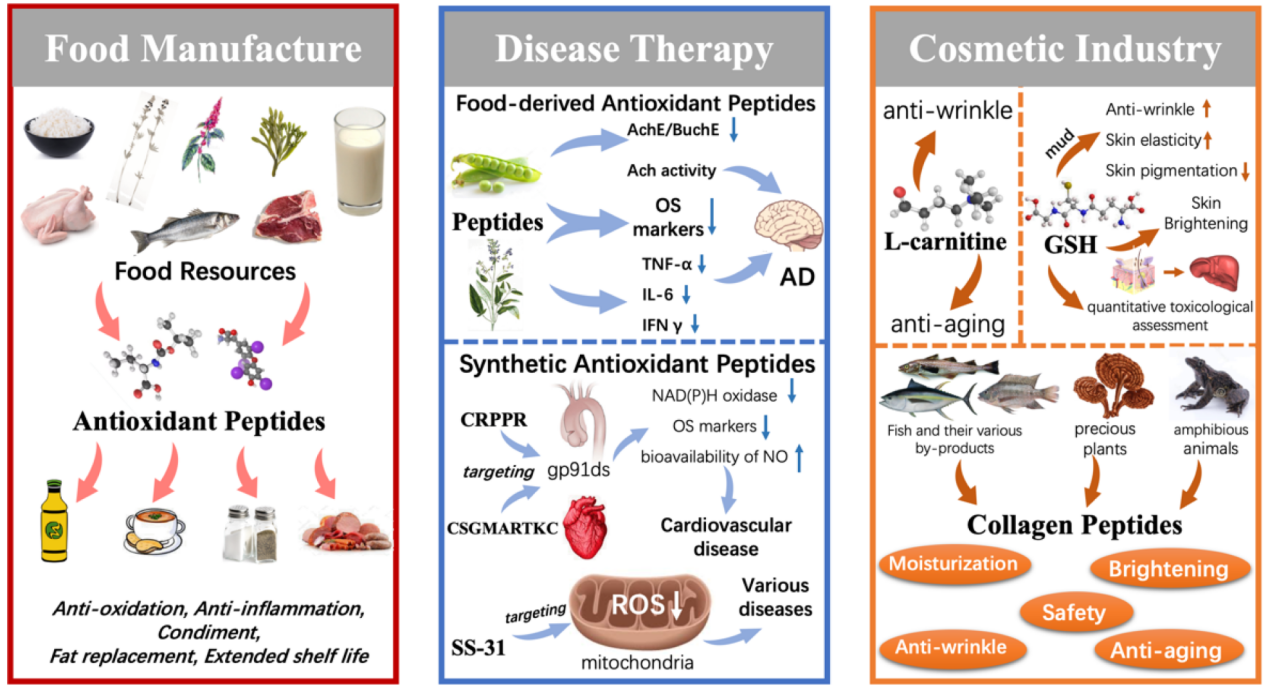
Zhang, Y. et al. Antioxidants (Basel). 2024.
Figure 1. Application of Antioxidant Peptides
FAQ
Q1: What types of samples are suitable?
MtoZ Biolabs accepts a wide range of biological samples, including but not limited to:
For other sample types, please contact us in advance for tailored preparation guidance.
Q2: How should I prepare my samples?
1. Ensure samples are freshly prepared or snap-frozen.
2. Avoid using detergents, reducing agents, or preservatives that may interfere with LC-MS/MS analysis.
3. Store samples at –80 °C before shipment.
4. Transport samples on dry ice to maintain stability during delivery.
For more information, please refer to Sample Submission Guidelines for Proteomics.
Q3: What is the service general workflow?

Q4: What data formats are provided?
Start Your Project with MtoZ Biolabs
Contact us to discuss your experimental design or request a quote. Our comprehensive solutions provide reliable, high-quality data to support the discovery and development of peptides for pharmaceutical, food, and biotechnology applications, enabling clients to efficiently transform innovative concepts into tangible results.
How to order?




