






Advantages and Disadvantages of TMT-based Quantitative Proteomics
Tandem Mass Tag (TMT)-based quantitative proteomics has been extensively utilized in diverse areas of life science research, including biomarker discovery, disease mechanism elucidation, and drug effect profiling, owing to its robust multiplexing capability and high quantitative reproducibility. Similar to iTRAQ, TMT employs an isobaric labeling strategy in mass spectrometry. However, it exhibits distinct technical features in terms of sensitivity, interference resistance, and platform compatibility.
Principle of TMT-Based Quantitative Proteomics
TMT technology enables the simultaneous quantification of peptides derived from different biological samples by chemically labeling them with isobaric tags. Upon fragmentation during MS/MS analysis, the tags release reporter ions of distinct masses, which are then used for relative quantification across samples.
Workflow:
1. Extraction and enzymatic digestion of proteins from samples.
2. Peptide labeling using TMT reagents (e.g., TMT 6plex, 10plex, 11plex, 16plex, or 18plex).
3. Mixing of all labeled peptide samples into a single pool.
4. LC-MS/MS analysis, during which the intensity of reporter ions corresponding to different tags is measured in the MS/MS spectra.
5. Reporter ion intensities reflect the relative abundance of peptides in each sample, which are subsequently used to infer protein-level quantification.
TMT reagents are designed to be isobaric at the MS1 level, ensuring identical mass behavior, while releasing reporter ions of varying masses (e.g., 126–131 Da or 126–134 Da) upon MS2 fragmentation for downstream quantification.
Advantages of TMT-Based Quantitative Proteomics
1. High-Throughput Parallel Quantification
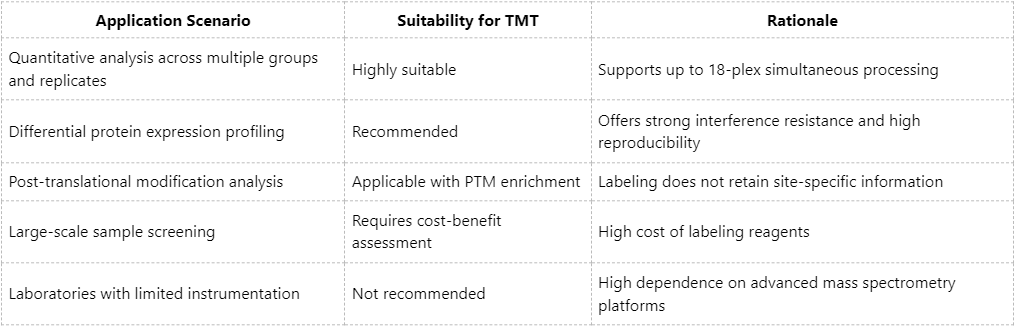
TMT enables up to 18-plex simultaneous analysis (TMTpro 18plex), greatly enhancing experimental throughput and the accuracy of inter-group comparisons. This feature is particularly beneficial for studies involving time-series analyses, multiple experimental groups, or biological replicates. MtoZ Biolabs offers integrated processing solutions based on the TMTpro 18plex system to minimize batch effects and improve data comparability.
2. Improved Interference Tolerance via MS3
TMT quantification at the MS2 level is susceptible to co-isolation interference, commonly known as ratio compression. However, TMT is compatible with advanced platforms such as the Thermo Orbitrap Fusion Lumos, which support the SPS-MS3 (Synchronous Precursor Selection) acquisition mode. This significantly mitigates interference and improves quantification accuracy. Compared to iTRAQ, TMT provides a more comprehensive solution for MS3-based quantification, making it more suitable for experiments demanding high precision.
3. High Quantitative Reproducibility
By labeling samples prior to mixing and subjecting them to a unified LC-MS workflow, TMT minimizes batch-to-batch and injection variability. This significantly enhances data consistency and the reproducibility of quantitative measurements.
4. High Sensitivity for Complex Biological Samples
When combined with high-resolution mass spectrometry and nano-flow liquid chromatography systems, TMT enables the reliable detection and quantification of medium- and low-abundance proteins in complex biological matrices such as serum, tissues, and cell lines. It is widely applied in oncology, immunology, and neuroscience research.
Disadvantages of TMT-Based Quantitative Proteomics
1. Ratio Compression in MS2-Based Quantification
During MS2 acquisition, target peptides can co-fragment with background peptides, leading to mixed reporter ion signals and underestimation of true expression differences. This issue is exacerbated in highly complex samples.
Mitigation Strategies:
-
Employ high-resolution Orbitrap Fusion Lumos mass spectrometers
-
Activate SPS-MS3 acquisition mode
-
Optimize peptide pre-fractionation and sample preparation to reduce co-isolation events
2. Strong Dependence on High-End Instrumentation
TMT-based workflows are best supported by Thermo Orbitrap mass spectrometry platforms. Their implementation on non-Orbitrap systems is technically challenging, thereby limiting accessibility for laboratories with constrained instrumentation.
3. High Cost of Labeling Reagents
TMT reagents are relatively expensive, especially in large-scale studies involving 18-plex designs with biological replicates. Therefore, careful planning of sample numbers and grouping strategies is essential to achieve cost-effective experimental designs.
4. Requirement for PTM Enrichment in Modification Studies
As TMT labeling occurs at the peptide level, information about post-translational modification (PTM) sites on intact proteins is not retained. To analyze modifications such as phosphorylation or acetylation, PTM-specific enrichment strategies (e.g., TiO₂-based enrichment) are required. MtoZ Biolabs provides combined TMT + PTM analysis services that accommodate both peptide labeling and site-specific modification detection.
Suitability of TMT for Various Application Scenarios
TMT-Based Proteomics Solutions by MtoZ Biolabs
MtoZ Biolabs offers a comprehensive suite of services for TMT-based proteomic analyses, including:
-
Selection of multiplexing strategies (TMT 6plex, 10plex, 16plex, 18plex)
-
Support for sample grouping design and experimental planning
-
Access to Orbitrap Fusion Lumos systems with MS2 and SPS-MS3 modes
-
High-quality bioinformatics pipelines covering differential protein identification, enrichment analysis, and protein–protein interaction (PPI) network construction
-
Integrated multi-omics analysis services combining proteomics with metabolomics and transcriptomics
Through standardized workflows and customizable solutions, we aim to provide researchers with high-quality, publication-ready data from TMT-based quantitative proteomics at an optimal cost-performance ratio.
TMT technology offers unparalleled advantages in multiplexing capability, data consistency, and interference resistance. While the associated costs and equipment requirements must be considered, TMT remains an indispensable tool for studies requiring high-resolution, inter-sample comparability, and quantitative precision. Researchers planning to conduct TMT-based proteomics, or seeking guidance on selecting among TMT, iTRAQ, or label-free quantification strategies, are encouraged to consult with MtoZ Biolabs' technical team for tailored experimental solutions.
MtoZ Biolabs, an integrated chromatography and mass spectrometry (MS) services provider.
Related Services
How to order?




