






Advantages and Disadvantages of iTRAQ-based Quantitative Proteomics
iTRAQ (Isobaric Tags for Relative and Absolute Quantitation) is a quantitative proteomics method that combines stable isotope labeling with mass spectrometry, widely applied in the analysis of protein expression across multiple samples and complex biological systems. By labeling peptides with isobaric tags, iTRAQ ensures that peptides from different samples exhibit identical masses at the MS1 level. Upon MS/MS fragmentation, the tags generate reporter ions with distinct masses, enabling multiplexed relative quantification.
The standard workflow of iTRAQ-based quantitative proteomics consists of:
1. Protein extraction and enzymatic digestion (typically with trypsin)
2. Labeling each sample with a distinct iTRAQ reagent
3. Mixing labeled samples for fractionation, enrichment, and LC-MS/MS analysis
4. Quantification based on the intensity of reporter ions in MS/MS spectra
Major Advantages of iTRAQ-Based Quantitative Proteomics
1. Multiplexed High-Throughput Quantification
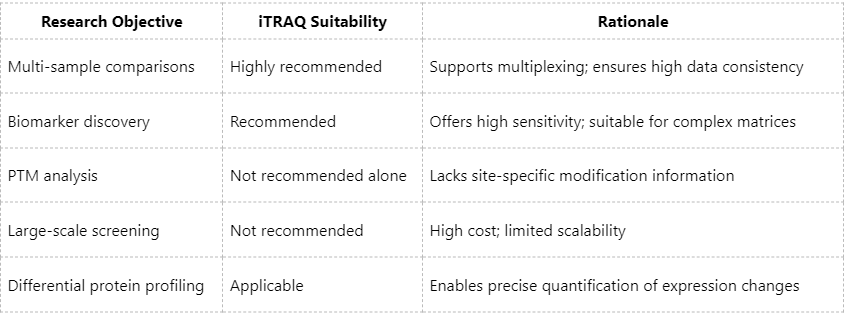
A key advantage of iTRAQ is its ability to quantify up to 8 or even 10 samples simultaneously in a single experiment, significantly enhancing throughput and minimizing batch-to-batch variability. This makes it ideal for analyzing dynamic protein expression across multiple biological conditions or time points. In disease models, iTRAQ facilitates the comparison of protein expression across various treatment groups by reducing sample processing variability and improving data reliability.
2. High Sensitivity and Broad Coverage
When combined with high-resolution mass spectrometry platforms (e.g., Orbitrap or QTOF), iTRAQ enables the detection and quantification of thousands of proteins, including low-abundance and membrane proteins. This makes it particularly suitable for complex biological specimens such as tissues and body fluids.
3. Strong Data Consistency and Integrability
As labeled samples are pooled and processed simultaneously, the experimental workflow is highly uniform, minimizing technical variability. This facilitates cross-sample comparison and data normalization, supporting the construction of differential protein expression profiles and the identification of potential biomarkers.
Major Disadvantages of iTRAQ-Based Quantitative Proteomics
1. Reporter Ion Interference (Ratio Compression)
Quantification via iTRAQ depends on reporter ions generated during MS/MS. However, due to co-isolation and co-fragmentation of peptides, signals from non-target peptides may interfere, causing ratio compression and underestimation of true expression differences. This can be mitigated using techniques such as MS3 or employing high-selectivity instruments (e.g., Orbitrap Fusion Lumos).
2. High Labeling Cost
Compared to label-free or TMT approaches, iTRAQ reagents are costly and require advanced mass spectrometry platforms, resulting in a higher overall expense. Therefore, iTRAQ is less suitable for projects with limited budgets or large sample sizes.
3. Quantitative Accuracy Dependent on Instrumentation
The accuracy of iTRAQ quantification is contingent upon the resolution and dynamic range of the mass spectrometer. In complex samples, factors such as low signal-to-noise ratios and peptide overlap can affect reproducibility. Additionally, peptide loss and variability in labeling efficiency during sample preparation may introduce bias, necessitating careful optimization of digestion, labeling, and cleanup procedures.
4. Inability to Trace Pre-Digestion Protein Information
As iTRAQ labels peptides post-digestion, it does not retain site-specific information from intact proteins. Thus, it is not suitable for studies of post-translational modifications (PTMs) that require localization data, unless coupled with specific PTM enrichment strategies.
Recommended Applications of iTRAQ-Based Quantitative Proteomics
Service Advantages of MtoZ Biolabs
MtoZ Biolabs offers a comprehensive iTRAQ-based quantitative proteomics service supported by end-to-end quality control and high-resolution mass spectrometry. Key features include:
-
Optimized sample preparation protocols to ensure protein integrity and extraction efficiency
-
High-accuracy, low-bias quantification using Orbitrap MS platforms
-
Integrated bioinformatics analysis delivering end-to-end results from raw data to biological interpretation
-
Flexible strategy combinations, including iTRAQ with PTM enrichment or metabolomics for multidimensional profiling
Thanks to its high throughput and sensitivity, iTRAQ plays a pivotal role in life science research. However, its adoption should be carefully aligned with experimental goals, budget constraints, and accuracy requirements. Partnering with professional service providers like MtoZ Biolabs enables researchers to fully harness the potential of iTRAQ, providing robust data support for studies on disease mechanisms, drug target discovery, and biomarker identification.
MtoZ Biolabs, an integrated chromatography and mass spectrometry (MS) services provider.
Related Services
How to order?




