






4D-DIA vs 4D-PRM: Which 4D Quantitative Approach Suits Your Project Better?
In contemporary proteomics, Data-Independent Acquisition (DIA) and Parallel Reaction Monitoring (PRM) have emerged as two principal strategies for non-targeted and targeted protein quantification, respectively. With the integration of Ion Mobility technology, 4D proteomics on the timsTOF Pro platform incorporates the mobility dimension into the analytical framework, substantially enhancing both separation and quantification performance. Within this technological context, 4D-DIA and 4D-PRM have become crucial options that researchers must consider during experimental design.
Fundamental Principles of 4D-DIA and 4D-PRM
1. What is 4D-DIA?
4D-DIA (Data-Independent Acquisition with Ion Mobility) is a full-spectrum acquisition strategy that extends conventional DIA by adding the ion mobility (CCS) dimension. Compared to DIA, 4D-DIA provides superior spectral separation, enhanced noise suppression, and improved detection of low-abundance proteins. Its key principles include:
-
Ions migrate in the tims tube according to their volume-to-charge ratio (1/K0), introducing an additional separation dimension.
-
MS acquisition captures all fragment ions without relying on predefined targets.
-
Library-driven or library-free deconvolution and quantification can be performed using software such as DIA-NN or Spectronaut.
2. What is 4D-PRM?
4D-PRM (Parallel Reaction Monitoring with Ion Mobility) combines the high specificity of PRM with the resolution of Ion Mobility, enabling precise quantification of predefined target proteins or peptides:
-
Target ions are isolated using preset m/z, CCS, and retention time windows.
-
Fragment ions are recorded individually by high-resolution mass spectrometry (e.g., QTOF).
-
Background interference is minimized, making 4D-PRM ideal for validation studies or biomarker research with stringent regulatory requirements.
Scenario Comparison: Discovery vs. Verification Research
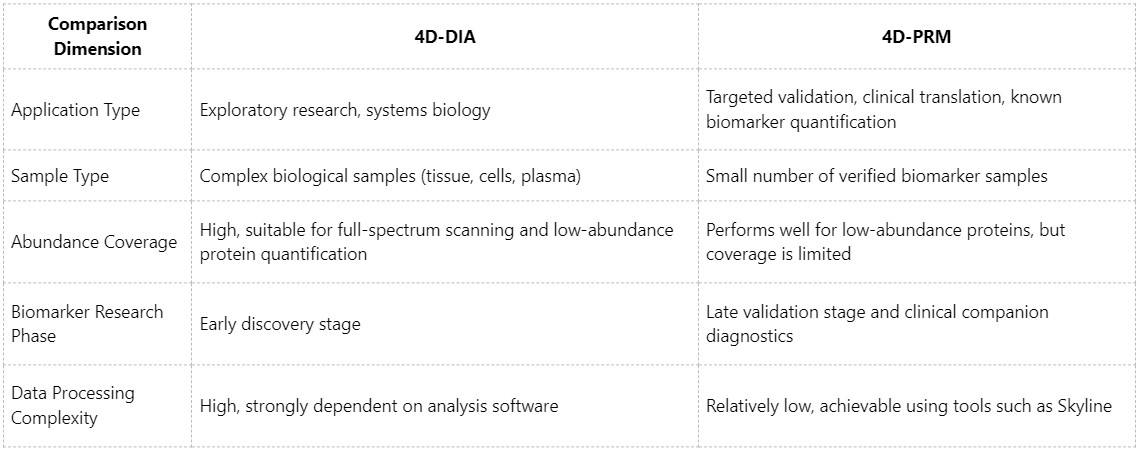
Thus, for projects focused on protein discovery, mechanistic studies, or omics exploration, 4D-DIA is advantageous. Conversely, for projects with well-defined targets requiring high-specificity quantification across multiple batches or centers, 4D-PRM is preferable.
Technical Performance Comparison: Trade-offs Between Quantitative Depth and Accuracy
1. Throughput and Coverage
4D-DIA inherently offers high throughput due to its non-targeted, full-scan acquisition. A single analysis can yield information on over 6,000 proteins and more than 50,000 peptides, making it suitable for large-scale sample comparison and differential expression studies.
In contrast, 4D-PRM is limited in the number of target peptides (generally recommended ≤200 peptides per run) but provides extremely high sensitivity for those targets, making it suitable for quantifying proteins with low abundance or wide dynamic ranges.
2. Quantitative Accuracy and Reproducibility
Optimized 4D-DIA workflows typically achieve coefficient of variation (CV) values within 15%, suitable for semi-quantitative studies. 4D-PRM, owing to its targeted selection and high-resolution acquisition, generally achieves CV values below 10%, offering higher quantitative accuracy.
Data Processing and Method Development Complexity
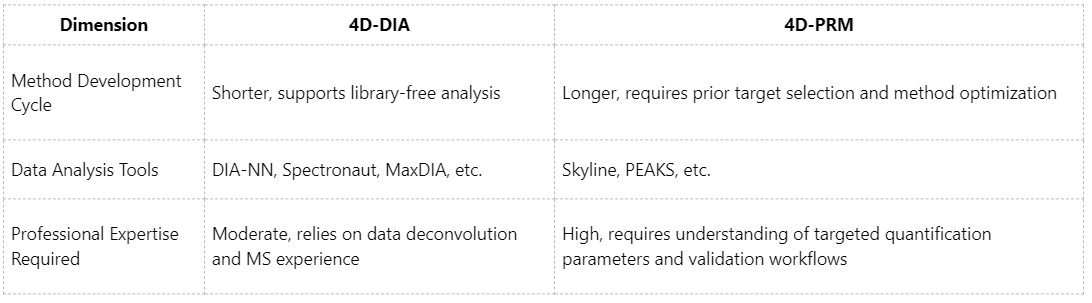
It is important to note that 4D-DIA demands substantial computational resources and benefits from GPU-accelerated workflows. In contrast, 4D-PRM is most suitable when the methodology is established and rapid quantification of batch samples is required.
Choosing the Appropriate Method: Strategy Based on Research Goals
MtoZ Biolabs: Enabling Optimal Mass Spectrometry Quantitative Strategies
At MtoZ Biolabs, we have over a decade of experience in proteomics and metabolomics. Leveraging the Bruker timsTOF Pro 2 platform and customized analytical workflows, we have successfully supported hundreds of scientific and industrial projects, including tumor biomarker discovery, exosome studies, stem cell differentiation, and synthetic biology.
Whether your project is in exploratory research or preparing for clinical translation, our technical experts provide:
-
Project evaluation and method selection guidance (DIA vs. PRM).
-
Library strategy design and optimization for 4D-DIA.
-
PRM method development and quantitative linearity validation.
-
Integrated bioinformatics analysis and pathway enrichment.
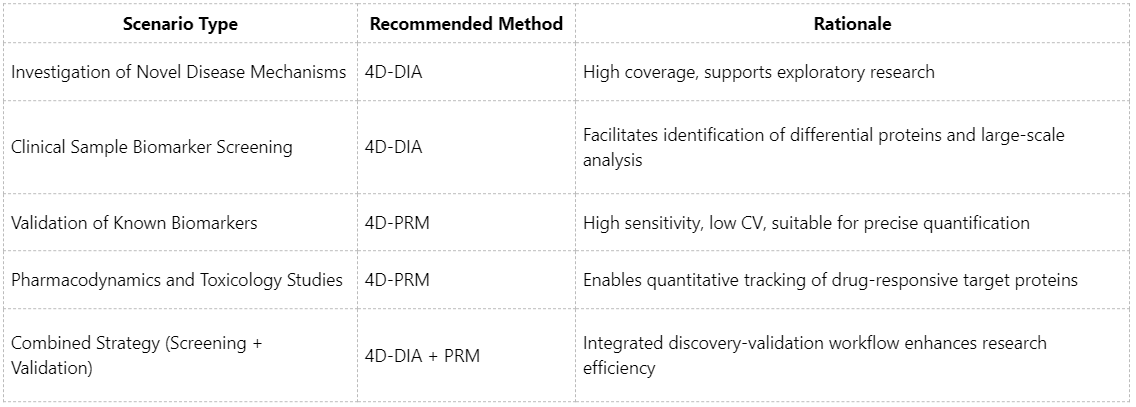
It should be emphasized that 4D-DIA and 4D-PRM are complementary rather than competitive approaches. 4D-DIA excels in large-scale discovery and data mining, whereas 4D-PRM focuses on high-precision quantification and target validation. Many successful projects employ a combination strategy of DIA screening followed by PRM validation. At MtoZ Biolabs, we strive to match the optimal technical approach for each project. Researchers seeking guidance on selecting quantitative strategies in proteomics are encouraged to contact our expert team for one-on-one support.
MtoZ Biolabs, an integrated chromatography and mass spectrometry (MS) services provider.
Related Services
How to order?




