






Workflow Comparison and Optimization Recommendations for N- and O-Glycoprotein Quantitative Analysis
Glycosylation is one of the most widespread post-translational modifications in eukaryotic proteins and plays integral roles in cellular communication, receptor recognition, immune regulation, tumorigenesis, and other biological processes. As two major forms of glycosylation, N-glycosylation and O-glycosylation share the same broad modification category but differ substantially in modification mechanisms, structural diversity, and analytical strategies. This article systematically compares the quantitative analysis workflows for these two types of glycoproteins and, in light of advances in mass spectrometry, proposes workflow optimization recommendations for efficient and accurate analysis.
N- and O-Glycosylation Features
N-glycosylation depends on a consensus sequence, Asn-X-Ser/Thr, and is generated through multi-step enzymatic reactions in the endoplasmic reticulum and Golgi apparatus. Its structures are commonly characterized by branched and complex glycan chains. In contrast, O-glycosylation does not depend on a specific consensus sequence. Instead, glycans are attached directly to serine or threonine residues. O-glycosylation exhibits greater diversity in structural types and site distribution and is particularly enriched in adhesion molecules, mucins, and related proteins.
Core Workflow Components for Quantitative Analysis
Quantitative glycoprotein analysis generally includes the following steps:
- Sample preparation: protein extraction, reduction, and alkylation to minimize structural interference during downstream analysis.
- Proteolytic digestion strategy: proteases are used to generate peptides suitable for mass spectrometric analysis.
- Glycopeptide enrichment: glycopeptides are selectively separated using HILIC, lectin affinity, or chemical labeling-based methods.
- Glycan processing: N-glycans can be enzymatically released, whereas O-glycans often require alkaline chemical methods or derivatization-assisted strategies.
- Quantitative labeling: labeling techniques such as TMT and iTRAQ, or label-free strategies based on MS signal intensity, can be used for quantification.
- Mass spectrometric detection: LC-MS/MS enables glycopeptide identification, modification site localization, and quantitative analysis.
- Data processing: high-resolution spectra and computational algorithms are used to identify glycopeptide structures and generate quantitative results.
Workflow Comparison Between N- and O-Glycoprotein Analysis
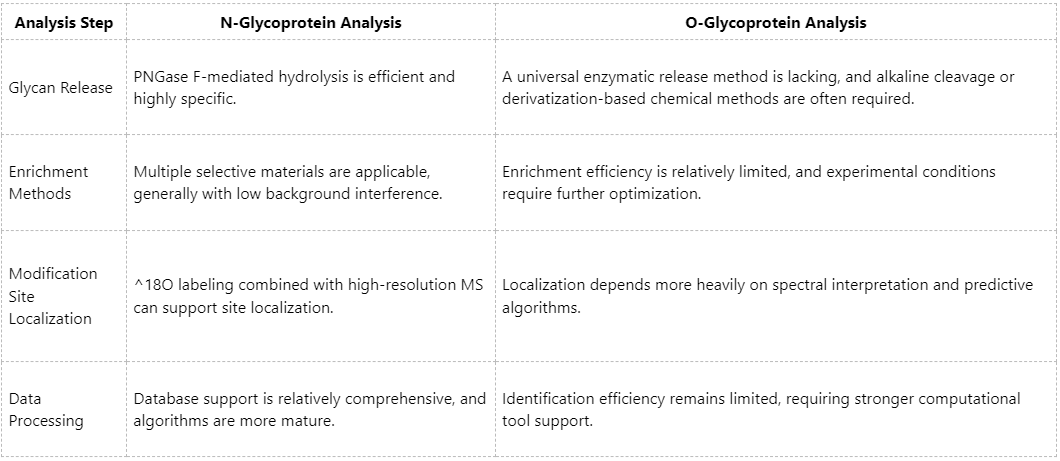
Workflow Optimization Recommendations
1. Combining Multiple Proteases to Improve Site Coverage
A single proteolytic digestion strategy is often limited by the detectability of peptides located near modification sites. Combining different proteases, such as Trypsin with Glu-C or Asp-N, is recommended for complementary cleavage, thereby improving the coverage and detection sensitivity of both N-glycosylation and O-glycosylation sites.
2. Integrating Multiple Enrichment Mechanisms to Enhance Specificity
For N-glycopeptides, combined lectin- and HILIC-based tandem enrichment strategies are recommended to improve specificity and recovery. For O-glycopeptides, integrated enrichment approaches based on peptide hydrophilicity, chemical derivatization, and selective capture, such as BEMAD, are recommended to reduce nonspecific background interference.
3. Customizing Modification Site Identification Strategies
N-glycosylation sites can be analyzed using ^18O water labeling to support quantitative release and assist site localization. In contrast, because O-glycosylation lacks an enzymatic release-labeling pathway comparable to that used for N-glycosylation, accurate O-glycosylation site localization relies more heavily on fragmentation strategies such as ETD and EThcD in combination with high-resolution computational algorithms. Algorithms that support spectrum-level interpretation, such as Byonic and O-Pair, are recommended.
4. Introducing High-Resolution Mass Spectrometry Platforms
High-resolution LC-MS/MS systems can significantly improve the detection throughput of low-abundance glycopeptides and enhance the analytical capacity for modification characterization. DIA or PRM strategies are recommended for highly reproducible quantification of key modification sites, particularly in O-glycosylation research.
5. Strengthening the Integration of Bioinformatics Analysis Tools
Current O-glycomics data analysis still faces several challenges, including insufficient database coverage and the need for improved glycopeptide prediction accuracy. A multi-engine parallel analysis strategy is recommended, combined with manual curation and AI-assisted annotation, to improve site identification rates and quantitative accuracy.
Professional Support From MtoZ Biolabs
Based on high-resolution mass spectrometry platforms, MtoZ Biolabs has established a full-process analytical system covering quantitative analysis of both N- and O-glycoproteins. By integrating multiple enrichment strategies, optimized proteolytic digestion workflows, advanced labeling-based quantitative technologies, and in-depth spectral interpretation algorithms, we provide research clients with high-accuracy and high-coverage quantitative analysis services for glycosylation modifications. Whether for fundamental mechanistic studies or disease biomarker development, we can provide customized solutions and data support. For further information on high-throughput glycoproteomics solutions, please contact us.
MtoZ Biolabs, an integrated chromatography and mass spectrometry (MS) services provider.
Related Services
How to order?




