






Which Antibody Is Optimal for Histone Butyrylation Enrichment?
Histone acetylation, methylation, and other post-translational modifications have long been central to epigenetics research. Histone butyrylation (Histone Butyrylation, HBu), a novel short-chain fatty acylation modification, is increasingly attracting attention from both academia and the biopharmaceutical industry. Accurate investigation of HBu dynamics is critical for understanding gene regulation, metabolic states, and disease mechanisms. In histone modification analyses, the enrichment step is pivotal, and the choice of antibody directly influences enrichment efficiency and downstream data quality. Determining the optimal antibody for histone butyrylation enrichment is therefore essential.
Types of Antibodies for Histone Butyrylation Enrichment
Selecting an appropriate antibody is crucial in experimental design. Currently, the commonly employed antibodies can be categorized as follows:
1. Modification-Specific Antibodies
(1) Characteristics: Recognize butyrylated residues at specific histone positions (e.g., H3K9Bu, H4K8Bu).
(2) Advantages: High specificity, suitable for investigating the biological function of a particular site.
(3) Limitations: Restricted to capturing modifications at the targeted site; do not reflect global HBu levels; generally higher cost.
For instance, when assessing H3K9 butyrylation in stem cells, H3K9Bu-specific antibodies provide enriched peptides with high signal-to-noise ratios, facilitating subsequent quantitative mass spectrometry analysis.
2. Pan-Butyrylation Antibodies
(1) Characteristics: Recognize multiple butyrylation sites on histones without residue specificity.
(2) Advantages: Enable enrichment at the whole-histone level, supporting comprehensive PTM analysis.
(3) Limitations: Lower specificity, potential cross-reactivity with acetylation or other fatty acylations; requires rigorous validation.
For example, in tumor metabolomics studies, pan-butyrylation antibodies can efficiently capture global histone HBu modifications. Subsequent LC-MS/MS-based quantitative analysis can provide insights into metabolic regulatory mechanisms.
3. Cross-Validation Antibodies
(1) Characteristics: Validate the same HBu site using antibodies derived from different sources or antigen strategies.
(2) Advantages: Enhance experimental reliability and reduce false-positive signals.
(3) Application: For critical experiments or publications, it is recommended to verify results using at least two different antibodies.
Key Technical Parameters for Antibody Selection
Antibody choice should consider not only brand or cost but also the following technical parameters:
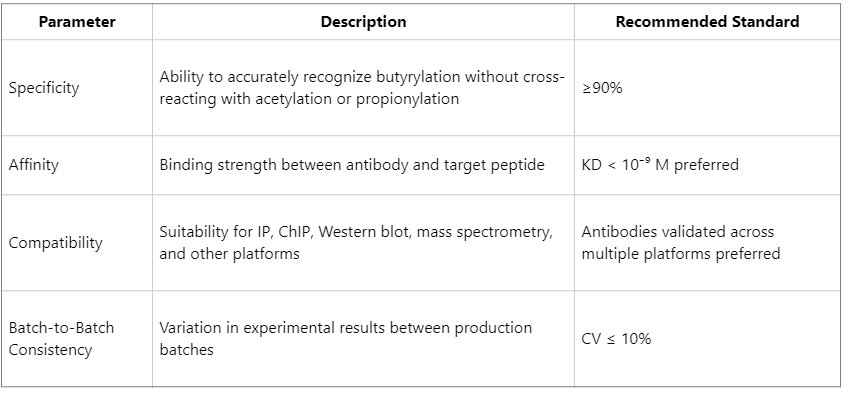
In practice, it is recommended that antibodies be pre-validated via Dot blot or peptide competition assays before being applied to large-scale histone enrichment experiments.
Technical Strategies and Optimization Recommendations
1. Peptide Pre-Treatment
Prior to enrichment, histones should undergo acid extraction or SDS-PAGE separation to remove non-specific proteins and enhance antibody capture efficiency.
2. Optimization of Enrichment Conditions
Parameters such as buffer salt concentration, pH, and non-ionic detergents can influence antibody binding efficiency. For low-abundance HBu sites, extending the incubation time or increasing antibody amount can improve recovery.
3. Integration with Mass Spectrometry
Enriched peptides can be analyzed quantitatively using high-resolution mass spectrometry (e.g., Orbitrap). For low-abundance sites, TMT or iTRAQ labeling enables comparative analysis across multiple samples.
4. Cross-Validation
Results should be verified using multiple antibodies or alternative platforms (e.g., ChIP-seq, Western blot) to avoid misinterpretation due to reliance on a single antibody.
In summary, the selection of antibodies for histone butyrylation enrichment experiments should be guided by research objectives. For site-specific functional studies, modification-specific antibodies are recommended; for global analyses, pan-butyrylation antibodies are appropriate; and for critical validation, cross-validation antibodies should be employed. Coupled with experimental optimization, mass spectrometry analysis, and rigorous validation, these strategies enable the acquisition of reliable, high-quality HBu data. Leveraging antibodies and comprehensive analytical services provided by MtoZ Biolabs, researchers can efficiently and accurately elucidate histone butyrylation modifications, thereby supporting investigations into disease mechanisms, drug target discovery, and metabolic regulation.
MtoZ Biolabs, an integrated chromatography and mass spectrometry (MS) services provider.
Related Services
How to order?




