






What Is the Difference Between Histone Kbhb and Acetylation?
With the rapid advancement of epigenetics research, histone post-translational modifications (Histone Post-Translational Modifications, PTMs) have become a central focus for elucidating mechanisms of gene expression regulation. Traditional studies have primarily concentrated on classical histone modifications such as acetylation, methylation, and phosphorylation. In recent years, however, a novel metabolism-associated modification, histone lysine β-hydroxybutyrylation (Histone Lysine β-Hydroxybutyrylation, Kbhb), has emerged as an important area of investigation.
What Is Histone Kbhb?
Histone Kbhb refers to the β-hydroxybutyrylation modification occurring on lysine residues. This modification was first systematically reported in 2016, and subsequent studies demonstrated that it is closely associated with ketone body metabolism.
Mechanism of Formation
-
β-Hydroxybutyrate (β-Hydroxybutyrate, BHB) increases significantly under physiological conditions such as fasting, diabetes, or ketogenic diets.
-
BHB is metabolically converted into β-hydroxybutyryl-CoA.
-
Under the catalysis of acetyltransferases (e.g., p300), the β-hydroxybutyryl group is transferred to the ε-amino group of lysine residues.
In essence, Kbhb represents a histone modification directly derived from metabolic intermediates and is therefore regarded as an important molecular link connecting cellular metabolism and epigenetic regulation.
What Is Histone Acetylation?
Histone acetylation is one of the earliest discovered and most extensively studied histone modifications.
Mechanism of Formation
-
Acetyl-CoA functions as the acyl donor
-
The reaction is catalyzed by histone acetyltransferases (HATs).
-
An acetyl group is transferred to lysine residues on histones.
The canonical function of histone acetylation can be summarized as follows:
-
Neutralization of the positive charge on lysine residues → reduced DNA–histone interaction → chromatin relaxation → transcriptional activation
Histone acetylation participates in nearly all major gene regulatory processes and is widely recognized as a classical epigenetic marker of transcriptional activation.
Core Differences Between Kbhb and Acetylation
1. Differences in Chemical Structure
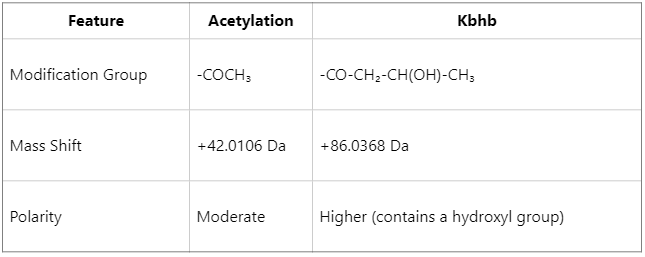
Because the Kbhb group possesses a longer carbon chain and an additional hydroxyl group, its steric volume and hydrophilicity are significantly greater than those of acetylation. Consequently:
-
Potential effects on chromatin architecture may differ.
-
Recognition and interaction modes with reader proteins may also vary.
2. Differences in Metabolic Context
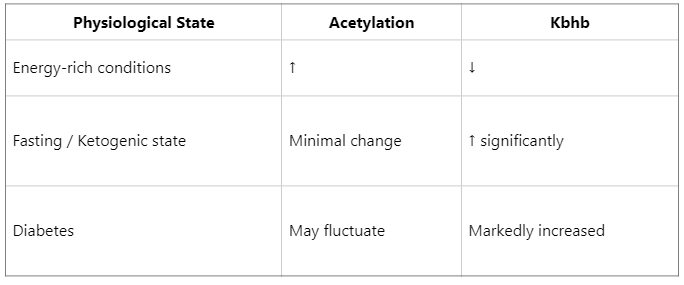
Kbhb is therefore considered a metabolic stress-responsive histone modification, showing particularly pronounced changes in tissues such as liver, heart, and skeletal muscle.
Consequently, Kbhb-related studies have expanded rapidly in several research areas:
-
Metabolic diseases
-
Cancer metabolic reprogramming
-
Neurodegenerative disorders
-
Mechanistic studies of ketogenic diets
3. Differences in Gene Regulatory Functions
Although both modifications are associated with transcriptional activation, important distinctions exist.
-
Acetylation: broadly enriched at promoter and enhancer regions
-
Kbhb: preferentially associated with metabolism-related genes
Studies have shown that modification sites such as H3K9bhb and H3K14bhb are significantly elevated under fasting conditions and specifically activate genes involved in fatty acid oxidation and ketone body utilization.
These findings suggest that:
-
Acetylation functions primarily as a general marker of transcriptional activation.
-
Kbhb acts more as a metabolic stress-responsive epigenetic signal.
Key Differences at the Level of Mass Spectrometry Detection
For researchers, accurately distinguishing Kbhb from acetylation is a critical consideration in experimental design.
1. Precise Discrimination Based on Mass Shift
-
Acetylation: +42.0106 Da
-
Kbhb: +86.0368 Da
High-resolution mass spectrometry platforms (e.g., Orbitrap systems) enable accurate differentiation between these modifications.
However, several practical challenges remain:
-
Low abundance of Kbhb modifications
-
Potential coexistence with other acylation modifications (e.g., crotonylation)
-
Limited specificity of currently available antibodies
2. Differences in Enrichment Strategies
Acetylation studies typically employ:
-
Pan-acetyl-lysine antibody enrichment
In contrast, Kbhb analysis often requires:
-
Kbhb-specific antibodies
-
Chemical derivatization-based enrichment strategies
-
Global acylome profiling approaches
For highly complex biological samples, the following analytical strategy is recommended:
- High-resolution LC-MS/MS combined with precise modification-site localization algorithms and stringent false discovery rate (FDR) control
Why Is Mass Spectrometry Essential for Studying Kbhb?
Several factors contribute to the importance of mass spectrometry in Kbhb research:
-
Kbhb is a relatively newly identified histone modification.
-
The specificity of commercial antibodies remains under continuous optimization.
-
Substantial site heterogeneity exists across histone proteins.
Therefore, unbiased identification strategies based on mass spectrometry have become the mainstream analytical approach.
Key advantages include:
-
High mass accuracy and resolution
-
Simultaneous detection of multiple acylation modifications
-
Quantitative comparison (Label-free or TMT-based)
-
Dynamic profiling of modification sites
For research groups aiming to elucidate metabolism-epigenetics regulatory mechanisms, obtaining high-quality histone modification omics data is critically important.
Research Trends and Future Directions of Kbhb
Current research hotspots include:
-
The role of Kbhb in cancer metabolic reprogramming
-
Ketone body signaling regulation in the nervous system
-
Coupling mechanisms between metabolism and epigenetic regulation
-
Cross-talk among multiple acylation modifications
It is anticipated that Kbhb will become a new research frontier in epigenetic regulation, following the emergence of acetylation and lactylation.
Technical Recommendations: Designing Kbhb Research Experiments
Recommended experimental strategies include:
-
Selecting metabolic stimulation models (e.g., fasting or BHB treatment)
-
Extracting and purifying histones
-
Performing high-resolution LC-MS/MS analysis
-
Conducting parallel profiling of multiple acylation modifications
-
Integrating transcriptomic validation
In practical research projects, detection sensitivity, modification-site localization accuracy, and data reproducibility are critical determinants of experimental quality.
In summary, acetylation functions primarily as a general marker of transcriptional activation, whereas Kbhb represents a metabolism-responsive epigenetic signal associated with elevated ketone bodies. These two modifications can be clearly distinguished using high-resolution mass spectrometry based on both mass shifts and modification-site identification. If you are conducting histone modification studies such as Kbhb or acetylation, MtoZ Biolabs provides integrated services including histone extraction, LC-MS/MS identification and quantification, and bioinformatics interpretation to support the generation of reliable and publication-quality data.
MtoZ Biolabs, an integrated chromatography and mass spectrometry (MS) services provider.
Related Services
How to order?




