






What Is the Difference Between Histone Butyrylation and Acetylation?
In life science research, epigenetic modifications represent a central focus in the regulation of gene expression. Among these, histone acetylation and butyrylation are two key post-translational modifications (PTMs) that play critical roles in chromatin organization, transcriptional regulation, and disease initiation and progression. Although both modifications occur on lysine residues of histones, they differ significantly in their chemical structures, functional mechanisms, and biological effects.
What Is Histone Acetylation?
Histone acetylation refers to the addition of an acetyl group (-COCH₃) to lysine residues on histone proteins. This process is typically catalyzed by histone acetyltransferases (HATs), whereas its removal is mediated by histone deacetylases (HDACs).
The primary functions of histone acetylation include:
-
Chromatin relaxation: Acetylation neutralizes the positive charge of lysine residues, reducing electrostatic interactions between histones and DNA, thereby promoting a more open chromatin conformation that facilitates transcription factor binding.
-
Gene activation: Acetylation is strongly associated with transcriptional activation and is widely recognized as a hallmark of active promoters.
-
Involvement in signaling pathways: For instance, acetylation of p53 regulates cell cycle progression and apoptosis.
-
Disease association: Dysregulated histone acetylation is closely linked to various diseases, including cancer and neurodegenerative disorders.
Notably, acetylation was the first identified form of histone acylation and remains the most extensively studied epigenetic modification.
What Is Histone Butyrylation?
Histone butyrylation involves the addition of a butyryl group (-CO-(CH₂)₂-CH₃) to lysine residues. Compared with acetyl groups, butyryl groups are longer and bulkier. This modification is catalyzed by specific acyltransferases, including members of the p300/CBP family, and can also be influenced by intracellular levels of short-chain fatty acids derived from metabolic processes.
Key features of histone butyrylation include:
-
Enhanced chromatin relaxation: The larger size of the butyryl group exerts a stronger effect on histone-DNA interactions, leading to a more pronounced open chromatin state.
-
Metabolic sensitivity: Butyrylation levels are closely associated with intracellular concentrations of short-chain fatty acids, such as butyrate, highlighting a direct link between cellular metabolism and epigenetic regulation.
-
Gene-specific regulation: Butyrylation has been shown to regulate the expression of specific metabolic and inflammatory genes.
-
Emerging research focus: Compared with acetylation, butyrylation has gained increasing attention for its roles in cancer biology, immune regulation, and microbiota-derived metabolism.
Comparison of Chemical Structure and Functional Differences
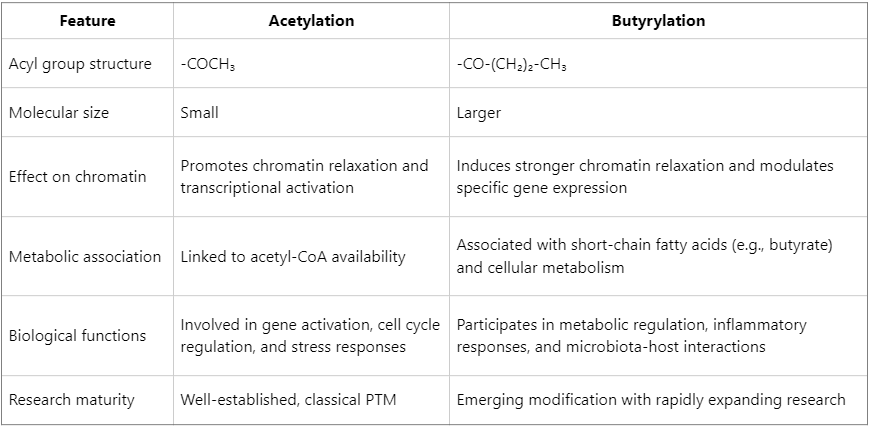
As summarized above, although both modifications belong to lysine acylation, butyrylation is distinguished by its larger molecular size and stronger metabolic responsiveness, offering new insights into the interplay between epigenetics and metabolism.
Crosstalk and Synergy Between Histone Acetylation and Butyrylation
In biological systems, histone acetylation and butyrylation rarely function in isolation. Many lysine residues, such as K9 and K27, can undergo multiple acyl modifications. The combinatorial patterns of these modifications contribute to the formation of a complex “histone code,” which fine-tunes gene expression. For example:
-
In intestinal epithelial cells, butyrate produced by microbial fermentation promotes butyrylation at specific loci while reducing acetylation levels, thereby contributing to immune tolerance.
-
In cancer cells, hyperacetylation or reduced butyrylation may result in aberrant chromatin organization and dysregulated gene expression.
Therefore, elucidating the interplay between these modifications is essential for precise modulation of gene expression and the development of targeted small-molecule regulators.
Detection Methods for Histone Acetylation and Butyrylation
Modern studies rely on high-resolution analytical techniques to characterize histone modifications. Common approaches include:
1. Mass Spectrometry (MS)
Proteomics-based strategies enable precise identification and quantification of acetylation and butyrylation sites. Advanced platforms, such as Orbitrap high-resolution mass spectrometry combined with optimized sample preparation workflows, allow highly sensitive detection of low-abundance modifications.
2. Western Blot and Immunofluorescence (IF)
Modification-specific antibodies are used to detect histone acetylation or butyrylation, enabling visualization and comparative analysis under different conditions.
3. Chromatin Immunoprecipitation Sequencing (ChIP-seq)
By integrating modification-specific antibodies with high-throughput sequencing, ChIP-seq enables genome-wide mapping of histone modifications and identification of their regulatory networks.
Advantages of MtoZ Biolabs in Research Support
In histone modification research, high-throughput and multidimensional analytical capabilities are essential for elucidating the functional differences between acetylation and butyrylation. MtoZ Biolabs provides:
-
Mass spectrometry-based omics services: Comprehensive identification of multiple histone acylation sites, including acetylation, butyrylation, and other short-chain fatty acid-derived modifications.
-
Customized experimental design: Tailored workflows optimized for specific cell types or disease models.
-
Data interpretation and bioinformatics analysis: Integration of epigenetic, transcriptomic, and metabolomic data to construct comprehensive regulatory networks.
These capabilities enable researchers to efficiently investigate the roles of acetylation and butyrylation in disease mechanisms, metabolism, and microbiota-host interactions.
In summary, although histone acetylation and butyrylation are both lysine acylation modifications, they differ significantly in chemical structure, chromatin remodeling capacity, metabolic sensitivity, and gene regulatory functions. Acetylation is a well-established epigenetic mark widely involved in gene activation and cellular regulation, whereas butyrylation, as an emerging modification, is more responsive to metabolic states and participates in the regulation of specific gene expression and microbiota-host interactions. Understanding the distinctions and crosstalk between these modifications is essential not only for fundamental biological research but also for the development of precision medicine and metabolic intervention strategies. In this context, MtoZ Biolabs provides advanced mass spectrometry platforms and professional research services, delivering accurate and high-efficiency data support to facilitate the transition from mechanistic studies to translational applications.
MtoZ Biolabs, an integrated chromatography and mass spectrometry (MS) services provider.
Related Services
How to order?




