






What Is MS-Based Protein Identification and How Does It Work?
- DDA-, DIA-, and PRM-based protein identification workflows
- High-throughput data analysis and visualization reporting
- Integrated multi-omics data analysis
- Customized experimental design and project consultation
In modern life science research, protein identification represents a foundational step for elucidating cellular functions, disease mechanisms, and biomarker discovery. With the rapid advancement of proteomics, mass spectrometry (MS)-based protein identification has emerged as a central analytical strategy owing to its high sensitivity, high throughput, and robust quantitative capability.
What Is MS-Based Protein Identification?
Protein identification refers to the experimental determination of the protein composition within a sample, including the identification of protein sequences or their biological origin. Among available protein analysis approaches, mass spectrometry enables the direct measurement of peptide masses, allowing rapid and accurate identification of thousands of proteins from complex biological mixtures.
In contrast to conventional methods such as SDS-PAGE and Western blotting, which rely on antibodies or labeling strategies, mass spectrometry-based identification depends on peptide mass-to-charge ratios (m/z) and fragmentation patterns, thereby enabling high-throughput and high-precision protein identification without antibody dependence.
Working Principle of MS-Based Protein Identification: Core Workflow Analysis
MS-based protein identification typically follows a standardized analytical workflow consisting of “protein extraction - proteolytic digestion - peptide separation - mass spectrometry analysis - data interpretation”:
1. Protein Extraction and Enzymatic Digestion: From Complex Samples to Analyzable Units
Proteins are first extracted from biological materials such as cells, tissues, or serum. Because mass spectrometry analyzes peptides rather than intact proteins, extracted proteins are enzymatically digested using proteases such as trypsin to generate peptides of defined lengths, which are suitable for downstream mass spectrometric analysis.
2. Peptide Separation (LC): Enhancing Detection Depth of Complex Samples
Prior to mass spectrometric analysis, peptide mixtures are commonly separated by liquid chromatography (LC). Based on differences in physicochemical properties such as hydrophobicity, peptides are resolved over distinct retention times, substantially increasing analytical depth, detection sensitivity, and overall protein coverage.
3. Mass Spectrometry Analysis (MS & MS/MS): Acquisition of Peptide-Specific Fragmentation Patterns
Following chromatographic separation, peptides are ionized (e.g., via electrospray ionization [ESI] or matrix-assisted laser desorption/ionization [MALDI]) to generate charged ions. The mass spectrometer first records precursor ion masses (MS), after which selected ions undergo collision-induced dissociation (CID or HCD), producing fragment ions that are analyzed by tandem mass spectrometry (MS/MS).
The resulting fragmentation patterns provide peptide-specific spectral features that serve as molecular identifiers for peptide and protein assignment.
4. Data Analysis and Protein Matching: Inferring Protein Identity From Peptide Evidence
Mass spectrometry data, including mass-to-charge ratios and signal intensities, are computationally matched against protein sequence databases such as UniProt or Swiss-Prot to determine protein identities present in the sample. Widely used search and analysis platforms include MaxQuant, Mascot, and Proteome Discoverer.
Data Acquisition Modes: Differences Among DDA, DIA, and PRM
Currently, three principal mass spectrometry acquisition strategies are employed for protein identification:
1. DDA (Data-Dependent Acquisition): Fragmentation is selectively triggered for the most intense precursor ions, making it suitable for exploratory and discovery-driven analyses.
2. DIA (Data-Independent Acquisition): Ions within predefined mass windows are fragmented simultaneously, improving reproducibility and quantitative accuracy, particularly in large-scale quantitative studies.
3. PRM (Parallel Reaction Monitoring): A targeted strategy for predefined proteins, offering high sensitivity and specificity, commonly applied in validation and verification stages.
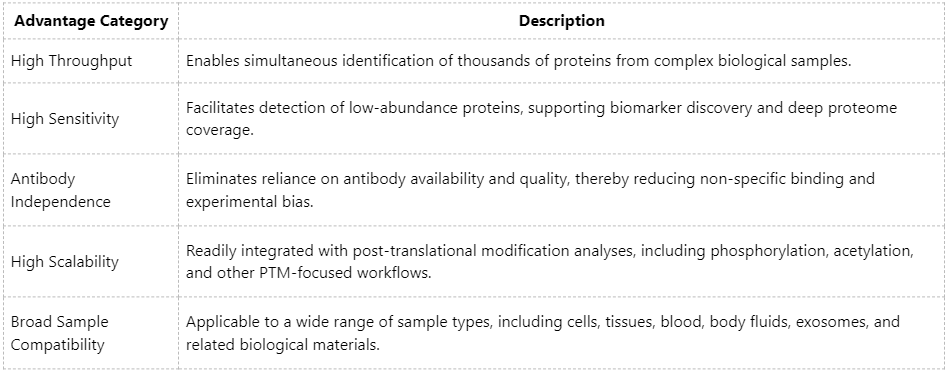
Advantages of MS-Based Protein Identification
Application Fields: From Basic Research to Precision Medicine
MS-based protein identification is widely applied across diverse research areas:
1. Disease Mechanism Studies: Identification of key signaling pathways and differentially expressed proteins.
2. Drug Target Discovery: Supporting target screening and mechanistic studies in drug development.
3. Biomarker Discovery: Enabling development of early diagnostic and companion diagnostic markers.
4. Functional Proteomics: Integration with PTM proteomics, interactomics, and structural proteomics for in-depth functional characterization.
Mass spectrometry-based proteomics plays an essential role in translational medicine, immunology, microbiome research, agriculture, forestry, fisheries, and synthetic biology.
MtoZ Biolabs: One-Stop Solutions for MS-Based Protein Identification
MtoZ Biolabs specializes in integrated multi-omics research, encompassing proteomics, metabolomics, and epigenomics, and has supported hundreds of academic institutions and biopharmaceutical enterprises. Our services include:
Supported by advanced instrumentation platforms and an experienced data analysis team, MtoZ Biolabs is committed to translating scientific hypotheses into actionable data and providing robust analytical support for research projects.
MS-based protein identification has become a cornerstone of modern proteomics. Its combination of sensitivity, throughput, and versatility underpins its indispensable role in both academic research and industrial applications. With continued advances in mass spectrometry technologies and computational algorithms, its impact on disease diagnosis, drug development, and precision medicine is expected to expand further. Researchers seeking reliable protein identification support are encouraged to collaborate with MtoZ Biolabs, which is dedicated to providing dependable analytical solutions for every research endeavor.
MtoZ Biolabs, an integrated chromatography and mass spectrometry (MS) services provider.
Related Services
How to order?




