






What is mass spectrometry used for in proteomics?
Introduction
A proteomics project can start with a simple but consequential question: what should mass spectrometry actually deliver for this sample? A signaling biology group may need to know which proteins change after drug treatment. A biopharmaceutical team may need sequence-level confirmation for a therapeutic antibody. A biomarker program may need reproducible abundance measurements across many clinical specimens. In each case, mass spectrometry is not the endpoint. It is the analytical engine that converts peptide or protein measurements into identification lists, quantitative tables, modification maps, or targeted monitoring reports.
Mass spectrometry is used in proteomics to identify proteins, compare abundance across samples, map post-translational modifications, characterize biologics, and validate selected protein panels with sequence evidence. The same LC-MS/MS platform can support discovery-scale experiments, comparability review, and assay-style follow-up when the workflow is matched to the biological or quality question. Understanding what mass spectrometry is used for in proteomics helps teams choose the right experiment before sample preparation begins.
The Direct Answer: What Mass Spectrometry Does in Proteomics
In proteomics, mass spectrometry measures the mass and abundance of peptide or protein ions and uses fragmentation patterns to assign sequence evidence. Bottom-up LC-MS/MS digests proteins into peptides, separates them by liquid chromatography, and uses tandem mass spectrometry to match spectra against protein databases. Top-down and native mass spectrometry analyze intact proteins or proteoforms when sample complexity is controlled. Targeted PRM or MRM monitors selected peptide transitions for repeated quantification.
The practical outputs differ by project goal. Discovery proteomics produces protein identification tables and differential abundance lists. Modification studies produce site-level PTM maps after enrichment. Biologics characterization produces peptide coverage, disulfide connectivity, and glycopeptide evidence. Targeted workflows produce panel-level abundance values with defined acceptance criteria. Mass spectrometry is therefore used in proteomics as a flexible measurement platform that links ion signals to protein-level conclusions.
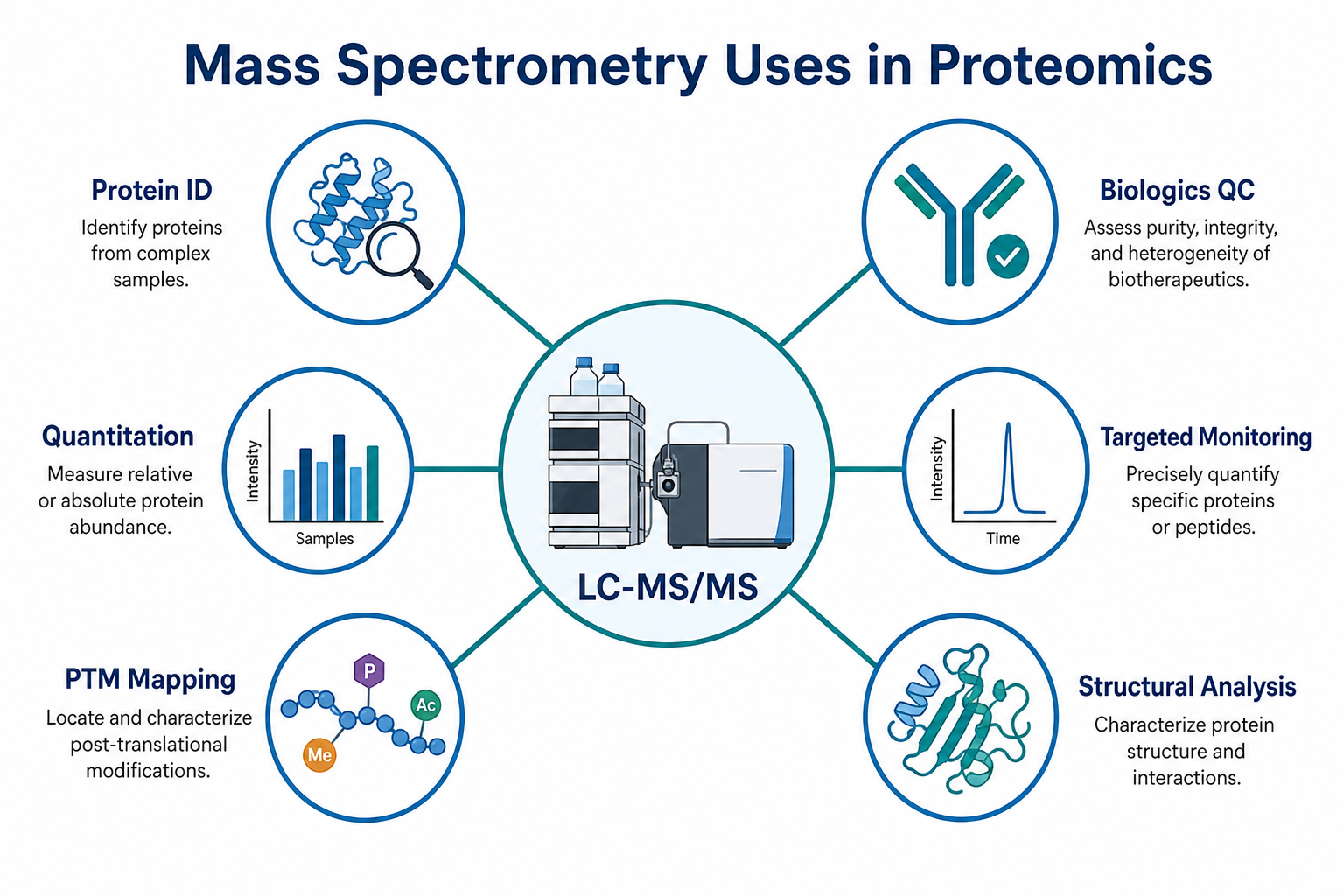
Figure 1. Mass spectrometry supports multiple proteomics purposes, from discovery identification and quantitation to PTM mapping, biologics characterization, targeted monitoring, and structural analysis.
Protein Identification in Complex Mixtures
The most common use of mass spectrometry in proteomics is protein identification. In bottom-up workflows, proteins are digested into peptides, separated by reversed-phase LC, and analyzed by LC-MS/MS. The instrument records precursor ions in survey scans and fragments selected precursors to generate product ions that reflect peptide sequence.
Database search engines compare experimental MS/MS spectra with in silico fragment ions from protein sequence databases and assign peptide-spectrum matches with scoring metrics. False discovery rate filtering removes low-confidence matches before protein inference groups peptides into protein identifications. This approach is widely used for cell lysates, tissue extracts, immunoprecipitation eluates, exosome preparations, and other complex matrices where many proteins must be identified in one experiment.
Identification depth depends on sample complexity, digestion strategy, LC gradient length, acquisition mode, and search parameters. Data-dependent acquisition prioritizes intense precursors for MS/MS fragmentation. Data-independent acquisition fragments peptides across predefined m/z windows and is often selected when cohort comparison requires consistent measurement across samples.
Relative and Absolute Protein Quantification
Mass spectrometry is also used in proteomics to compare protein abundance across conditions, time points, or treatment groups. Quantification is peptide-based. The instrument measures ion intensities for peptides across samples, and software rolls those values up to protein groups for statistical comparison.
Label-free quantitation uses extracted ion chromatograms or spectral feature alignment across LC-MS runs. Isobaric labeling with TMT or iTRAQ reporters enables multiplexed comparison within a single MS run. Metabolic labeling with SILAC distinguishes newly synthesized proteins from background proteomes. SWATH and DIA acquisition modes support reproducible label-free quantitation across large sample sets when acquisition parameters are held consistent.
Absolute quantification is possible when stable isotope-labeled reference peptides or protein standards are spiked into samples before analysis. Targeted PRM can then monitor defined transitions for selected peptides with assay-style reporting. Quantitative proteomics by mass spectrometry is used in drug mechanism studies, disease model comparison, biomarker discovery, and process development when reproducible abundance change is the primary readout.
Post-Translational Modification Mapping
Another major use of mass spectrometry in proteomics is mapping post-translational modifications. Phosphorylation, acetylation, ubiquitination, glycosylation, methylation, and other modifications alter peptide mass and fragmentation patterns. Enrichment steps isolate modified peptides before LC-MS/MS analysis so low-abundance signals are not lost in the background proteome.
Modified peptide searching compares observed spectra with predicted fragment ions that include the modification mass shift. Localization algorithms assign modification sites when fragment ions bracket the modified residue. Phosphoproteomics, glycoproteomics, and histone modification studies rely on this capability because immunoassays alone cannot provide site-resolved multiplexed maps across hundreds of modified peptides.
Mass spectrometry is therefore used in proteomics when the biological question depends on where and how strongly a protein is modified, not only whether the protein is present.
Biologics and Therapeutic Protein Characterization
In biopharmaceutical development, mass spectrometry is used in proteomics workflows to confirm primary structure, map critical quality attributes, and support comparability review. Peptide mapping digests therapeutic proteins or antibodies and uses LC-MS/MS to confirm sequence coverage, detect sequence variants, and localize modifications such as oxidation, deamidation, or glycosylation.
Disulfide bond mapping compares reduced and non-reduced digests to assign cysteine connectivity. Glycopeptide analysis identifies occupied glycosylation sites and major glycan structures. Intact mass analysis of antibodies or subunits complements peptide-level evidence by revealing intact proteoform heterogeneity. These applications use mass spectrometry to produce documentation-grade structural evidence that supports release testing, biosimilar comparison, and CMC reporting.
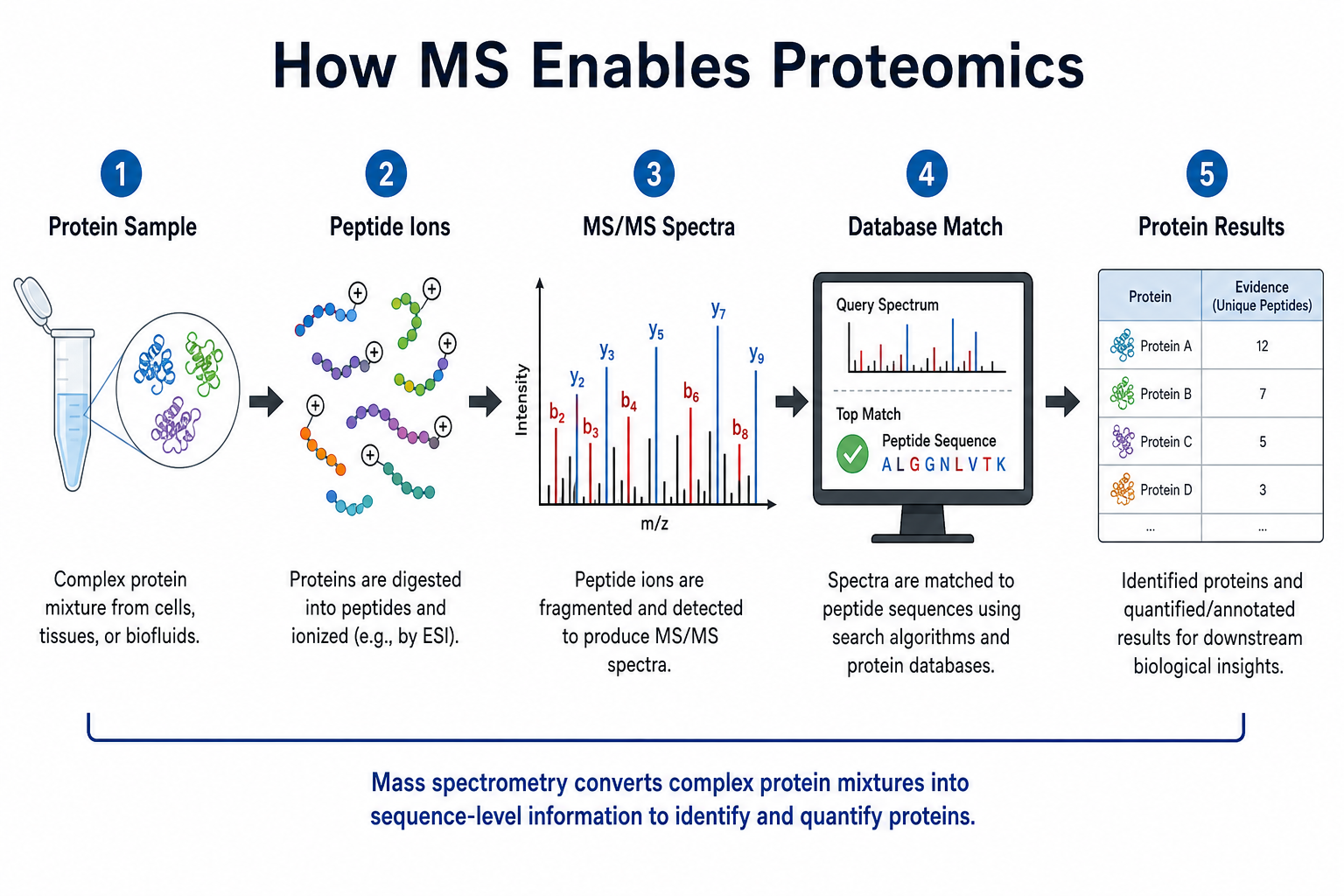
Figure 2. Mass spectrometry enables proteomics applications by converting digested peptides or intact proteins into measurable ions, interpretable MS/MS spectra, and protein-level reports.
Targeted Protein Monitoring and Validation
Discovery proteomics often identifies candidate proteins that require follow-up measurement. Mass spectrometry is used in targeted proteomics to monitor selected peptide ions by PRM or MRM with higher reproducibility and defined acceptance criteria than broad discovery acquisition provides.
Targeted workflows are common after biomarker nomination, pathway validation, or assay transfer from discovery datasets. Researchers define a peptide panel, optimize transitions, and measure the same targets across many samples with stable chromatography and calibration controls. This use of mass spectrometry supports hypothesis testing, orthogonal confirmation of antibody-based assays, and repeated monitoring in preclinical or translational studies.
Structural and Interaction Proteomics
Mass spectrometry is also used in proteomics to study protein structure, assembly, and interactions. Native mass spectrometry measures intact protein complexes under non-denaturing conditions. Hydrogen-deuterium exchange mass spectrometry maps solvent-accessible regions and conformational changes. Cross-linking mass spectrometry provides distance constraints between residues in protein complexes.
Affinity purification followed by LC-MS/MS identifies interaction partners in pull-down or co-immunoprecipitation experiments. Chemical proteomics uses activity-based probes to enrich labeled proteins before mass spectrometry identification.
Related Services
Protein Identification Service
Quantitative Proteomics Service
Quantitative Phosphoproteomics Service
Proteomics Bioinformatic Analysis Service
Researchers planning proteomics projects can consult MtoZ Biolabs to align mass spectrometry workflow selection with identification, quantitation, or characterization goals before phase 1 sample intake.
Proteomics Use Cases and Typical MS Outputs
The table below summarizes common proteomics purposes and the mass spectrometry outputs each purpose typically requires.
|
Proteomics purpose |
Typical MS workflow |
Primary output |
|---|---|---|
|
Discovery protein identification |
Bottom-up LC-MS/MS, DDA or DIA |
Protein list with peptide evidence |
|
Differential abundance comparison |
Label-free, TMT, SILAC, or SWATH LC-MS/MS |
Quantitative protein table across groups |
|
PTM site mapping |
Enrichment plus modified peptide LC-MS/MS |
Site-level modification map |
|
Biologics primary structure review |
Peptide mapping LC-MS/MS |
Sequence coverage and localized variants |
|
Biomarker or panel validation |
PRM or MRM targeted LC-MS/MS |
Repeated peptide panel quantification |
|
Intact proteoform review |
Top-down or native MS |
Intact mass and proteoform profile |
This mapping helps teams distinguish between experiments that share the same instrument but produce different reporting packages.
When Mass Spectrometry Is the Right Proteomics Tool
Mass spectrometry is widely selected in proteomics when sequence evidence, multiplexed comparison, or site-resolved modification data are required. Immunoassays remain useful for single-target detection, but they do not typically provide unbiased discovery, residue-level modification assignment, or simultaneous measurement of hundreds of proteins in one run.
Mass spectrometry is often preferred when sample complexity is high, when antibody reagents are unavailable, when biologics characterization requires peptide-level documentation, or when discovery results must be validated with targeted peptide monitoring.
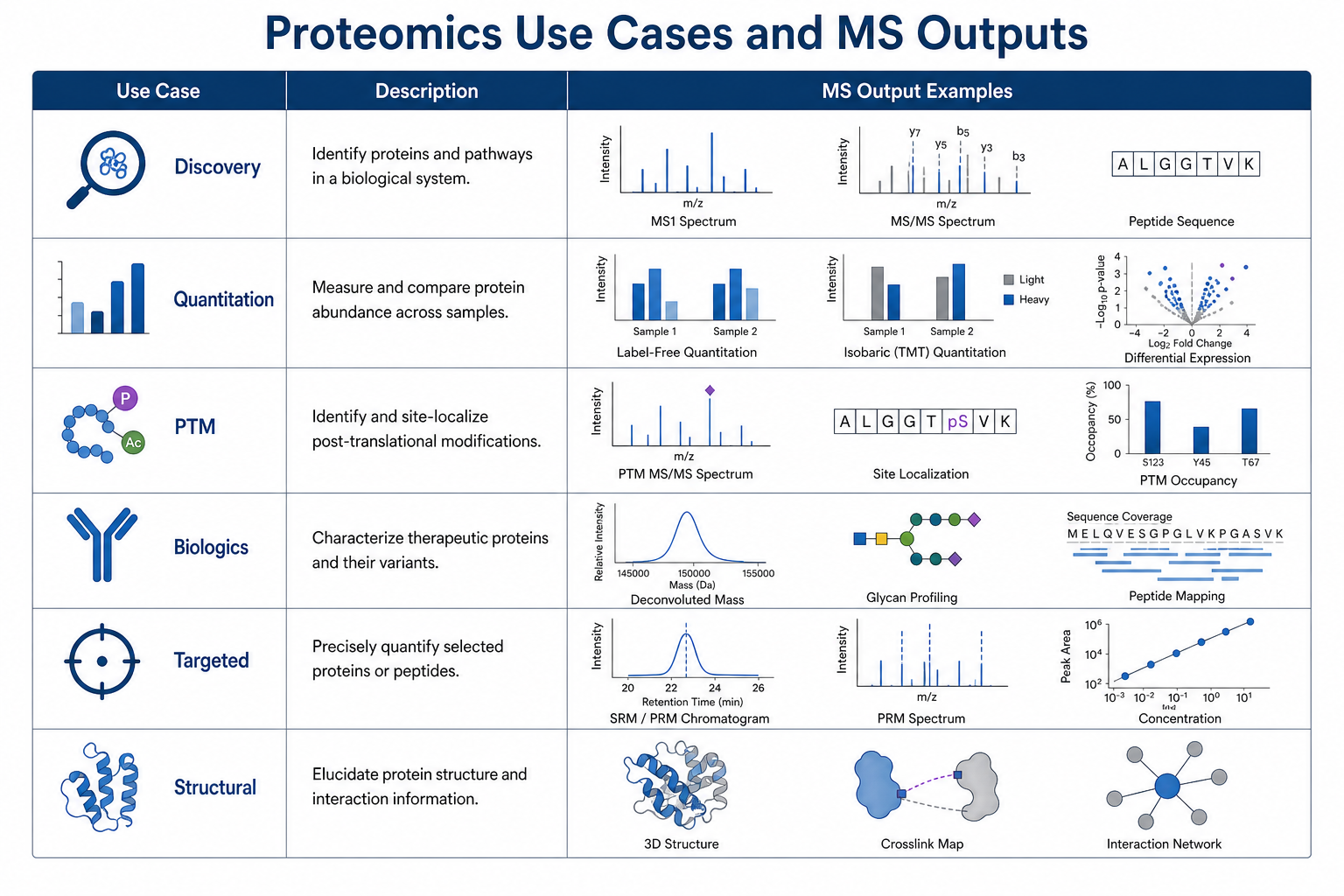
Figure 3. Different proteomics use cases require different mass spectrometry outputs, from identification tables and quantitative comparisons to modification maps and targeted panel monitoring.
Advantages of Using Mass Spectrometry in Proteomics
Mass spectrometry provides sequence-level evidence that supports confident protein assignment beyond mass alone. High-resolution instruments improve precursor and fragment assignment in complex mixtures. Multiplexed quantification strategies allow many proteins to be measured in parallel within one experimental design.
Modification mapping delivers site-resolved information that immunoassay panels alone cannot provide at comparable scale. Targeted PRM adds reproducible measurement of defined peptides after discovery. For biologics, peptide mapping integrates with CMC workflows and produces auditable spectral evidence for sequence and critical quality attribute review.
Frequently Asked Questions
1. What is mass spectrometry used for in proteomics?
Mass spectrometry is used in proteomics to identify proteins, quantify abundance across samples, map post-translational modifications, characterize therapeutic proteins, and monitor selected peptide panels with targeted LC-MS/MS.
2. Is protein identification the only use of mass spectrometry in proteomics?
No. Identification is one major use, but mass spectrometry also supports quantitative comparison, PTM mapping, biologics peptide mapping, interaction proteomics, and structural characterization depending on sample preparation and acquisition mode.
3. What is the difference between discovery and targeted proteomics by mass spectrometry?
Discovery proteomics surveys many proteins in a sample to build identification and abundance lists. Targeted proteomics monitors a defined peptide panel with PRM or MRM for repeated validation or assay-style measurement.
4. Can mass spectrometry quantify proteins in proteomics?
Yes. Mass spectrometry quantifies proteins through peptide ion intensities using label-free, isobaric labeling, metabolic labeling, or targeted monitoring strategies matched to the study design.
5. When is LC-MS/MS preferred over intact mass analysis in proteomics?
LC-MS/MS is often preferred for complex mixtures and peptide-level sequence confirmation. Intact or top-down mass spectrometry is often selected for purified proteins when proteoform heterogeneity and intact mass review are central to the analysis goal.
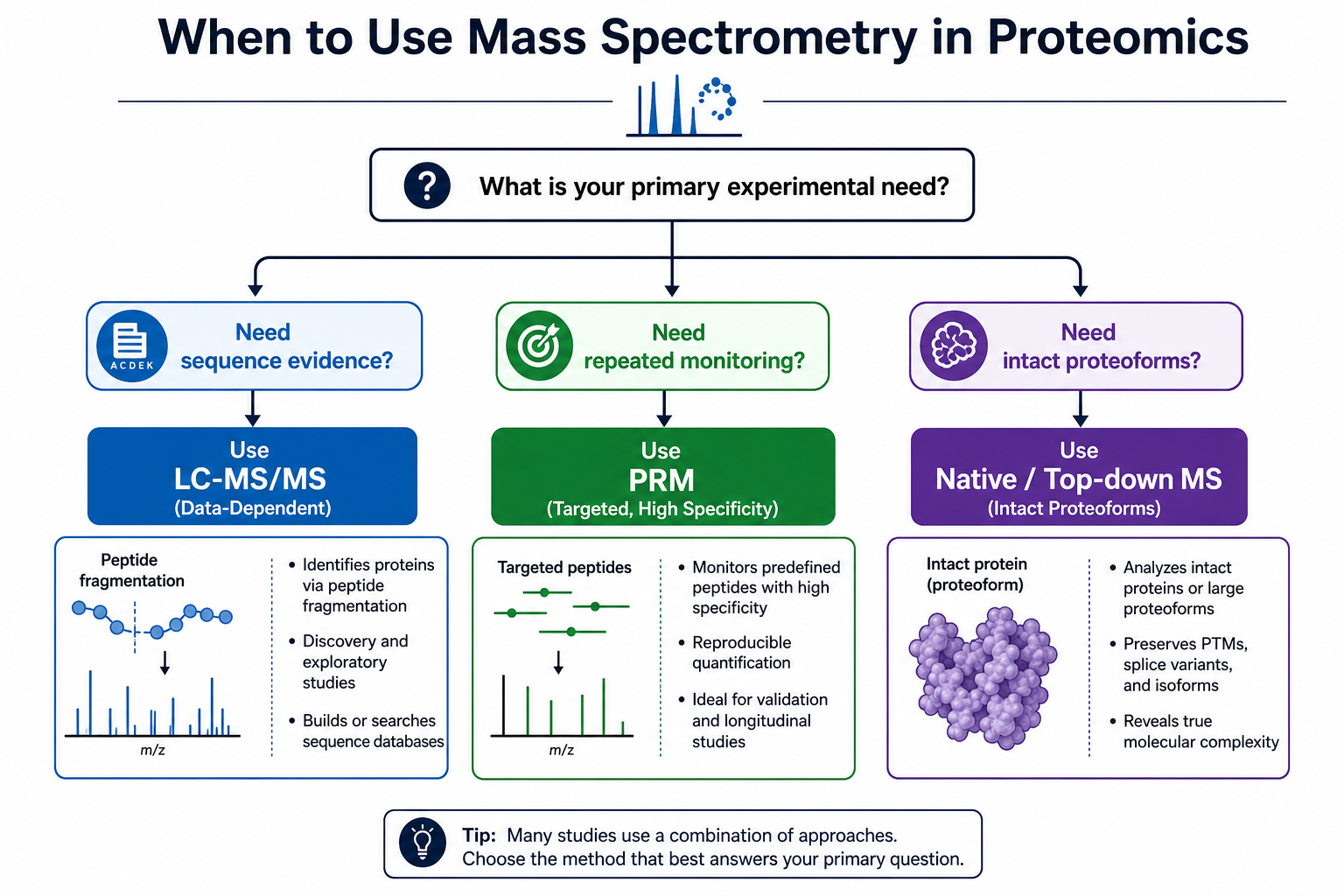
Figure 4. Mass spectrometry workflow selection in proteomics depends on whether the project requires sequence evidence from LC-MS/MS, repeated panel monitoring by PRM, or intact proteoform analysis.
Conclusion
Mass spectrometry is used in proteomics to answer distinct analytical questions with distinct evidence types. Protein identification, quantitative comparison, modification mapping, biologics characterization, targeted validation, and structural analysis all rely on peptide or protein ion measurement, but each purpose requires a different sample preparation and acquisition strategy. Teams that define the required output before phase 1 preparation and phase 2 LC-MS/MS acquisition are more likely to receive proteomics data that support the next research or development decision.
If your project requires discovery identification, reproducible quantitation, or biologics peptide mapping by mass spectrometry, MtoZ Biolabs can help align workflow selection with the reporting format your study requires. Contact MtoZ Biolabs to review sample type, proteomics goal, and the mass spectrometry route suited to your identification or quantitation needs.
How to order?




