






What Is Histone β-Hydroxybutyrylation (Kbhb)?
Histone β-hydroxybutyrylation (Kbhb, lysine β-hydroxybutyrylation) is a novel post-translational modification (PTM) characterized by the covalent attachment of a β-hydroxybutyryl group to lysine residues (Lys), representing a type of short-chain fatty acid acylation. The discovery of Kbhb reveals a direct link between cellular metabolites and epigenetic regulation, emerging as a research focus at the intersection of epigenetics and metabolomics in recent years.
Chemical Nature and Formation Mechanism of Histone β-Hydroxybutyrylation
Kbhb is a histone modification dependent on cellular metabolic status, with the following formation mechanism:
- Under conditions such as starvation, fasting, exercise, or ketone body-producing diets, the organism generates substantial amounts of β-hydroxybutyrate (BHB) via fatty acid oxidation.
- BHB is subsequently converted inside cells to its active acyl donor, β-hydroxybutyryl-CoA.
- Catalyzed by acyltransferases (e.g., p300), the β-hydroxybutyryl group is covalently attached to histone lysine residues, resulting in Kbhb modification.
This modification is commonly observed at sites including H3K9bhb, H3K14bhb, and H4K8bhb.
Biological Significance of Histone β-Hydroxybutyrylation
1. Novel Mechanism of Epigenetic Regulation
Kbhb is an epigenetic mark positively associated with gene activation, functioning similarly to histone acetylation sites such as H3K9ac and H3K27ac. Studies indicate that:
(1) Kbhb levels increase significantly under starvation.
(2) Promoter regions of metabolism-related genes, including those associated with fatty acid oxidation (FAO) and the Krebs cycle, are enriched with Kbhb.
(3) Kbhb enhances chromatin accessibility, thereby facilitating transcriptional activation.
2. Interdisciplinary Research Focus
Research on Kbhb bridges several cutting-edge fields:
(1) Metabolomics: β-hydroxybutyrate is a representative energy metabolite.
(2) Epigenetics: Modulates chromatin structure and gene expression through histone modification.
(3) Nutritional science and aging research: Kbhb may play roles in ketogenic diets and lifespan extension.
Comparison of Histone β-Hydroxybutyrylation With Other Histone Acylation Modifications
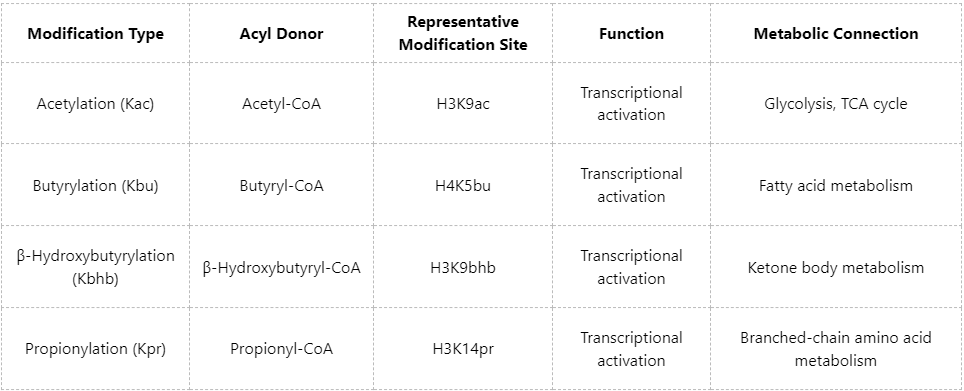
Kbhb is a non-canonical acylation modification whose expression is enhanced under metabolic stress, indicating its potential role as a metabolic sensor.
Research Methods and Detection Techniques for Histone β-Hydroxybutyrylation
Currently, mainstream approaches for detecting histone Kbhb modifications include:
1. Antibody Enrichment Combined With Proteomics
(1) Enrichment using Kbhb-specific antibodies.
(2) Used in combination with high-resolution mass spectrometry for PTM site identification and quantitative analysis.
2. ChIP-seq Analysis
(1) Chromatin immunoprecipitation employing Kbhb-specific antibodies.
(2) High-throughput sequencing to determine the genome-wide distribution of Kbhb.
(3) Facilitates elucidation of the gene networks regulated by Kbhb.
Research Prospects and Challenges of Histone β-Hydroxybutyrylation
1. Potential Applications
(1) Disease mechanism studies: Kbhb is closely associated with tumor metabolic reprogramming, diabetes, and neurodegenerative disorders.
(2) Drug target development: Kbhb-related acyltransferases and deacylases may serve as targets for novel epigenetic therapies.
(3) Nutrition and longevity interventions: Kbhb is involved in the regulatory mechanisms of dietary restriction and lifespan extension.
2. Current Challenges
(1) The comprehensive spectrum of modification sites remains incomplete, requiring additional high-throughput mass spectrometry data.
(2) Limited availability of specific antibodies and standards constrains functional studies.
(3) Cross-regulatory mechanisms between Kbhb and other acylation modifications require further investigation.
Histone β-hydroxybutyrylation (Kbhb) represents not only a rising star in epigenetics but also a key indicator of how metabolism influences gene expression. It provides deeper insights into cellular responses to nutritional changes. MtoZ Biolabs, integrating advanced mass spectrometry platforms, high-specificity antibody enrichment, and multi-omics analysis capabilities, offers researchers reliable support for detecting Kbhb modifications and conducting functional studies, thereby contributing to the elucidation of metabolic regulatory mechanisms.
MtoZ Biolabs, an integrated chromatography and mass spectrometry (MS) services provider.
Related Services
How to order?




