






What Does Histone Khib Mean in Epigenetic Regulation?
In the past decade, the development of high-resolution mass spectrometry has significantly advanced research on protein post-translational modifications (PTMs). Beyond classical modifications such as acetylation and methylation, a new class of lysine acylations has attracted increasing attention. Among these, lysine β-hydroxyisobutyrylation (Khib) has emerged as a prominent focus in epigenetic research.
What Is Histone Khib Modification?
Khib is a novel acylation occurring on lysine residues and was first identified in multiple species, including humans and yeast, through high-precision mass spectrometry. Chemically, it involves the attachment of a β-hydroxyisobutyryl group to the ε-amino group of lysine.
Compared with conventional acetylation, Khib exhibits distinct characteristics:
-
Larger spatial structure: The side chain of Khib is bulkier, exerting a more pronounced effect on chromatin architecture.
-
Higher polarity: The hydroxyl group increases molecular polarity.
-
Metabolically linked: Khib is closely connected to the metabolism of branched-chain amino acids such as valine.
These structural differences suggest that Khib may play unique roles in chromatin remodeling and transcriptional regulation.
How Does Khib Contribute to Epigenetic Regulation?
Epigenetic regulation primarily involves modulating interactions between DNA and histones, thereby controlling chromatin accessibility. As a novel histone modification, Khib has been increasingly recognized for its key role in this process.
1. Regulation of Chromatin Conformation
Khib occurs on lysine residues in histone tails, regions directly involved in DNA binding:
-
Neutralizes the positive charge of lysine.
-
Weakens electrostatic interactions between histones and negatively charged DNA.
-
Promotes a more relaxed chromatin structure (euchromatin).
Outcome: Facilitates enhanced transcriptional activity.
2. Marker for Transcriptional Activation
Studies indicate that Khib is enriched at gene promoters and positively correlates with transcriptionally active genes:
-
Significantly enriched at promoters of highly expressed genes.
-
Closely associated with RNA Polymerase II activity.
-
Frequently co-localized with other activation marks, such as H3K27ac.
This evidence positions Khib not only as a structural regulator but also as a functional marker for transcriptional activation.
3. Coupling With Metabolic Status
A distinctive feature of Khib is its close association with cellular metabolism:
-
β-hydroxyisobutyryl-CoA is derived from valine catabolism.
-
Changes in metabolic flux directly affect Khib modification levels.
-
Dynamically regulated under varying nutrient or stress conditions.
These observations highlight Khib as a bridge connecting cellular metabolism with epigenetic regulation.
Differences and Synergies Between Khib and Other Histone Modifications
In complex epigenetic networks, modifications often exhibit “crosstalk,” and Khib is no exception.
1. Comparison with Acetylation
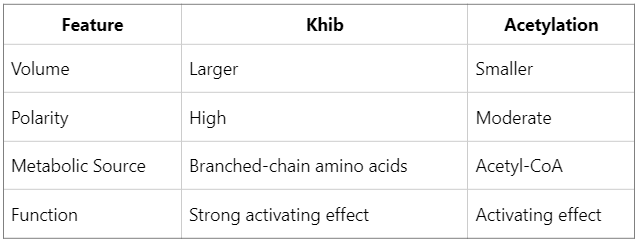
Khib may provide stronger or more stable transcriptional activation signals in specific contexts.
2. Synergistic Interactions
-
Khib may compete with acetylation (Kac) at the same lysine site.
-
Synergizes with methylation (e.g., H3K4me3) to enhance transcription.
-
Combinatorial patterns of modifications constitute the “histone code.”
This complex regulatory interplay positions Khib as an essential component for fine-tuning gene expression.
Functional Significance of Khib in Biological Processes
Accumulating evidence demonstrates Khib involvement in diverse biological processes:
1. Development and Differentiation
-
Dynamic changes of Khib during stem cell differentiation.
-
Regulation of key developmental gene expression.
2. Disease Relevance
-
Abnormal Khib levels in tumor cells.
-
Potential influence on oncogene or tumor suppressor gene expression.
-
Closely associated with metabolic reprogramming.
3. Immune Regulation
-
Modulation of inflammation-related gene expression.
-
Participation in immune cell activation.
These findings suggest that Khib holds significance not only in basic research but also as a candidate for clinical translation.
Technical Challenges and Solutions in Khib Research
Despite its promising potential, Khib research faces several technical hurdles:
1. Low Abundance and Detection Difficulty
-
Khib occurs at low stoichiometry.
-
Signals may be masked by other modifications.
2. Limited Specific Antibodies
-
Commercial antibodies vary in quality.
-
Verification of specificity is challenging.
3. Complex Data Analysis
-
Coexistence of multiple modification sites.
-
High demands for accurate quantitative analysis.
4. Solutions: Mass Spectrometry-Driven High-Throughput Proteomics
Currently, high-resolution mass spectrometry-based approaches (e.g., Orbitrap) dominate Khib research:
-
Enrichment strategies (antibody- or chemical-based).
-
High-sensitivity LC-MS/MS detection.
-
Quantitative proteomics analysis (Label-free or TMT).
-
Bioinformatics functional annotation.
These methods enable systematic mapping of Khib distribution and function at the proteome-wide level.
Future Research Directions
Key areas for future Khib research include:
-
Identification of Khib “writer” and “eraser” enzymes.
-
Discovery of specific “reader” proteins.
-
Dynamics of Khib across tissues and disease states.
-
Influence of metabolic interventions, such as diet or drugs.
The integration of multi-omics approaches is expected to address these questions progressively.
The discovery of histone Khib provides a novel dimension for understanding epigenetic regulation. It expands the “histone code” concept and illuminates how metabolic states intricately regulate gene expression. In this field, high-quality mass spectrometry data and systematic analytical capabilities are pivotal for advancing scientific discovery. As a specialized platform for proteomics and post-translational modification studies, MtoZ Biolabs leverages advanced mass spectrometry and established Khib enrichment workflows to deliver comprehensive solutions from sample preparation to data analysis, supporting in-depth investigation of Khib functions and mechanisms in complex biological systems and accelerating research translation.
MtoZ Biolabs, an integrated chromatography and mass spectrometry (MS) services provider.
Related Services
How to order?




