






What Does Histone Kbu Reveal About Chromatin Regulation?
In the context of advancing research in epigenetic regulation, histone post-translational modifications (PTMs) have expanded beyond traditional acetylation and methylation to include diverse novel acylation forms. Among these, lysine butyrylation (Kbu) of histones, identified as an important modification in recent years, has attracted widespread attention due to its close association with cellular metabolic states. Mediated by butyryl-CoA, Kbu directly integrates metabolic signals into the regulation of chromatin structure, providing a molecular-level basis for understanding gene expression regulation and emerging as a key research focus linking metabolic reprogramming with epigenetic control.
What Is Histone Kbu?
Histone Kbu is a post-translational modification in which a butyryl group is covalently attached to lysine residues. It was first identified using high-resolution mass spectrometry. Structurally, Kbu resembles acetylation but contains a longer carbon chain (C4 versus C2).
Origin of Kbu: Metabolism-Driven Modification
The primary donor of Kbu is butyryl-CoA, whose levels are directly influenced by:
-
Fatty acid metabolism
-
Short-chain fatty acids such as butyrate produced by gut microbiota
-
Changes in cellular energy status
Thus, Kbu functions not only as an epigenetic mark but also as a direct "readout" of the cellular metabolic state.
Chromatin Regulatory Mechanisms Involving Kbu
1. Regulation of Chromatin Accessibility
Similar to acetylation, Kbu neutralizes the positive charge of lysine residues, weakening the electrostatic interactions between histones and DNA, which:
-
Promotes chromatin relaxation
-
Enhances accessibility for transcription factors
-
Activates gene expression
Compared with Kac, Kbu exhibits greater steric hindrance and stronger hydrophobicity, which may result in more persistent or specific alterations in chromatin structure.
2. Establishing a Differential "Modification Language"
Kbu does not merely replace Kac but contributes to a more complex combinatorial modification landscape:
-
The same lysine residue may be modified by Kac, Kbu, Kcr (crotonylation), or other competing PTMs
-
Different modification combinations influence recognition by specific "reader" proteins.
For example:
-
Certain bromodomain-containing proteins are sensitive to Kac but show weaker binding to Kbu.
-
Specific readers may preferentially recognize long-chain acylation modifications.
These observations suggest that Kbu adds new layers and complexity to the histone code.
3. Linking Metabolic Reprogramming to Gene Expression
Kbu exhibits dynamic regulation in several biological processes:
(1) Differentiation of Intestinal Epithelial Cells
Butyrate, a metabolite produced by gut microbiota, can directly increase Kbu levels:
-
Activates genes related to differentiation
-
Suppresses inflammatory pathways
(2) Tumor Metabolic Reprogramming
Abnormal fatty acid metabolism in cancer cells:
-
Alters the supply of butyryl-CoA
-
Remodels Kbu distribution patterns
-
Influences tumor-related gene expression.
Therefore, Kbu serves as a critical link connecting cellular metabolism with epigenetic regulation in cancer.
4. Synergistic and Antagonistic Interactions With Other PTMs
Kbu exhibits complex relationships with multiple modifications:
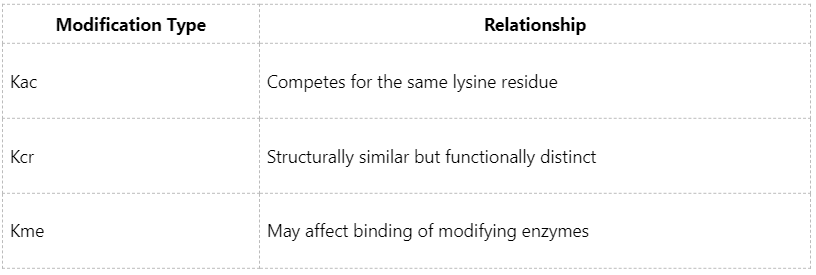
This "modification crosstalk" enables:
-
Fine-tuning of gene expression levels
-
Spatiotemporal-specific regulation
-
Formation of dynamic regulatory networks
5. Enzymatic Regulation of Kbu Dynamics
The deposition and removal of Kbu are mediated by specific enzymes:
(1) Writers
- Acetyltransferases such as p300/CBP can also catalyze lysine butyrylation
(2) Erasers
-
Histone deacetylases (HDACs), for example HDAC1 and HDAC2
-
Sirtuins, for example SIRT1 and SIRT2
Differences in substrate specificity among these enzymes further contribute to the precise regulation of Kbu.
Technical Challenges and Advances in Kbu Research
Due to its low abundance and structural similarity to other acylations, Kbu research heavily relies on advanced analytical technologies. Key approaches include:
1. High-Resolution Mass Spectrometry (LC-MS/MS)
-
Accurately differentiates Kbu from Kac and other PTMs
-
Enables comprehensive proteome-wide modification analysis
2. Targeted Enrichment Strategies
-
Enrichment using Kbu-specific antibodies
-
Enhances sensitivity for low-abundance modifications
3. Quantitative Proteomics (TMT or DIA)
-
Profiles dynamic changes of Kbu
-
Facilitates construction of regulatory networks
4. Multi-Omics Integrative Analysis
-
Combines transcriptomic and metabolomic data
-
Reveals functional mechanisms
Significance of Kbu Research: A New Paradigm Beyond a Novel Modification
Overall, Kbu contributes to chromatin regulation by:
-
Expanding the hierarchy of epigenetic control from single modifications to multidimensional combinatorial codes
-
Establishing a metabolism-epigenetics coupling model
-
Providing novel targets for disease research such as cancer, inflammation, and metabolic disorders
-
Advancing the development of precision medicine
The discovery of histone Kbu not only enriches the repertoire of post-translational modifications but also uncovers a novel regulatory logic whereby cellular metabolic states can be directly "written" onto chromatin through chemical modifications, enabling precise control of gene expression programs. With further research, Kbu is poised to become a critical bridge connecting fundamental biology with clinical translation. In studies of Kbu and other emerging PTMs, accurate and comprehensive data are essential. MtoZ Biolabs, leveraging advanced Orbitrap high-resolution mass spectrometry platforms along with optimized PTM enrichment and quantitative proteomics techniques, can achieve high-sensitivity site identification, integrative analysis, dynamic quantification, and multi-omics integration for Kbu and other PTMs, providing a one-stop, high-quality solution for mechanistic and disease-focused research.
MtoZ Biolabs, an integrated chromatography and mass spectrometry (MS) services provider.
Related Services
How to order?




