






What Can Untargeted Metabolomics Reveal in Comparative Studies?
In a comparative study, untargeted metabolomics shows you how the small-molecule profile differs between groups without needing a predefined target list. It answers the practical question behind most group-difference designs: which metabolites separate treated from control, disease from healthy, or one biological state from another.
Concretely, a comparative run gives you several linked readouts:
-
Overall profile patterns: whether samples show broad group-related patterns in multivariate analysis.
-
Differential features: which individual metabolite features rise or fall between groups, with direction and relative magnitude.
-
A ranked candidate list: the features most worth following up, read against the biology of the study.
-
Pathway-level context: how those changes group into metabolic pathways, when database support allows.
Untargeted analysis mainly provides relative feature differences and candidate annotations where sufficient evidence is available rather than automatically providing confirmed molecular identities or validated absolute concentrations. Priority candidates may require separately reviewed follow-up depending on target coverage and project scope.
Why Comparative Design Matters in Untargeted Metabolomics
Untargeted metabolomics is rarely run to admire a single profile. Its value in comparative metabolomics comes from contrast: what is different, and in which direction.
That framing changes how a project should be designed. For a comparative research question, a single-group profile cannot establish between-group differences. The signal lives in the difference between matched groups, which means the comparison has to be built into the study from the start rather than reconstructed afterward.
This is also why experimental design matters more here than in a simple inventory scan. If the groups differ in handling, timing, or collection as much as they differ in biology, the "difference" you find may be technical rather than real. A well-planned comparison keeps the biological contrast as the main thing that varies.
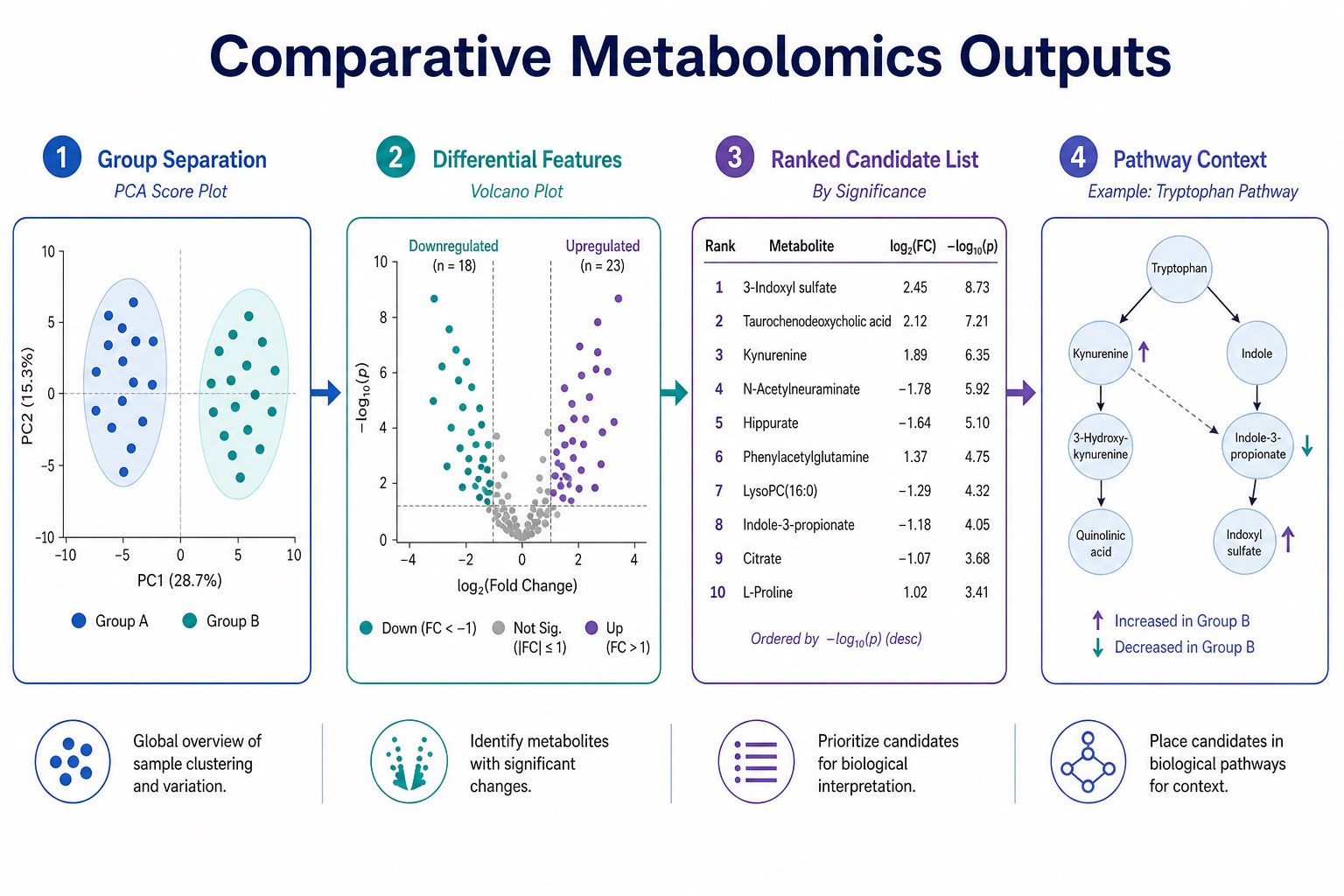
Figure 1. In comparative studies, untargeted metabolomics moves from overall group separation to differential features and a ranked candidate list.
What a Comparative Analysis Actually Shows
1. Overall Group Separation
The first question is usually whether the groups look metabolically distinct at all. Multivariate methods such as PCA and PLS-DA summarize hundreds of features into a view of how samples cluster.
Apparent group separation can indicate differences in overall metabolic profiles, but separation alone should not be treated as proof of a biological effect. Interpretation should also consider model validation, data quality, within-group variation, and complementary statistical evidence.
2. Differential Features with Direction
Beyond the overall pattern, the analysis identifies individual features that differ between groups. Each comes with a direction, up or down, and a relative magnitude such as a fold change.
This is the layer most teams care about, because it turns a broad profile into specific molecules that behave differently under the condition being studied.
3. A Ranked Shortlist for Follow-up
Discovery output is best read as a prioritized list rather than a final answer. Candidate features can be prioritized by considering the magnitude and consistency of change, statistical support, signal quality, annotation confidence, and biological relevance.
The resulting shortlist can guide which features may warrant separately reviewed follow-up.
4. Pathway-Level Interpretation
Differential features with sufficiently supported annotations may be mapped to metabolic pathways where database coverage allows. These results provide biological context and help identify patterns across related metabolites, but they do not establish pathway causality.
What the Comparison Can and Cannot Tell You
It helps to set expectations before the data comes back. The table below separates what a comparative untargeted run supports from what it does not.
|
Question |
Untargeted comparative run |
Needs additional work |
|---|---|---|
|
Do the groups differ metabolically? |
Yes, through multivariate and univariate views |
Mechanistic proof beyond association |
|
Which features change and in which direction? |
Yes, as relative differences |
Absolute concentrations |
|
Are candidate identities certain? |
No, annotations are putative |
Additional evidence may be required for stronger identification |
|
Do changes map to pathways? |
Often, where database coverage allows |
Pathway causality and flux |
|
Which candidates deserve validation? |
Yes, as a ranked shortlist |
Separately reviewed follow-up based on target coverage and project scope |
Read this as a scope guide, not a limitation list. A comparative untargeted study is meant to generate strong, testable hypotheses, and it does that well when its outputs are read at the right confidence level.
Key Design Considerations for Comparative Studies
The quality of a comparative result depends heavily on how the study is set up. A few design choices carry most of the weight.
-
Use enough biological replicates. Group differences need replication to be credible. Too few samples per group makes it hard to separate biology from noise.
-
Match handling across arms. Collection, storage, and freeze-thaw history should be as similar as possible between groups, so the contrast reflects biology rather than logistics.
-
Randomize where you can. Spreading groups across the run order avoids confounding a biological difference with an injection-order or batch effect.
-
Consider pooled QC samples where applicable. Pooled QC samples prepared from all or a representative subset of study samples are commonly used to monitor analytical consistency during untargeted metabolomics runs. Their preparation and use depend on sample availability and study design.
-
Record known confounders. Age, sex, diet, or time of collection can shape the metabolome, so capturing them helps separate the effect of interest from background variation.
None of these steps are exotic. They are simply what turns a comparative untargeted metabolomics dataset into one that reviewers and collaborators will trust.
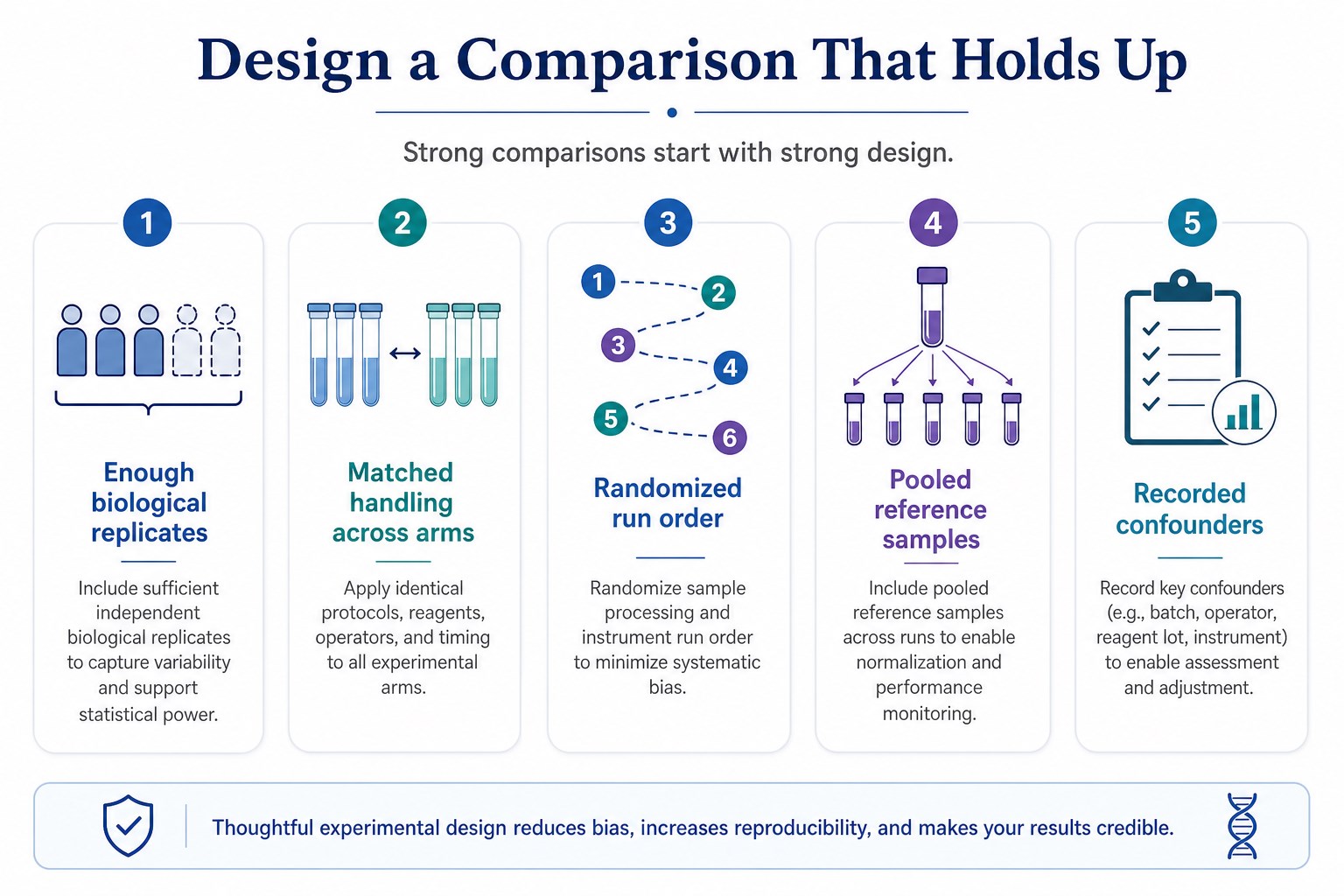
Figure 2. Reliable group comparisons depend on replication, matched handling, randomized run order, pooled QC samples, and recorded confounders.
Reading the Results Without Overstating Them
This is where interpretation most often drifts, so it is worth being explicit.
Annotation is not confirmed identity. Untargeted metabolite features may receive candidate annotations based on the available database, spectral-library, and structural evidence. The confidence of each annotation depends on the supporting evidence available for that feature.
Relative change is not absolute concentration. Comparative runs report how much a feature differs between groups, not how many nanomoles are present. Relative abundance should not be interpreted as absolute concentration. Quantitative concentration measurements require an appropriately designed and validated quantitative approach rather than being inferred from untargeted relative data.
Association is not mechanism. A metabolite that separates two groups is a candidate, not a proven driver. The comparative result points to where mechanism work should focus, rather than settling it.
Keeping these boundaries in view protects the downstream story. Describing findings as ranked, annotated candidates with a confirmation plan is both more accurate and more persuasive than presenting them as settled results.
Where Comparative Untargeted Studies Fit Best
This approach is a strong match when the biology is open-ended and the interesting molecules are not yet known.
-
Treatment versus control designs, where a drug, diet, or intervention is expected to shift the metabolome in unknown ways.
-
Disease versus healthy comparisons, where the goal is to surface candidate metabolic features associated with the biological state.
-
Genotype or phenotype contrasts, where two biological backgrounds are compared without a fixed target list.
-
Time-course or dose studies, where metabolic trajectories are compared across conditions.
In each case the shared logic holds: start broad to see what differs, rank the candidates, then prioritize selected candidates for further evaluation.
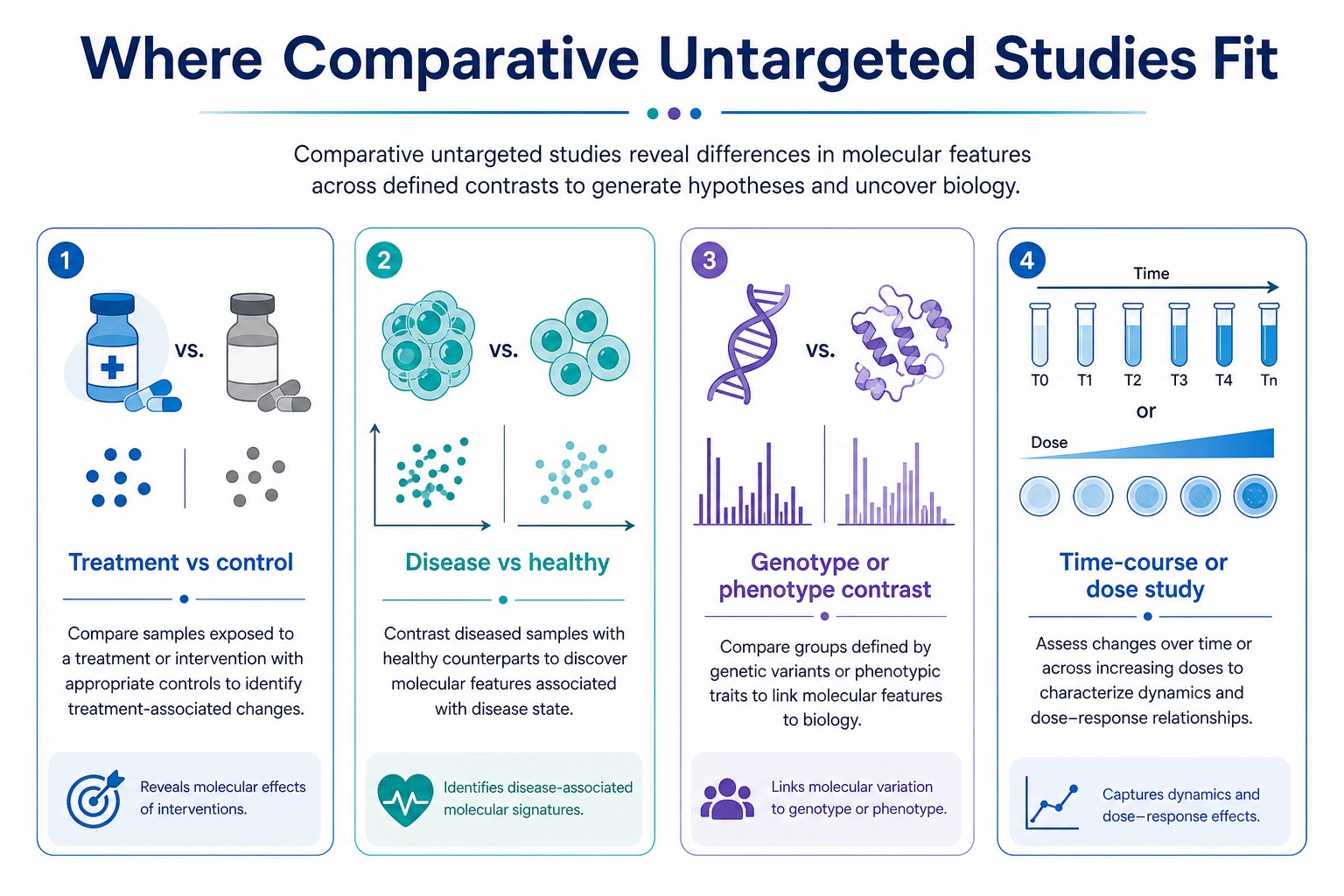
Figure 3. Comparative untargeted metabolomics fits open-ended designs where group differences, not predefined targets, drive the question.
Sample Notes for Comparative Designs
Sample planning has a direct effect on whether a comparison is interpretable.
Common inputs include serum or plasma, urine, feces, tissue, cells, and culture supernatant. Sample suitability and available amount should be reviewed against the proposed workflow before collection or submission. The values provided by MtoZ Biolabs are basic project-planning references rather than fixed minimums or recommended amounts.
Because every arm should be treated the same way, it is worth agreeing on collection and storage rules up front and applying them identically across groups. For teams unsure whether their design and samples fit a comparative workflow, MtoZ Biolabs can review the group structure and sample plan before the study begins.
Related Services
Metabolomics and Lipidomics Analysis Services
Untargeted Metabolomics Service
Targeted Metabolomics Analysis Service
Frequently Asked Questions
1. What can untargeted metabolomics reveal in comparative studies?
It reveals how the metabolic profile differs between groups, including overall group-related patterns, individual differential features with direction, a ranked candidate list, and pathway-level context where database coverage allows.
2. How is comparative metabolomics different from a single-group profile?
The value comes from the contrast between matched groups. For a comparative research question, a single-group profile cannot establish between-group differences. The comparison therefore needs to be incorporated into the study design from the start.
3. Does the comparison confirm which metabolites changed?
No. Untargeted analysis highlights candidate metabolite features and relative changes rather than automatically providing confirmed molecular identities. Candidates requiring stronger identification or quantitative follow-up should be evaluated separately according to the available evidence, target coverage, and project scope.
4. How many replicates does a group comparison need?
Enough to separate biology from noise. The exact number depends on effect size and variability, so it is best agreed during design rather than fixed by a generic rule.
5. Why are pooled QC samples used?
Pooled QC samples are commonly used in untargeted metabolomics to monitor analytical consistency and potential drift. The appropriate QC design depends on the sample type, available material, and analytical workflow.
Conclusion
In comparative studies, untargeted metabolomics turns an open question into a structured view of difference. It shows overall group-related patterns, which features change and in which direction, and which candidates may warrant further evaluation, all without a predefined target list.
The results are strongest when the comparison is designed carefully and read at the right confidence level: ranked annotations and relative changes, not final identities. Teams planning a treatment, disease, or state comparison can talk through the design with MtoZ Biolabs to align group structure, samples, and follow-up before the work begins.
How to order?




