






UV/VIS/NIR Spectroscopy Analytical Service
Ultraviolet-visible-near infrared spectroscopy (UV/VIS/NIR spectroscopy) is a technique for composition and structural analysis based on the absorption and transmission characteristics of molecules at different wavelengths of electromagnetic radiation. Its basic principle is that valence electrons in a substance undergo energy level transitions under ultraviolet, visible, and near-infrared light irradiation, generating characteristic absorption spectra, thereby revealing information such as the electronic structure, types of chemical bonds, and intermolecular interactions of the molecule. UV/VIS/NIR spectroscopy offers advantages including rapidity, sensitivity, and ease of operation, and it is widely applied in drug development, component identification, biomolecule detection, and formulation quality control.
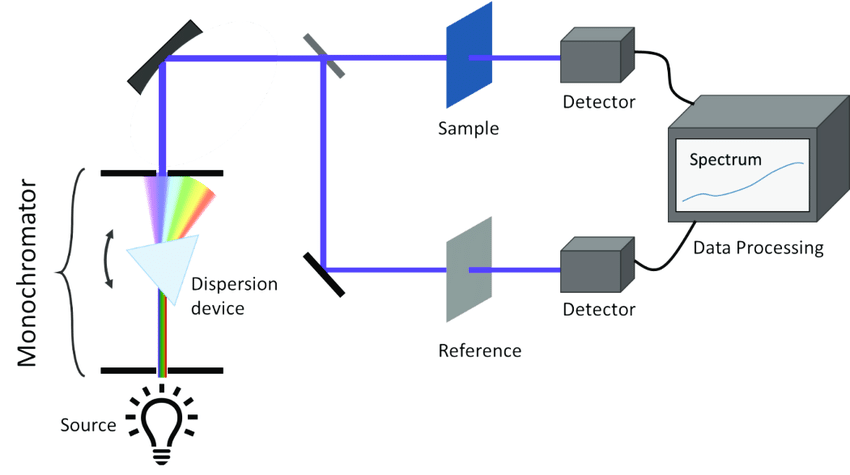
Han, S B. et al. Thermoelectric Polymer-Cellulose Composite Aerogels, 2019.
Figure 1. Schematic of UV-Vis-NIR Spectrophotometer
Services at MtoZ Biolabs
Based on an advanced UV/VIS/NIR spectroscopy platform, MtoZ Biolabs’ UV/VIS/NIR spectroscopy analytical service provides high-precision measurement of the light absorption and transmission characteristics of samples across different wavelength regions. This service can analyze the compositional features of drugs and excipients, structural variations of biomolecules, and the concentration distribution of substances in solutions. The resulting data include absorption spectra, qualitative and quantitative component information, as well as evaluations of molecular interactions and stability, providing reliable support for drug development, quality control, and biomedical research.
Analysis Workflow
1. Sample Preparation
Select the appropriate sample form (solution, film, or solid) according to the testing requirements and perform necessary pretreatment to ensure signal stability.
2. Spectral Acquisition
Record the sample’s light absorption and transmission using a high-precision spectrometer across the ultraviolet, visible, and near-infrared wavelength ranges.
3. Data Recording
Obtain complete spectral curves, including absorption intensities and characteristic peaks at different wavelengths.
4. Result Interpretation
Perform qualitative and quantitative analysis of the spectral features to extract compositional information, structural characteristics, and concentration distribution, and generate a standardized analytical report.
Sample Submission Suggestions
1. Sample Types
Applicable to various forms of samples, including solutions, powders, films, and transparent solids. Samples should be homogeneous and representative.
2. Sample Purity
It is recommended to minimize impurities or suspended particles to avoid interference with spectral signals and ensure clear and accurate absorption peaks.
3. Sample Storage
Samples should be stored under dry and light-protected conditions to prevent degradation caused by light exposure or high temperatures.
4. Sample Transportation
During transportation, use sealed containers and, if necessary, maintain low-temperature conditions to ensure the stability and integrity of the samples before reaching the analytical platform.
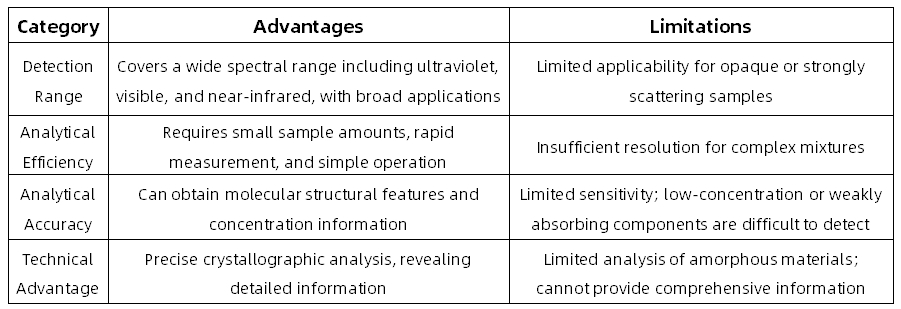
Advantages and Limitations
Applications
1. Drug Development
The UV/VIS/NIR spectroscopy analytical service can be used for the structural characterization and purity assessment of drug molecules, supporting new drug development and quality verification.
2. Formulation and Excipient Analysis
Evaluate excipient consistency and formulation stability through spectral features to ensure controllable quality during the production process.
3. Biological Sample Research
The UV/VIS/NIR spectroscopy analytical service can analyze structural changes and interactions of biomacromolecules such as proteins and nucleic acids.
4. Impurity and Degradation Product Monitoring
This service can rapidly detect degradation products or impurities in drugs and formulations, thereby enhancing drug safety and stability.
FAQs
Q1: Does the Sample Require Special Treatment?
A1: Liquid samples should be clear and free of bubbles, and filtered or diluted if necessary; solid samples can be ground into powder, uniformly pressed into pellets, or prepared as films. Different wavelength ranges may have specific sample preparation requirements.
Q2: What Is the Difference between UV/VIS and NIR Analysis?
A2: UV/VIS is mainly used to detect electronic transitions and is suitable for quantitative analysis and component identification; NIR is primarily used for vibrational energy absorption and is suitable for analyzing functional groups such as C-H, O-H, and N-H, commonly applied for qualitative or semi-quantitative analysis of materials and food.
Q3: Will the Sample Be Damaged?
A3: The measurement is generally non-destructive, but high-energy UV light or high-concentration solutions may cause photodegradation of the sample. It is recommended to assess sample stability in advance.
How to order?




