






Untargeted Metabolomics: Sample Collection, Processing, and QC
-
Wide Dynamic Range: Metabolite concentrations may span several orders of magnitude.
-
Variable Stability: Certain metabolites, such as ATP and NADH, are highly labile and prone to degradation.
-
Pronounced Matrix Effects: Complex biological matrices, including plasma and tissue samples, can significantly influence ionization efficiency.
-
Standardize sampling times (e.g., collection under fasting conditions in the morning).
-
Maintain consistent experimental conditions, such as temperature and light exposure.
-
Implement uniform housing and husbandry practices for experimental animals.
-
Tissue Samples: Immediate freezing in liquid nitrogen.
-
Cell Samples: Rapid washing with pre-chilled methanol or PBS followed by immediate freezing.
-
Polar Metabolites: Methanol/water systems (e.g., 80% methanol).
-
Lipid Metabolites: MTBE or chloroform/methanol extraction systems.
-
Biphasic Extraction: Simultaneous recovery of both polar metabolites and lipid fractions.
-
Add 3-4 volumes of cold methanol or acetonitrile.
-
Centrifuge at 4°C (typically ≥12,000 × g for 10-15 minutes).
-
Collect the supernatant for downstream analysis.
-
Dry samples using vacuum centrifugation (SpeedVac).
-
Reconstitute in LC–MS-compatible solvents (e.g., water/methanol mixtures).
-
Inject one QC sample after every 5-10 study samples.
-
Monitor signal drift and systematic variation.
-
Facilitate subsequent data correction procedures, such as LOESS normalization.
-
Randomize sample injection sequences whenever possible.
-
Process large sample cohorts in batches and include inter-batch QC samples.
-
Minimize systematic bias arising from batch effects.
-
Relative Standard Deviation (RSD): The RSD of metabolites in QC samples should generally be below 30%.
-
Principal Component Analysis (PCA): QC samples should exhibit tight clustering.
-
Number Of Detected Peaks And Metabolite Coverage: Indicators of analytical sensitivity and metabolome coverage.
With the rapid advancement of systems biology research, untargeted metabolomics has become a crucial tool for investigating dynamic changes in biological systems. Unlike targeted approaches, untargeted metabolomics aims to comprehensively capture metabolite profiles within samples, enabling biomarker discovery, metabolic pathway elucidation, and studies of disease mechanisms. However, the extensive diversity and varying physicochemical properties of metabolites mean that every step in the experimental workflow, particularly sample collection, processing, and quality control, directly impacts the reliability and reproducibility of the resulting data.
Technical Challenges And Key Control Points In Untargeted Metabolomics
The core technologies of untargeted metabolomics rely primarily on high-resolution mass spectrometry (HRMS), such as Orbitrap or Q-TOF platforms. These instruments can detect thousands of metabolites in a single run, yet they present several technical challenges:
Consequently, rigorous standardization is required throughout the entire workflow, from sample collection to data analysis, with particular emphasis on sample preparation procedures.
Sample Collection
1. Standardization Of Sampling Time And Conditions
Metabolite levels are highly sensitive to environmental and physiological factors, including circadian rhythms, dietary status, and stress responses. Therefore, experimental designs should aim to:
2. Rapid Quenching Of Metabolic Activity
Metabolic reactions continue even after cells or tissues are removed from their physiological environment. Therefore, metabolic activity must be rapidly quenched to preserve the native metabolic state:
Delays in sample processing can result in substantial alterations to metabolic profiles and represent a common source of variability in untargeted metabolomics studies.
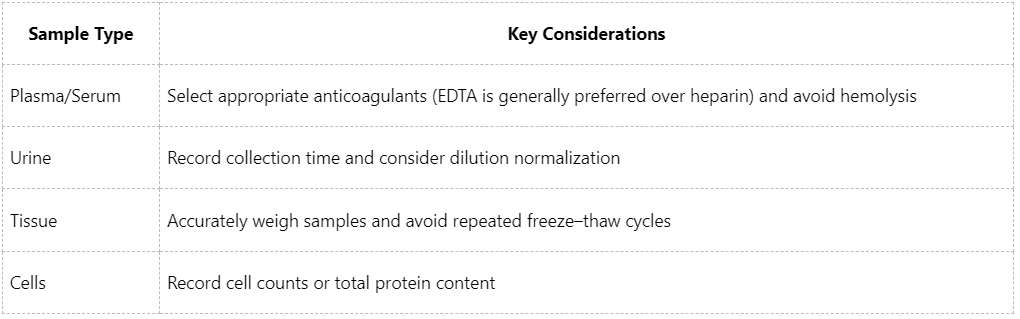
3. Considerations For Different Sample Types
Sample Processing
1. Metabolite Extraction Strategies
Untargeted metabolomics generally employs broad-spectrum extraction approaches to maximize the coverage of both polar and nonpolar metabolites:
Extraction solvents should be pre-cooled to −20°C or lower to improve metabolite stability and minimize degradation.
2. Protein Precipitation And Centrifugation
Proteins can interfere with mass spectrometric analysis and should therefore be removed through organic solvent precipitation:
3. Drying And Reconstitution
To enhance analytical sensitivity, samples are typically concentrated prior to analysis:
The reconstitution solvent should be compatible with chromatographic conditions to prevent peak distortion and compromised separation performance.
Quality Control
In untargeted metabolomics, quality control serves not only as an experimental requirement but also as a fundamental safeguard for data reliability.
1. Design And Application Of QC Samples
Quality control (QC) samples are typically prepared by pooling equal aliquots from all study samples and are used to assess instrument performance and analytical stability:
2. Use Of Internal Standards
Stable isotope-labeled internal standards can be added to correct for sample losses during processing, evaluate instrument response consistency, and improve quantitative accuracy. A panel of internal standards spanning a broad range of physicochemical properties and retention times is recommended.
3. Randomization And Batch Control
4. Data Quality Assessment Metrics
Commonly used quality assessment metrics include:
The success of untargeted metabolomics depends not only on advanced mass spectrometry platforms but also on rigorous sample preparation and quality control strategies. From standardized sample collection and optimized extraction procedures to the establishment of robust QC systems, every step directly influences the quality and reliability of the final dataset. MtoZ Biolabs leverages advanced high-resolution mass spectrometry platforms, including the Orbitrap series, together with well-established sample preparation workflows to provide comprehensive, end-to-end solutions covering sample preparation, data acquisition, and bioinformatics analysis.
MtoZ Biolabs, an integrated chromatography and mass spectrometry (MS) services provider.
Related Services
How to order?




