






Tyrosine Nitration Proteomics Analysis Service
MtoZ Biolabs provides dedicated Tyrosine Nitration Proteomics Analysis Service for systematic detection, quantification, and characterization of tyrosine nitration across the proteome. This service integrates advanced LC-MS/MS technology, antibody-based peptide enrichment, and bioinformatics interpretation to deliver precise identification of nitrated sites and protein-level changes.
Overview
Tyrosine nitration is a post-translational modification mediated by reactive nitrogen species (RNS), where a nitro group is covalently attached to the aromatic ring of tyrosine residues, forming 3-nitrotyrosine. This irreversible modification can alter protein conformation, disrupt catalytic activity, and impair protein-protein interactions.
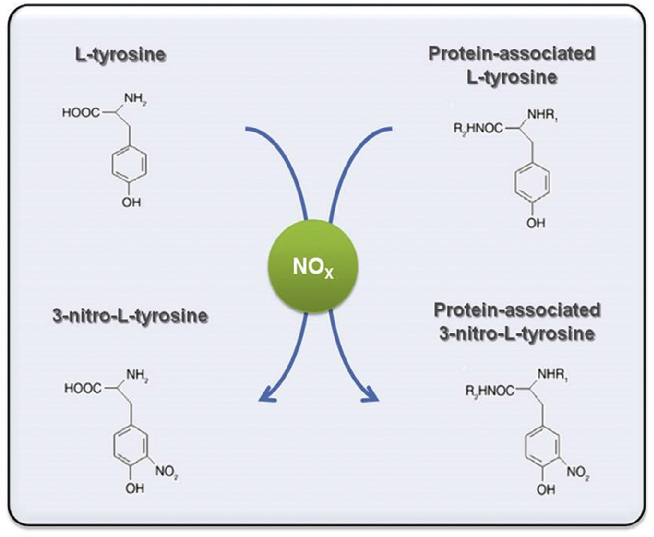
Teixeira, D. et al. Biochimie. 2016.
Figure 1. NOx-Mediated Conversion of Tyrosine to 3-Nitrotyrosine
Tyrosine Nitration Proteomics Analysis Service at MtoZ Biolabs
Based on advanced analytical platforms and comprehensive enrichment workflows, MtoZ Biolabs provides high-sensitivity identification and quantification of tyrosine nitration modifications. The service generates detailed datasets including nitrated peptide sequences, modification site localization, MS spectra, and quantitative profiles, supporting mechanistic studies in oxidative signaling and disease biology.
Our analytical approaches include:
Mass Spectrometry (MS)
High-resolution LC-MS/MS is the core analytical approach for detecting 3-nitrotyrosine modifications. It provides accurate site identification, peptide sequencing, and relative quantification. Coupling LC-MS/MS with anti-3-nitrotyrosine antibody-based enrichment enhances detection sensitivity for low-abundance peptides, enabling proteome-scale coverage.
High-Performance Liquid Chromatography (HPLC)
HPLC is used either as an independent analytical technique or as a preparatory separation step prior to MS. It resolves peptides based on modification state and supports semi-quantitative profiling of nitration patterns.
Nuclear Magnetic Resonance (NMR)
NMR spectroscopy offers structural validation of nitration in purified proteins, detecting local chemical shifts near modified residues and confirming modification positions.
Immunodetection Methods (Western Blot/ELISA)
Immunoassays employing anti-3-nitrotyrosine antibodies enable qualitative screening and target verification of nitrated proteins. These methods complement LC-MS/MS by providing rapid preliminary validation.
Through the integration of these techniques, MtoZ Biolabs delivers robust, reproducible, and comprehensive datasets suitable for both discovery-driven research and targeted validation studies.
Applications of Tyrosine Nitration Proteomics Analysis Service
· Global proteome profiling of tyrosine nitration under oxidative or nitrosative
· Identification of nitration-regulated enzymes, transporters, and receptors
· Mechanistic investigation of neurodegenerative and cardiovascular diseases
· Redox signaling network characterization in inflammation and immune response
· Evaluation of oxidative modifications in therapeutic protein stability studies
Why Choose MtoZ Biolabs?
✔ High-Throughput Nitration Profiling: Comprehensive detection of thousands of nitrated peptides in a single LC-MS/MS run, enabling large-scale assessment of nitration dynamics.
✔ Comprehensive Site Coverage: Accurate identification and quantification of 3-nitrotyrosine modifications across diverse protein classes, including enzymes, receptors, and signaling regulators.
✔ Advanced Analytical Platform: State-of-the-art LC-MS/MS systems such as Thermo Fisher Orbitrap Fusion Lumos and Q Exactive HF ensure superior mass accuracy and sensitivity.
✔ Quantitative Data Precision: Multiple quantification strategies (label-free, TMT, or SILAC) provide reproducible and comparable measurements across biological conditions.
✔ Extensive Sample Coverage: Applicable to tissues, serum, plasma, cell lysates, recombinant proteins, and microbial extracts.
Start Your Project with MtoZ Biolabs
MtoZ Biolabs combines advanced proteomics technology and extensive analytical expertise to provide accurate, reproducible, and high-throughput tyrosine nitration analysis. Contact us today to discuss your project or request a customized quotation.
FAQ
Q1: What types of samples are suitable?
Typical samples include purified proteins, cultured cells, tissues, and biological fluids such as serum, plasma, or urine. MtoZ Biolabs also supports analysis of recombinant proteins and microbial extracts.
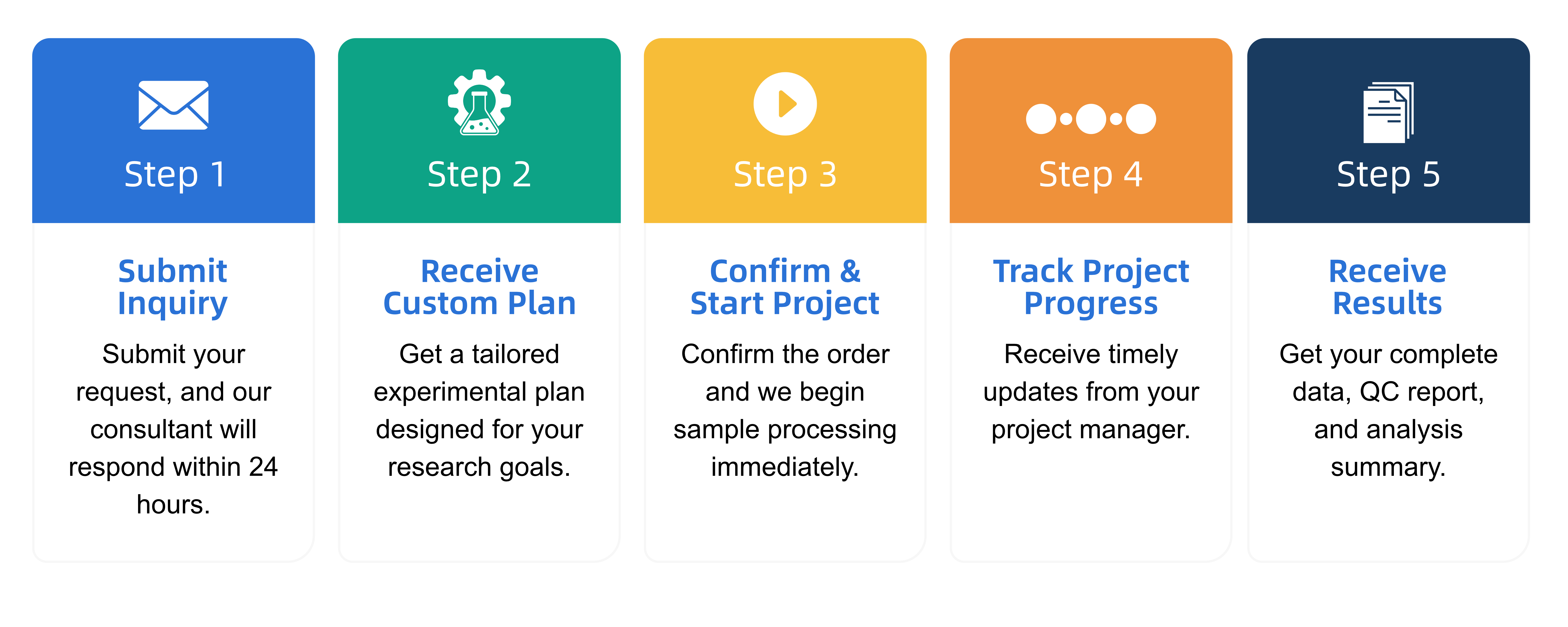
Q2: What is the service general workflow?
Q3: What data formats are provided?
● Raw LC-MS/MS data files
● Processed identification and quantification tables
● Site-specific nitration mapping results
● Pathway and structural bioinformatics reports
All data are provided in standard formats (Excel, PDF, and instrument raw files) suitable for publication and further bioinformatics analysis.
Q4: How should I prepare my samples?
● Avoid oxidizing and reducing agents before submission.
● Use neutral buffer systems free of detergents or salts.
● Snap-freeze immediately and store at −80°C.
● Include detailed background and treatment information for optimal data interpretation.
For more information, please refer to Sample Submission Guidelines for Proteomics. If you are unsure about sample preparation, our team is available for consultation and can guide you through the process to ensure optimal results.
Related Services
How to order?




