






Tutorial on Protein-Protein Interaction Network Analysis and Visualization Tools
In biological systems, proteins do not function in isolation; rather, they interact to form complex signaling, regulatory, and metabolic networks. Protein-Protein Interaction (PPI) network analysis not only facilitates the identification of key functional proteins and pathway nodes but also reveals underlying biological mechanisms, thereby promoting the discovery of disease biomarkers and therapeutic targets.
Overview of Common Protein Interaction Databases
1. STRING: A Widely Used Comprehensive PPI Database
STRING (Search Tool for the Retrieval of Interacting Genes/Proteins) is one of the most widely used protein interaction databases. It integrates multiple evidence sources, including experimental data, computational predictions, literature mining, and co-evolutionary analysis, to provide high-confidence interaction information. Its main features include:
-
Comprehensive coverage: supports over 2,000 species, including humans, mice, plants, and other model organisms.
-
Confidence scoring system: assigns a confidence score (0-1) to each protein pair based on the strength and type of supporting evidence.
-
User-friendly visualization: provides built-in interactive network visualization and functional enrichment analysis modules.
Recommendation: STRING is often used as a primary resource for interaction analysis of differentially expressed proteins identified by mass spectrometry.
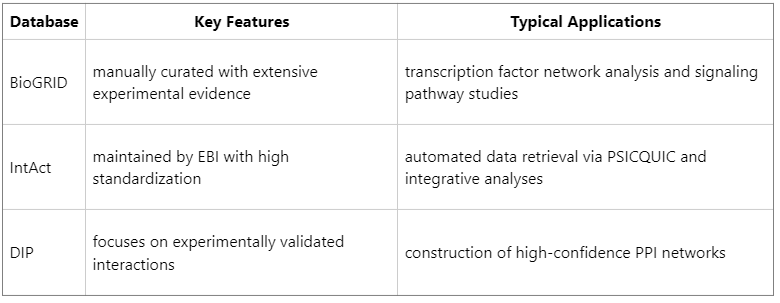
2. BioGRID, IntAct, and DIP: Experimentally Validated PPI Databases
For studies emphasizing experimentally supported interaction data, databases such as BioGRID, IntAct, and DIP provide rigorously curated datasets. These resources primarily include PPIs validated by experimental approaches such as yeast two-hybrid assays, co-immunoprecipitation, and mass spectrometry, making them suitable for mechanistic investigations.
Network Construction Tools: Cytoscape and Its Plugin Ecosystem
Following data acquisition, network construction and analysis represent critical steps in Protein-Protein Interaction studies. The Cytoscape platform is widely recommended for this purpose.
1. Introduction to Cytoscape
Cytoscape is an open-source software platform for network visualization and analysis, particularly suited for biological network modeling. Its advantages include:
-
Extensive plugin ecosystem (>300 plugins): supports network clustering, functional enrichment, and dynamic simulations.
-
Highly customizable visualization: node attributes (e.g., shape, color) and edge properties (e.g., weight) can be flexibly adjusted.
-
Multi-dimensional data integration: supports the incorporation of expression data, functional annotations, and other metadata.
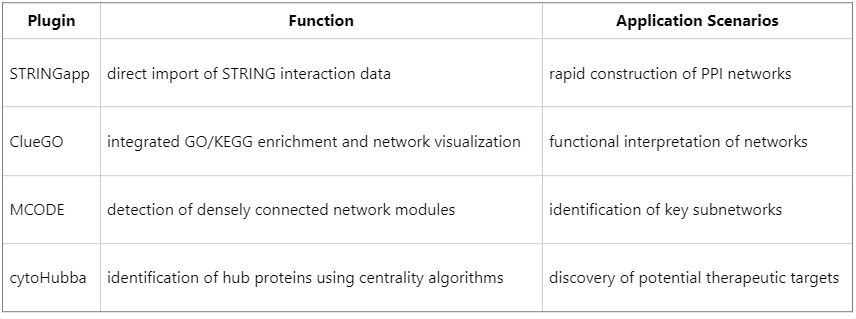
2. Recommended Plugins
Practical Workflow for Protein-Protein Interaction Network Analysis (STRING + Cytoscape)
1. Preparation of Differential Proteins
Quantitative proteomic data are obtained using mass spectrometry platforms, followed by the identification of significantly altered proteins (e.g., Log2FC > 1, p < 0.05).
2. Construction of Interaction Networks in STRING
-
Access the STRING database.
-
Input target protein names or UniProt IDs.
-
Select the appropriate species and submit the query.
-
Adjust the confidence threshold (recommended ≥ 0.7).
-
Export network data (e.g., TSV or XGMML format).
3. Network Visualization in Cytoscape
-
Launch Cytoscape and install the STRINGapp plugin.
-
Import network files or retrieve interaction data directly via STRINGapp.
-
Apply visual mapping to associate expression levels with node color and size.
-
Perform module detection and hub identification using MCODE or cytoHubba.
4. Functional Interpretation via Enrichment Analysis
-
Perform enrichment analysis using ClueGO or external tools (e.g., DAVID, Metascape).
-
Identify significantly enriched pathways (KEGG) and biological processes (GO).
-
Map enrichment results onto the network to enhance biological interpretability.
Advanced Strategies: Dynamic Networks and Multi-Omics Integration
In time-series experiments or multi-condition comparisons, static Protein-Protein Interaction networks may not fully capture dynamic biological changes. In such cases:
1. Dynamic network analysis can be performed using plugins such as dyNet.
2. Multi-omics datasets (e.g., transcriptomics and phosphoproteomics) can be integrated into Protein-Protein Interaction networks to enhance mechanistic insights.
3. Node attributes can be stratified (e.g., expression patterns, functional categories) to enrich network representation.
Common Challenges and Optimization Strategies
1. How to Handle Overly Large Protein-Protein Interaction Networks?
Core subnetworks can be extracted using confidence filtering, differential expression thresholds, and clustering algorithms such as MCODE.
2. How to Assess Interaction Reliability?
A comprehensive evaluation can be performed by integrating STRING confidence scores, experimental evidence annotations (e.g., “exp”), and supporting literature.
3. How to Identify Key Nodes?
Centrality metrics such as Degree, Betweenness, and Closeness, implemented in cytoHubba, can be used to rank node importance.
MtoZ Biolabs: Empowering High-Quality Protein-Protein Interaction Network Analysis
In proteomics research, Protein-Protein Interaction network analysis enhances data interpretation and serves as a powerful approach for uncovering biological mechanisms. MtoZ Biolabs offers an integrated workflow encompassing differential protein screening, Protein-Protein Interaction network construction, and functional enrichment analysis, enabling clients to derive reliable interaction networks from raw mass spectrometry data and identify potential biomarkers or key regulatory factors.
Our advantages include:
1. Advanced mass spectrometry platforms (e.g., Orbitrap Fusion, timsTOF).
2. Standardized Cytoscape-based analytical workflows with high-quality visualization outputs.
3. Support for SCI-level figure preparation and scientific report writing.
Protein-Protein Interaction network analysis serves as a critical bridge linking omics data to biological interpretation. By integrating reliable databases (e.g., STRING), robust visualization tools (e.g., Cytoscape), and systematic analytical strategies, researchers can uncover biologically meaningful interaction patterns from complex proteomic datasets. With the advancement of multi-omics integration and AI-assisted analysis, Protein-Protein Interaction networks are expected to play an increasingly important role in precision medicine, drug discovery, and mechanistic research. For customized protein interaction analysis solutions, MtoZ Biolabs provides comprehensive technical support.
MtoZ Biolabs, an integrated chromatography and mass spectrometry (MS) services provider.
Related Services
How to order?




