






Top 5 Phosphopeptide Enrichment Strategies Compared: IMAC, TiO₂, and More
Protein phosphorylation is one of the most prevalent post-translational modifications and plays a central role in biological processes such as signal transduction, cell cycle regulation, and apoptosis. Due to the extremely low abundance of phosphopeptides in complex proteomes (typically <1%), comprehensive coverage is difficult to achieve by direct LC-MS/MS analysis. Therefore, effective phosphopeptide enrichment prior to mass spectrometry is a critical step for elucidating phosphorylation-mediated regulatory networks.
IMAC (Immobilized Metal Affinity Chromatography)
1. Principle and Mechanism
IMAC utilizes immobilized metal ions (e.g., Fe³⁺ and Ga³⁺) to selectively capture phosphopeptides via electrostatic interactions with phosphate groups.
2. Advantages
-
High enrichment efficiency for multiphosphorylated peptides.
-
The method is well-established and compatible with diverse sample preparation workflows.
-
It is reusable and relatively cost-effective.
3. Disadvantages
-
It is prone to co-enrichment of peptides containing acidic amino acids (e.g., Asp and Glu), which reduces specificity.
-
Its selectivity for monophosphorylated peptides is relatively limited.
TiO₂ (Titanium Dioxide Chromatography)
1. Principle and Mechanism
TiO₂ exhibits strong affinity for phosphate groups and selectively enriches phosphopeptides through Lewis acid-base interactions.
2. Advantages
-
High specificity, particularly suitable for enriching low-abundance phosphopeptides.
-
Simple operation and compatibility with a wide range of buffer systems.
3. Disadvantages
-
It is susceptible to co-enrichment of negatively charged non-phosphorylated peptides (e.g., acidic peptides).
-
It preferentially enriches monophosphorylated peptides, while multiphosphorylated peptides may not be completely eluted.
ZrO₂ (Zirconium Dioxide Chromatography)
1. Principle and Mechanism
ZrO₂ functions as a Lewis acid and exhibits stronger affinity for phosphate groups, particularly under neutral pH conditions.
2. Advantages
-
It reduces the co-enrichment of acidic peptides compared with TiO₂.
-
It demonstrates superior retention of multiphosphorylated peptides relative to TiO₂.
3. Disadvantages
-
Its relatively high cost limits large-scale applications.
-
Its enrichment performance is more sensitive to buffer composition.
MOAC (Metal Oxide Affinity Chromatography)
1. Principle and Mechanism
MOAC is a broad category encompassing various metal oxide materials, including TiO₂ and ZrO₂, which achieve selective enrichment through interactions between phosphate groups and metal centers.
2. Advantages
-
Materials can be flexibly selected according to specific research objectives.
-
It is complementary to IMAC and suitable for tandem enrichment strategies.
3. Disadvantages
-
Different oxides exhibit varying sensitivities to sample types, requiring careful optimization.
-
Its performance depends on material stability and batch-to-batch consistency.
Phospho-Specific Antibody Enrichment
1. Principle and Mechanism
Phospho-specific monoclonal or polyclonal antibodies targeting specific residues or modification types (e.g., p-Tyr, p-Ser, and p-Thr) are used to capture phosphopeptides via immunoaffinity enrichment.
2. Advantages
-
It offers exceptionally high specificity and is well suited for site-specific investigations.
-
It enables site-level quantification and dynamic tracking.
3. Disadvantages
-
It is costly.
-
It cannot comprehensively cover unknown phosphorylation sites.
-
Batch-to-batch variability of antibodies may affect reproducibility.
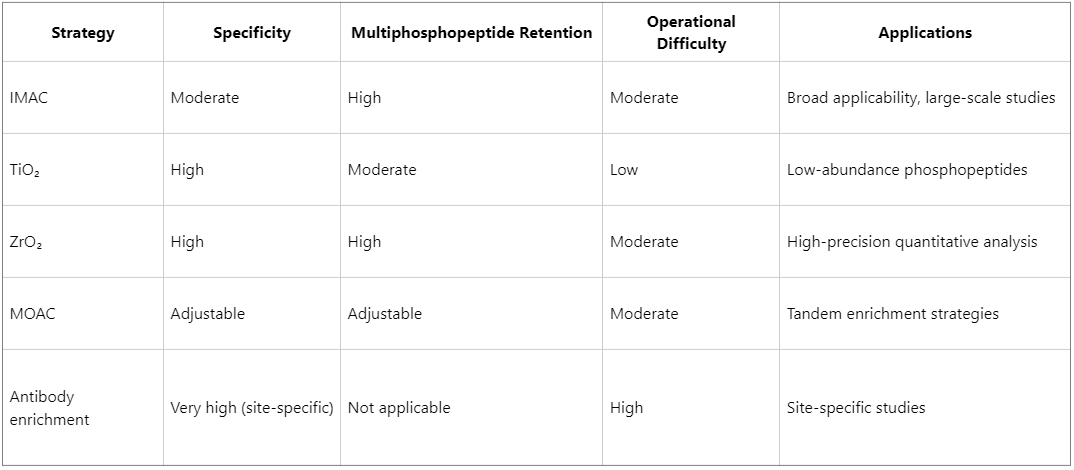
Summary Comparison Table
Advantages of MtoZ Biolabs in Phosphopeptide Research
In phosphoproteomics research, MtoZ Biolabs leverages a high-resolution Orbitrap mass spectrometry platform combined with an in-house optimized IMAC-TiO₂ tandem enrichment strategy to achieve the following:
-
Phosphopeptide coverage increased by more than 30%.
-
Identification of over 10,000 phosphorylation sites in a single analysis.
-
Accurate discrimination of Ser, Thr, and Tyr modifications with quantitative capability.
-
Support for multiple species and tissue types, including human, mouse, and plant samples.
Phosphopeptide enrichment strategies are diverse, each with distinct advantages. Researchers should select appropriate approaches based on their research objectives, sample types, and budget constraints. MtoZ Biolabs is committed to transforming advanced technologies into efficient research tools, enabling precise elucidation of phosphorylation regulatory mechanisms.
MtoZ Biolabs, an integrated chromatography and mass spectrometry (MS) services provider.
Related Services
How to order?




