






Thermogravimetric-infrared (TG-IR) Analytical Services
Thermogravimetric-infrared (TG-IR) analysis is a detection method that combines thermogravimetric analysis (TGA) with infrared spectroscopy (IR). Its basic principle is that when a sample undergoes decomposition, oxidation, or volatilization during controlled heating, thermogravimetric analysis records the mass changes in real time, while the released gases are introduced into the infrared spectrometer to obtain their characteristic absorption information, thereby enabling qualitative and semi-quantitative analysis of the decomposition products. This method not only reveals the thermal stability and decomposition mechanisms of the sample but also simultaneously acquires the characteristics of the gaseous components, enhancing the integrity of the research. TG-IR technology, by combining the advantages of thermal analysis and molecular spectroscopy, is widely applied in drug stability and the analysis of thermal decomposition products of biomaterials.
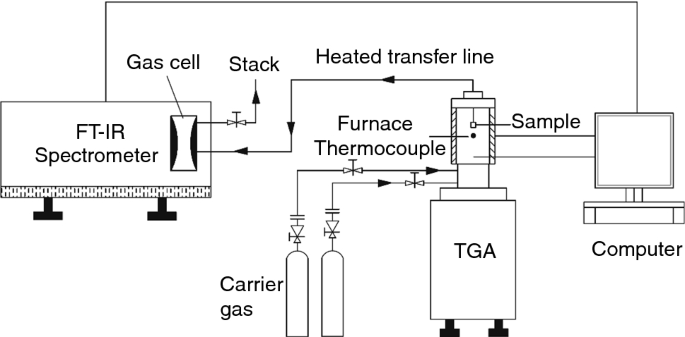
Verma, R K. et al. Journal of Thermal Analysis and Calorimetry, 2023.
Figure 1. The Instrument of TG-FTIR
Services at MtoZ Biolabs
Based on a high-performance thermogravimetric analyzer combined with an infrared spectroscopy platform, MtoZ Biolabs offers thermogravimetric-infrared (TG-IR) analytical services that can simultaneously track mass changes and gas release characteristics of samples during heating. This service is able to identify decomposition stages and their corresponding products, providing direct data support on thermal stability, decomposition behavior, and gaseous components. The results include complete thermogravimetric curves and infrared spectral data, helping researchers accurately analyze the thermal reaction characteristics and stability of samples such as drugs, excipients, and biomaterials.
Analysis Workflow
1. Sample Preparation
Weigh and pretreat the sample to ensure mass stability and avoid interference from impurities during thermal decomposition and gas detection.
2. Controlled Heating
Gradually heat the sample in the thermogravimetric analyzer, recording mass changes in real time and capturing decomposition or volatilization processes.
3. Gas Collection
Direct the gases released during thermal decomposition into the infrared spectroscopy system to ensure complete signal transmission.
4. Spectral Acquisition
Use the infrared spectrometer to record the characteristic absorption signals of the gases and obtain molecular information of each component.
5. Data Analysis
Correlate the thermogravimetric curves with the infrared spectral data to identify decomposition stages and product types.
6. Result Output
Generate complete TG-IR curves, infrared absorption spectra, and product analysis reports to provide intuitive results on thermal stability and decomposition mechanisms.
Sample Submission Suggestions
1. Sample Type
Applicable to samples such as drugs, excipients, macromolecular materials, and polymers. Samples should be representative and uniform to ensure the reliability of thermal decomposition and gas detection results.
2. Sample Purity
It is recommended to minimize impurities or moisture to avoid generating additional signals during heating, which could interfere with the analysis of mass changes and gas composition.
3. Sample Storage
Samples should be stored under dry, low-temperature, and dark conditions to prevent changes in physicochemical properties caused by moisture, oxidation, or light exposure.
4. Sample Transport
Samples should be transported in sealed containers, and if necessary, with cold-chain conditions to ensure stability and integrity before reaching the analytical platform.
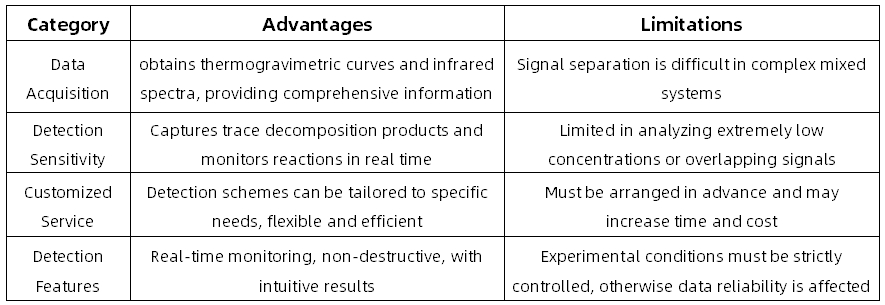
Advantages and Limitations
Applications
1. Biomaterial Thermal Stability Research
Thermogravimetric-infrared (TG-IR) analytical services can be used to evaluate the thermal decomposition behavior of biodegradable biomaterials, revealing their stability and safety of use.
2. Characterization of Tissue and Cell Samples
By detecting the products released from tissue or cell samples during heating, their compositional features and physicochemical properties can be analyzed.
3. Excipients and Carrier Performance Evaluation
Suitable for thermal decomposition and product detection of medical excipients and carrier materials, supporting their application in formulation design and performance control.
4. Environmental and Biosafety Analysis
Thermogravimetric-infrared (TG-IR) analytical services can be used to monitor gaseous components released from biomedical samples during heating, assess potential risks, and ensure the safety of experiments and applications.
FAQs
Q1: What Advantages Does TG-IR Have Compared with Thermogravimetric Analysis or Infrared Spectroscopy Alone?
A1: TG-IR combines thermogravimetric analysis with infrared spectroscopy, allowing simultaneous acquisition of mass changes and gas composition information of the sample. It is more comprehensive than a single method and can reveal the correlation between the thermal decomposition process and its products.
Q2: Can Quantitative Analysis Be Performed?
A2: TG-IR is more suitable for qualitative and semi-quantitative studies. The relative content of products can be reflected through infrared absorption intensity, but for precise quantification, it usually needs to be combined with other techniques.
Q3: What Factors May Affect the Accuracy of Detection?
A3: Uneven samples, impurity interference, moisture, or unstable control of experimental conditions can all affect the results. Therefore, strict sample preparation and storage are recommended.
How to order?




