






Technical Analysis of Labeling-Based Quantitative Phosphoproteomics
Protein phosphorylation is a critical post-translational modification (PTM) that plays essential roles in cellular signal transduction, cell cycle regulation, and metabolic homeostasis. In pathological conditions, alterations in phosphorylation sites often precede detectable changes in total protein expression levels, thereby providing important insights into disease mechanisms and potential therapeutic targets. However, phosphorylation is characterized by high dynamics, low stoichiometry, and susceptibility to interference, which collectively pose substantial challenges for quantitative analysis at the omics scale. To achieve highly sensitive, high-throughput, and reproducible quantitative profiling of the phosphoproteome, labeling-based quantification strategies have become a preferred approach in contemporary phosphoproteomics research.
What Is Labeling-Based Quantitative Phosphoproteomics?
Labeling-based quantitative methods involve the introduction of stable isotopes or chemical tags during the sample preparation stage, enabling samples derived from different experimental conditions to be analyzed simultaneously within a single mass spectrometry run and thereby achieving relative quantification. Labeling strategies commonly applied in phosphoproteomics research include:
-
TMT (Tandem Mass Tag)
-
iTRAQ (Isobaric Tags for Relative and Absolute Quantitation)
-
SILAC (Stable Isotope Labeling by Amino Acids in Cell Culture)
Analysis of Mainstream Labeling Technologies and Their Applications in Phosphoproteomics
1. TMT Labeling: A Mainstream Strategy for High-Throughput Multiplexed Analysis
(1) Technical Principle
TMT is an isobaric tagging technology that enables multiplex labeling of up to 18 samples (TMTpro 18plex). During MS/MS fragmentation, characteristic reporter ions are released, allowing relative quantification across samples.
(2) Advantages
-
Simultaneous processing of multiple samples, improving experimental throughput
-
Compatibility with enrichment strategies such as TiO₂ and IMAC, facilitating the detection of low-abundance phosphopeptides
-
Suitable for large-scale signaling pathway analyses and time-series experimental designs
(3) Challenges
-
Ratio compression may occur and often requires optimization using MS³-based acquisition strategies.
-
Relatively high cost and dependence on advanced mass spectrometry instrumentation
2. iTRAQ Labeling: A Classical and Reliable Quantitative Approach
(1) Technical Principle
iTRAQ employs isobaric tags to label peptide N-termini and lysine side chains, enabling quantitative analysis of up to eight samples within a single experiment.
(2) Advantages
-
High reproducibility, suitable for experimental designs with well-defined control groups
-
Stable performance following phosphopeptide enrichment, supporting studies with relatively large sample sizes
(3) Challenges
-
Slightly lower sensitivity compared with TMT
-
Potential reporter ion interference among tags requiring careful optimization of mass spectrometric parameters
(4) Applicable Scenarios
In clinical sample analyses or animal model studies, iTRAQ is frequently used to compare phosphorylation levels among different treatment groups.
3. SILAC Labeling: Precise Quantification at the Cellular Level
(1) Technical Principle
SILAC introduces “light” and “heavy” isotopically labeled amino acids into cell culture media, allowing intracellular proteins to incorporate these labels during biosynthesis and thereby enabling in vivo metabolic labeling-based quantification.
(2) Advantages
-
Avoids chemical labeling steps, providing high quantitative accuracy
-
Eliminates the need for tag removal procedures, resulting in a streamlined sample preparation workflow
-
Well suited for monitoring dynamic phosphorylation events
(3) Limitations
-
Restricted to culturable cell systems and therefore difficult to apply to tissue specimens or clinical samples
-
Extended labeling periods and stringent requirements for cell growth conditions
(4) Emerging Applications
SILAC is widely used to investigate rapid phosphorylation responses following activation of signaling molecules or pharmacological stimulation.
The Importance of Enrichment Strategies in Quantitative Phosphoproteomics
Phosphopeptides typically constitute less than 1% of total peptides, necessitating effective enrichment strategies to enhance detection sensitivity. Common enrichment methods include:
-
TiO₂ enrichment: High selectivity under acidic conditions with operational simplicity
-
IMAC enrichment: Utilizes immobilized metal ions (e.g., Fe³⁺) to capture phosphate groups, providing robust enrichment performance
-
MOAC (Metal Oxide Affinity Chromatography): Particularly suitable for identifying phosphorylation modifications in neutral or mildly basic peptide contexts
MtoZ Biolabs integrates a dual-round enrichment strategy (serial IMAC followed by TiO₂) within its phosphopeptide enrichment workflow, significantly increasing coverage of low-abundance phosphorylation sites and enabling comprehensive characterization of subtle dynamic changes within signaling pathways.
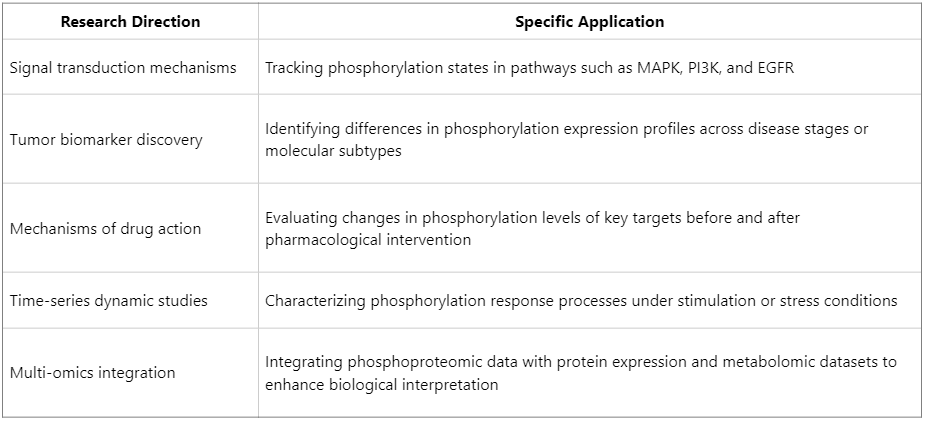
Application Scenarios of Labeling-Based Quantitative Phosphoproteomics
Phosphoproteomics Solutions at MtoZ Biolabs
In phosphoproteomics research, platform stability, analytical depth, and quantitative accuracy represent critical metrics for evaluating service quality.
MtoZ Biolabs is equipped with:
-
Advanced mass spectrometry platforms (Orbitrap Eclipse, Exploris 480, among others)
-
Extensive practical experience with TMT, iTRAQ, and SILAC workflows
-
Optimized phosphopeptide enrichment strategies combined with MS³-enhanced quantification
-
Standardized data analysis pipelines that support comprehensive bioinformatic interrogation
Labeling-based quantitative phosphoproteomics provides a powerful analytical framework for elucidating complex signaling networks and cellular regulatory mechanisms. When designing experimental strategies, appropriate labeling approaches and enrichment methods should be selected based on the biological system, sample type, and budget considerations. As a research service platform specializing in proteomics, MtoZ Biolabs is committed to delivering high-quality, reproducible, and publication-ready phosphoproteomic datasets to support continued innovation in life science research.
MtoZ Biolabs, an integrated chromatography and mass spectrometry (MS) services provider.
Related Services
How to order?




