






Targeted vs Untargeted Metabolomics Approaches
Metabolomics is a core discipline within systems biology, focusing on the comprehensive characterization of small-molecule metabolite dynamics in biological systems. With the rapid advancement of mass spectrometry technologies and computational data analysis tools, targeted metabolomics and untargeted metabolomics have emerged as two principal analytical strategies widely applied in disease mechanism studies, drug development, nutritional research, and environmental toxicology.
Targeted vs Untargeted Metabolomics: Differences in Definitions and Underlying Principles
1. Targeted Metabolomics
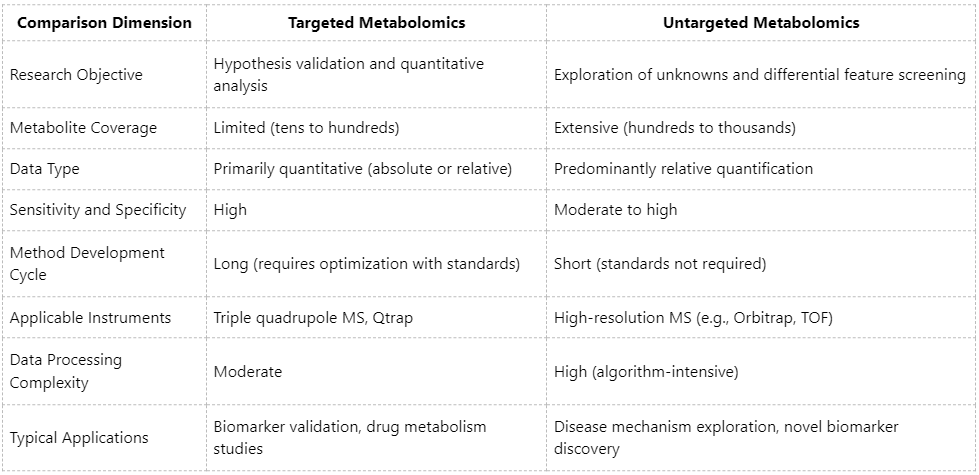
Targeted metabolomics represents a hypothesis-driven analytical approach. Prior to experimental implementation, a predefined list of metabolites of interest is established, and quantitative measurements are performed using authentic reference standards. This strategy typically employs multiple reaction monitoring (MRM) or selected reaction monitoring (SRM) acquisition modes to achieve enhanced analytical specificity and sensitivity.
Core characteristics:
-
Clearly defined analytical targets with high quantitative accuracy.
-
High analytical throughput with limited metabolite coverage.
-
Strong reliance on reference standards and accumulated prior knowledge.
2. Untargeted Metabolomics
Untargeted metabolomics is an exploration-driven strategy designed to capture, as comprehensively as possible, the full spectrum of metabolites present in a given sample, including both known and previously uncharacterized compounds. High-resolution full-scan acquisition modes, such as data-dependent acquisition (DDA) and data-independent acquisition (DIA), are commonly employed, followed by metabolite annotation through database matching or manual spectral interpretation.
Core characteristics:
-
Broad metabolite coverage, enabling the discovery of novel biomarkers.
-
High data complexity with generally lower reproducibility.
-
Substantial demands on mass spectrometric resolving power and advanced data mining algorithms.
Technical Comparison Overview: From Analytical Performance to Data Interpretation
Recommendations for Method Selection: Aligning Analytical Strategies With Research Objectives
MtoZ Biolabs Solutions: Integrated Services for Targeted and Untargeted Metabolomics
In practical metabolomics research, data quality and interpretative rigor are equally critical. Leveraging high-resolution Orbitrap mass spectrometry platforms together with a well-established MRM method development framework, MtoZ Biolabs provides integrated, end-to-end metabolomics services spanning untargeted profiling, metabolite identification, targeted validation, and comprehensive bioinformatics analysis.
Key features include:
-
A curated library comprising over 300 endogenous metabolite reference standards.
-
High-throughput MRM-based targeted assay libraries.
-
Customized metabolic pathway enrichment and integrative multi-omics analyses.
-
Flexible project design and technical support to facilitate translational research applications.
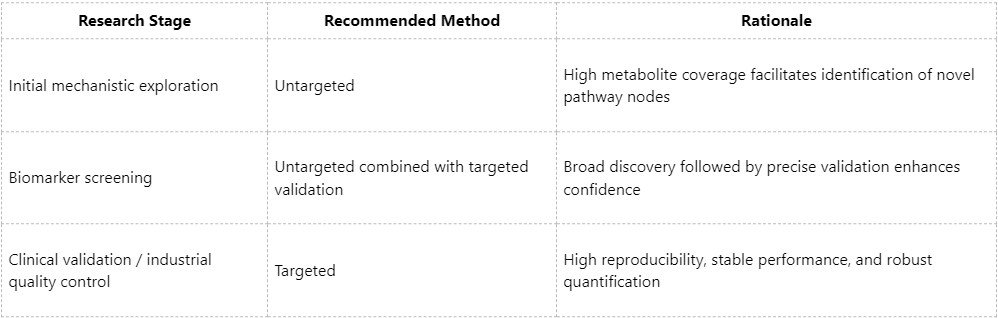
Targeted and untargeted metabolomics differ in research strategy, technical implementation, and application scope. Targeted approaches are well suited for validating clearly defined hypotheses, whereas untargeted strategies are particularly powerful for uncovering previously unrecognized metabolic features. Strategic selection and complementary integration of these methodologies are essential for maximizing research efficiency and translational impact. As precision medicine and systems biology continue to advance, the convergence of targeted and untargeted metabolomics is expected to deepen further. Supported by robust analytical platforms and experienced collaborators, the transition from metabolite discovery to functional interpretation can be substantially accelerated. Researchers seeking customized metabolomics solutions are encouraged to engage with MtoZ Biolabs to enhance research efficiency and scientific impact.
MtoZ Biolabs, an integrated chromatography and mass spectrometry (MS) services provider.
Related Services
How to order?




