






Strategic Considerations in the Design of ABPP Probes
Activity-Based Protein Profiling (ABPP) is a functional proteomics approach designed to selectively capture enzymatically active proteins within cells or tissues. Beyond offering protein expression profiles, ABPP provides insight into the actual functional state of enzymes, making it a critical tool for target identification, elucidation of drug mechanisms, and biomarker discovery. Central to the success of ABPP is the rational design of chemical probes. An effective ABPP probe must exhibit high target specificity, robust reactivity, and reliable signal detectability. Accordingly, the scientific design and strategic selection of probe components are pivotal in advancing ABPP research.
Basic Structural Components of ABPP Probes
A standard ABPP probe generally comprises three primary elements:
1. Reactive Warhead : covalently binds to the active site of the target enzyme.
2. Recognition Element (optional) : enhances structural selectivity toward specific targets.
3. Tag (e.g., fluorophores, biotin) : enables signal detection or downstream enrichment.
In many cases, a Linker is inserted between the warhead and tag to confer structural flexibility and minimize steric hindrance, thereby improving labeling efficiency.
Key Strategy 1: Selection of Reactive Warhead Based on Enzyme Class
Different classes of enzymes exhibit distinct preferences for reactive functional groups. Choosing a suitable warhead is the foundational step in probe design:
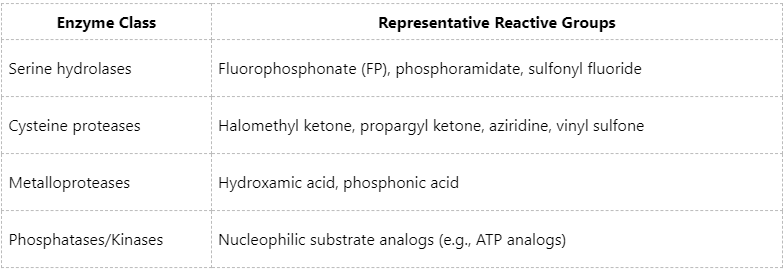
Key Strategy 2: Tag Selection Aligned with Application Requirements
The choice of tag should be tailored to the specific experimental context:
1. Fluorophores (e.g., Cy5, FITC): suitable for live-cell imaging and flow cytometry.
2. Biotin Tags: enable affinity enrichment via streptavidin and subsequent MS-based analysis.
3. Click Chemistry Handles (e.g., alkyne, azide): facilitate modular labeling via copper-catalyzed azide-alkyne cycloaddition (CuAAC).
4. Isotopic Labels (e.g., ¹⁵N): compatible with quantitative proteomics workflows, allowing ABPP-quant analysis.
Key Strategy 3: Linker Design as a Determinant of Probe Performance
Although often overlooked, the linker significantly influences probe efficacy. An optimal linker should demonstrate:
1. Chemical Stability : to resist degradation in biological environments.
2. Sufficient Flexibility : to prevent interference with enzyme binding.
3. Appropriate Length : to maintain favorable spatial conformation and minimize steric effects.
Common linker choices include polyethylene glycol (PEG) chains, alkyl linkers, and peptide linkers, which can be selected based on specific applications.
Key Strategy 4: Minimizing Non-specific Interactions via Structural Optimization
High background signals due to non-specific interactions remain a major challenge in ABPP. The following approaches are recommended:
1. Employ structural analogs as competitive inhibitors to evaluate probe specificity.
2. Include negative controls lacking the warhead to assess non-covalent binding.
3. Incorporate cleavable tag motifs to facilitate elution, purification, and precise signal identification.
MtoZ Biolabs offers ABPP services utilizing a comprehensive database of enzymatic properties and warhead reactivity profiles to deliver customized probe solutions optimized for high-efficiency and low-background target capture.
MtoZ Biolabs, an integrated chromatography and mass spectrometry (MS) services provider.
Related Services
How to order?




