






Steady-state/Transient Fluorescence Spectrometer Analytical Service
The steady-state/transient fluorescence spectrometer is an analytical instrument used to measure the fluorescence properties and dynamic behaviors of samples. Fluorescence spectroscopy is based on the energy transitions and relaxation processes of molecules under excitation light, which can reveal molecular structures and interactions. Its principle includes steady-state fluorescence, which measures the emission intensity distribution under continuous light excitation, and transient fluorescence, which records the decay kinetics after pulsed excitation to obtain information on excited-state lifetimes and energy transfer. This technique features high sensitivity, rapid response, and the capability to simultaneously analyze steady-state and transient data, and it is widely applied in monitoring protein conformational changes, analyzing nucleic acid and peptide interactions, and studying drug-target binding.
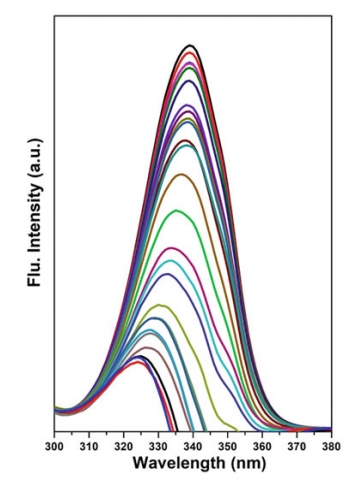
Kenoth, R. et al. Optical Spectroscopic and Microscopic Techniques, 2022.
Figure 1. Change in Fluorescence Intensity of Protein upon Ligand Binding
Services at MtoZ Biolabs
Based on advanced steady-state/transient fluorescence spectrometers, MtoZ Biolabs offers the steady-state/transient fluorescence spectrometer analytical service to analyze the structural features, molecular interactions, and excited-state dynamics of samples. Steady-state fluorescence provides information on emission intensity, emission wavelength, and quantum yield, while transient fluorescence records decay curves to obtain excited-state lifetimes and energy transfer data. The service ultimately generates complete fluorescence spectra along with qualitative and quantitative analysis results, providing reliable support for biomedical research, drug development, and molecular mechanism studies.
Analysis Workflow
1. Sample Preparation
Select liquid, solid, or film samples according to the measurement requirements and perform necessary treatments to ensure homogeneity and signal stability.
2. Steady-State Fluorescence Measurement
Record the emission intensity and wavelength of the sample under continuous light excitation to obtain fluorescence intensity and quantum yield information.
3. Transient Fluorescence Measurement
Record fluorescence decay curves under pulsed excitation to analyze excited-state lifetimes and energy transfer characteristics.
4. Data Processing
Organize steady-state and transient fluorescence data for qualitative and quantitative analysis.
5. Result Output
Generate complete fluorescence spectra and analysis reports to provide data support for studies on molecular structure, interactions, and dynamics.
Sample Submission Suggestions
1. Sample Type
Suitable for solution, film, and solid samples, which should be homogeneous and representative.
2. Sample Purity
Minimize impurities and suspended particles to avoid interference with fluorescence signals and ensure accurate measurements.
3. Sample Storage
Store samples under dark and low-temperature conditions to prevent changes in fluorescence properties caused by light exposure or high temperature.
4. Sample Transport
Transport samples in sealed containers and, if necessary, maintain low-temperature conditions to ensure stability and integrity before reaching the analytical platform.
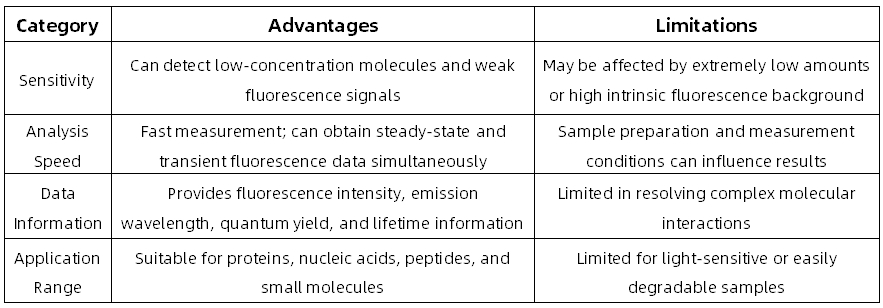
Advantages and Limitations
Applications
1. Protein Conformation Analysis
The steady-state/transient fluorescence spectrometer analytical service can be used to monitor changes in protein folding, denaturation, and aggregation states.
2. Nucleic Acid and Peptide Interaction Studies
Analyze the binding kinetics and complex formation of nucleic acid–peptide or peptide–peptide interactions through changes in fluorescence intensity, emission wavelength, and excited-state lifetimes.
3. Protein–Protein Interaction Studies
The steady-state/transient fluorescence spectrometer analytical service can be used to elucidate protein complex formation and stability, providing quantitative data for further studies.
4. Macromolecular Dynamics Analysis
Evaluate excited-state lifetimes and energy transfer processes through transient fluorescence decay curves to reveal characteristics of molecular interactions.
FAQs
Q1: What Is the Difference Between Steady-state and Transient Fluorescence?
A1: Steady-state fluorescence measures the emission intensity distribution of a sample under continuous light excitation and is suitable for analyzing fluorescence intensity, emission wavelength, and quantum yield. Transient fluorescence records the time-dependent decay of fluorescence under pulsed excitation and can be used to analyze excited-state lifetimes, energy transfer, and molecular interactions.
Q2: Can the Sample Buffer or Solvent Affect the Measurement?
A2: Yes. Some buffers or solvents have intrinsic fluorescence or absorbance that may interfere with the measurement. It is recommended to use low-background solvents and record appropriate controls.
Q3: Is Light Protection Necessary During Measurement?
A3: Yes, especially for light-sensitive samples. Avoiding strong light exposure prevents fluorescence quenching or degradation, ensuring accurate measurements.
How to order?




