






SPR vs. BLI vs. ELISA: Comparing the Advantages and Limitations of Three Antibody Assay Techniques
The investigation of antibody-antigen interactions represents a central component of life sciences, drug development, and immunodiagnostics. The selection of an appropriate analytical technique is critical for ensuring the accuracy of experimental results and the reliability of data interpretation. Surface Plasmon Resonance (SPR), Bio-Layer Interferometry (BLI), and Enzyme-Linked Immunosorbent Assay (ELISA) are currently among the most widely employed antibody detection methods. Each technique has distinct advantages and inherent limitations.
Technical Principles of Three Antibody Detection Methods
1. Surface Plasmon Resonance (SPR)
SPR is a label-free optical technique that enables real-time monitoring of intermolecular interactions. By detecting variations in electron density at the metal surface, SPR enables dynamic determination of the association rate constant (ka), dissociation rate constant (kd), and equilibrium dissociation constant (KD).
2. Bio-Layer Interferometry (BLI)
BLI is also a label-free, real-time analytical method based on optical interference principles. It quantifies molecular binding events by measuring changes in the interference pattern of light reflected from the biosensor surface. With simpler operation and lower maintenance requirements, BLI is particularly suitable for medium and high throughput screening applications.
3. Enzyme-Linked Immunosorbent Assay (ELISA)
ELISA is a well-established antibody detection method based on the specific interaction between antigens and antibodies, followed by enzyme-mediated generation of detectable signals. Although labeling is required, ELISA offers high sensitivity and specificity, making it one of the most extensively utilized techniques in both clinical diagnostics and biomedical research.
Comprehensive Comparison of Advantages and Limitations
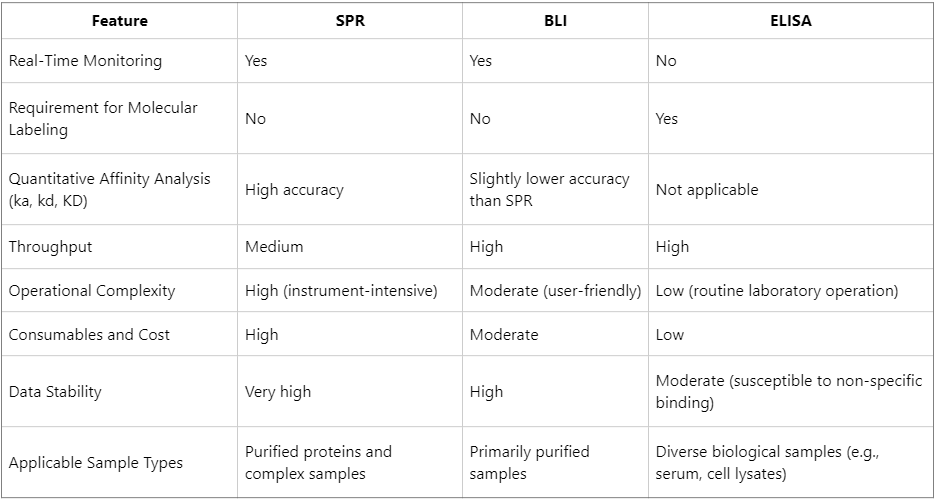
Recommended Techniques for Different Application Scenarios
1. Drug Screening and Antibody Affinity Evaluation
Recommended techniques: SPR or BLI
SPR provides highly precise kinetic parameters, making it ideal for quantitative evaluation of candidate antibody affinity. BLI serves as an efficient alternative, particularly advantageous in high-throughput screening settings and early-stage pipeline assessment.
2. Biomarker Validation and Immunological Studies
Recommended technique: ELISA
ELISA offers high sensitivity and robust reproducibility, making it well suited for large-scale sample analysis, such as serum antibody quantification and vaccine efficacy assessment. In addition, the availability of standardized commercial kits significantly lowers the technical barrier to implementation.
3. Mechanistic Studies of Protein Interactions
Recommended technique: SPR
For investigating complex kinetic interactions between proteins or between proteins and small molecules, SPR provides complete binding profiles with millisecond temporal resolution, making it an optimal choice for biophysical analyses.
Key Considerations for Technology Selection
1. Research objective: Is the focus on qualitative binding signals or precise kinetic parameters?
2. Sample conditions: Do the samples require purification, and do they contain complex backgrounds?
3. Budget and throughput requirements: Is high-throughput screening necessary, and are there cost constraints?
4. Experimental timeline and reproducibility: Are there specific requirements for turnaround time or data reproducibility?
Technical Advantages of MtoZ Biolabs
In antibody screening and protein interaction analysis services, MtoZ Biolabs integrates SPR, BLI, and ELISA platforms to establish a standardized and high-throughput workflow for data acquisition:
1. High-precision SPR analysis: Utilizing Biacore T200, supporting multiple fitting models (e.g., 1:1 and bivalent) to address complex systems.
2. Automated BLI platform: Compatible with 96/384-well formats, enabling rapid evaluation of hundreds of antibody affinities and specificities.
3. Customized ELISA development: Tailored to diverse targets, covering the entire process from antigen design to data delivery.
SPR, BLI, and ELISA each offer distinct strengths. The selection of an appropriate detection platform should be based on specific research objectives, sample characteristics, and budget considerations. As a professional provider of protein interaction analysis services, MtoZ Biolabs is committed to delivering flexible, precise, and reliable analytical solutions. For high-quality antibody affinity measurement or protein interaction studies, users are encouraged to contact MtoZ Biolabs for technical support and tailored evaluation strategies.
MtoZ Biolabs, an integrated chromatography and mass spectrometry (MS) services provider.
Related Services
How to order?




