






Single-Cell CUT&Tag Analysis Strategies and Common Challenges
Epigenetic profiling at the single-cell level has become an essential approach for investigating cellular heterogeneity and dynamic regulatory processes. Single-cell CUT&Tag (scCUT&Tag), characterized by high sensitivity and resolution, represents a state-of-the-art technique for profiling epigenetic states at single-cell resolution. However, several technical and analytical challenges remain in practical applications. This article provides an overview of experimental strategies for single-cell CUT&Tag, discusses key challenges encountered in implementation, and summarizes corresponding optimization strategies to facilitate robust single-cell chromatin profiling.
Why Choose Single-Cell CUT&Tag?
Single-cell CUT&Tag (scCUT&Tag) integrates CUT&Tag chemistry with single-cell sequencing technologies, enabling precise profiling of chromatin modifications and transcription factor binding at single-cell resolution. Its key advantages include:
- High sensitivity: enables detection of low-abundance chromatin features.
- Single-cell resolution: allows detailed characterization of cellular heterogeneity and regulatory dynamics.
- Streamlined workflow: provides a faster workflow than conventional single-cell ChIP-seq methods.
Basic Experimental Strategy for Single-Cell CUT&Tag Analysis
1. Single-Cell Isolation Strategies
A critical initial step in scCUT&Tag is efficient single-cell isolation and capture. Common strategies include:
(1) Droplet microfluidics platforms (e.g., 10x Genomics): enable high-throughput capture of thousands of single cells.
(2) Fluorescence-activated cell sorting (FACS): allows precise enrichment of defined subpopulations and is particularly suitable for rare cell populations.
(3) Micromanipulation: enables precise isolation of individual or small numbers of cells, but with limited throughput.
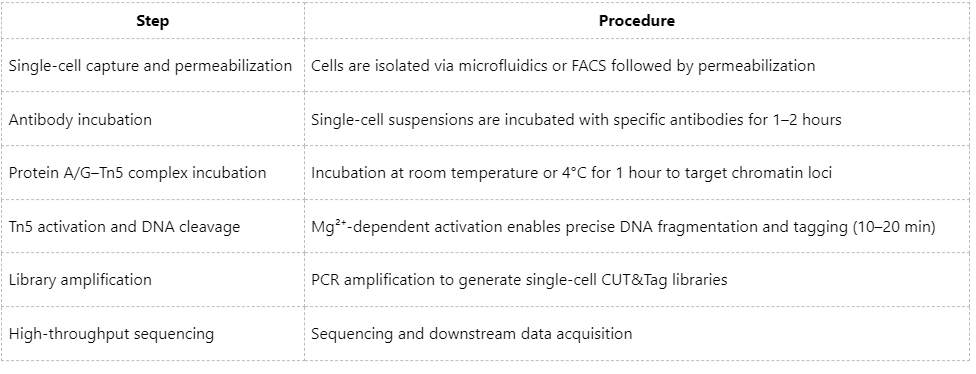
2. Experimental Workflow
Common Challenges and Corresponding Strategies in Single-Cell CUT&Tag
Despite its advantages, several technical challenges remain in scCUT&Tag workflows:
Challenge 1: Low Signal Intensity and High Background Noise
Due to limited starting material in single cells, scCUT&Tag may exhibit reduced signal-to-noise ratios.
Strategies:
(1) Use high-quality, highly specific antibodies, preferably ChIP-grade reagents.
(2) Optimize and reduce Tn5 activation time (typically 5–10 minutes) to minimize background noise.
(3) Employ optimized permeabilization buffers and reaction conditions, including validated commercial buffer systems (e.g., standardized reagents from MtoZ Biolabs).
Challenge 2: Low Single-Cell Capture Efficiency
Cell loss or damage during processing may reduce capture efficiency and limit data yield.
Strategies:
(1) Implement gentle and rapid sample processing to minimize cellular damage.
(2) Utilize high-throughput droplet microfluidics platforms (e.g., 10x Genomics) or high-precision FACS systems to improve capture efficiency.
Challenge 3: High Data Sparsity and Analytical Complexity
Intrinsic sparsity in single-cell datasets complicates signal detection and differential analysis.
Strategies:
(1) Apply dedicated single-cell epigenomic analysis tools such as SnapATAC and Signac.
(2) Increase sequencing depth and/or cell numbers to improve coverage and statistical robustness.
Challenge 4: Pronounced Batch Effects
Batch effects in single-cell experiments can significantly impact data integration and downstream interpretation.
Strategies:
(1) Include adequate quality control samples across batches to assess technical variability.
(2) Apply integration and batch correction tools such as Harmony, Seurat, or Scanpy.
Optimization Recommendations for Single-Cell CUT&Tag
To improve experimental robustness and reproducibility, the following optimizations are recommended:
- Pre-experimental optimization: systematically evaluate cell permeability, antibody specificity, and Tn5 activity.
- Reagent standardization: use validated commercial CUT&Tag kits (e.g., those provided by MtoZ Biolabs) to enhance consistency.
- Bioinformatics proficiency: utilize computational tools such as R/Python and dedicated single-cell analysis packages to strengthen data interpretation capabilities.
Applications of Single-Cell CUT&Tag
Single-cell CUT&Tag is widely applied in:
- Tumor heterogeneity analysis: characterization of chromatin variation across cancer subpopulations.
- Developmental biology: tracking chromatin state dynamics during embryogenesis and cellular differentiation.
- Immunology: profiling epigenetic differences among immune cell subsets.
- Neuroscience: investigating epigenetic landscapes of neurons and glial cells.
MtoZ Biolabs provides specialized CUT&Tag services, particularly optimized for single-cell applications. These include engineered Protein A/G–Tn5 fusion enzymes, high-specificity antibodies, and comprehensive experimental solutions. The company also offers standardized protocols and technical support, as well as high-quality reagents for single-cell capture and CUT&Tag workflows, ensuring reproducibility and experimental stability.
Although single-cell CUT&Tag represents a powerful tool in single-cell epigenomics, significant experimental and analytical challenges remain. Careful optimization of experimental procedures and selection of appropriate reagents and analytical strategies are essential for successful implementation.
MtoZ Biolabs, an integrated chromatography and mass spectrometry (MS) services provider.
Related Services
How to order?




