






Shotgun vs Targeted Mitochondrial Proteomics: How Do They Compare?
Mitochondria are the cellular powerhouses responsible for ATP production, regulation of apoptosis, and participation in metabolic signaling pathways. With advancements in mass spectrometry, mitochondrial proteomics has become a crucial tool for investigating cellular energy metabolism, neurodegenerative diseases, tumor metabolism, and drug mechanisms. In proteomics studies, researchers typically choose between two main strategies: the Shotgun (Global Proteome Scanning) Approach and the Targeted Approach.
Shotgun Approach: Comprehensive Mitochondrial Protein Profiling
1. Principle and Workflow
The Shotgun Approach, also referred to as Data Dependent Acquisition (DDA) or untargeted proteomics, aims to perform a global scan of complex protein mixtures. The typical workflow includes:
-
Protein Extraction and Digestion: Proteins isolated from mitochondria are extracted and digested into peptides using trypsin.
-
Liquid Chromatography (LC) Separation: Peptides are separated and gradually introduced into the mass spectrometer.
-
Mass Spectrometry Detection (MS/MS): The mass spectrometer first records peptide precursor ions (MS1), then selects peptides for fragmentation (MS2) based on signal intensity.
-
Database Search: Proteins are identified and quantified by matching fragment spectra to protein databases.
The major advantage of this method is its unbiased detection of a large number of proteins, including low-abundance mitochondrial proteins, components of protein complexes, and previously uncharacterized proteins.
2. Data Characteristics
-
Coverage: Broad; suitable for exploratory studies and revealing the global mitochondrial proteome.
-
Reproducibility: Moderate to low; peptide selection based on signal intensity may result in missing low-abundance proteins across experiments.
-
Quantification Variability: Label-based or label-free quantification may show fluctuations, requiring statistical correction.
3. Application Scenarios
-
Discovery of Novel Mitochondrial Proteins: For example, screening previously uncharacterized proteins associated with diseases.
-
Large-Scale Proteome Comparisons: Analysis of protein expression profiles under different experimental conditions or disease states.
-
Metabolic Pathway Exploration: Comprehensive analysis of mitochondrial energy metabolism and oxidative phosphorylation-related proteins.
Targeted Approach: Precise Monitoring of Key Proteins
1. Principle and Workflow
Targeted proteomics achieves precise quantification of specific proteins or peptides using Multiple Reaction Monitoring (MRM) or Parallel Reaction Monitoring (PRM). Its workflow involves:
-
Selection of Target Peptides: Representative peptides are chosen for specificity and reproducibility.
-
Customized Detection Method: Predefined precursor-fragment ion pairs (transitions) are set on the mass spectrometer.
-
Quantitative Analysis: Signal intensity of the peptides is monitored to achieve high-precision quantification.
This approach emphasizes purposeful detection, making it ideal for validation studies or accurate quantification of a limited number of key proteins.
2. Data Characteristics
-
High Reproducibility: Consistent quantification for the same peptides across experiments.
-
High Sensitivity: Capable of detecting low-abundance or rare proteins, particularly mitochondrial complex components.
-
Limited Throughput: Typically analyzes only tens to hundreds of target proteins per run; not suitable for global profiling.
3. Application Scenarios
-
Validation of Key Proteins: For example, members of mitochondrial respiratory complexes or apoptosis-related proteins.
-
Biomarker Studies: Quantitative analysis of disease-associated changes in mitochondrial proteins.
-
Drug Effect Assessment: Precise monitoring of drug-induced changes in mitochondrial protein expression.
Comparison Between Shotgun and Targeted Approaches
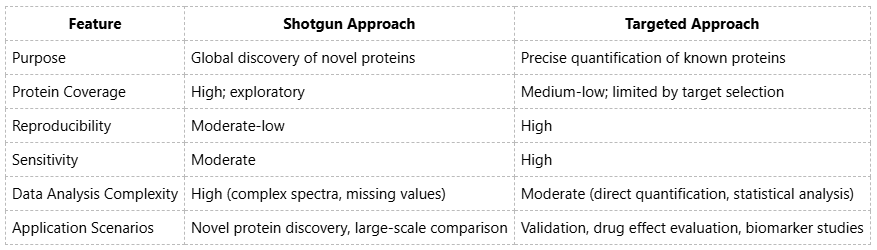
From a practical perspective, Shotgun and Targeted Approaches are often complementary. Researchers may first employ the Shotgun method for broad exploration to identify proteins of interest, followed by targeted experiments for precise validation.
Technical Integration and Future Trends
Modern mass spectrometry platforms, such as Orbitrap and Q-TOF systems, have significantly enhanced both the depth of Shotgun datasets and the sensitivity of Targeted measurements. Additionally, multidimensional separation techniques, peptide labeling strategies (e.g., TMT/iTRAQ), and machine learning algorithms further improve both the accuracy and throughput of mitochondrial proteomics.
Some advanced laboratories have implemented integrated Shotgun-PRM strategies: global protein profiles are first obtained via Shotgun, and PRM is subsequently applied to critical mitochondrial proteins, enabling a seamless transition from discovery to precise quantification. This integrated approach is highly valuable for studying disease mechanisms, validating drug targets, and analyzing metabolic networks.
In mitochondrial proteomics, Shotgun and Targeted Approaches each offer distinct advantages: Shotgun is ideal for global profiling and the discovery of low-abundance or uncharacterized proteins, whereas Targeted Approaches provide precise quantification suitable for validation studies and monitoring key proteins. Combining both strategies allows researchers to achieve both depth and breadth, providing a powerful framework for life sciences research. Service providers such as MtoZ Biolabs, using advanced mass spectrometry and optimized workflows, offer comprehensive solutions for researchers. Services range from sample preparation and Shotgun exploration to targeted validation. This enables rapid, high-quality, reproducible mitochondrial proteomics data and accelerates scientific translation.
MtoZ Biolabs, an integrated chromatography and mass spectrometry (MS) services provider.
Related Services
How to order?




