






Serum, Plasma, and CSF Proteomics Services for Diverse Research Needs
Serum, plasma, and cerebrospinal fluid are all widely used in proteomics research, but they should not be treated as interchangeable samples. Their protein composition, collection method, available volume, and sensitivity to pre-analytical variation differ substantially. A suitable workflow therefore begins with two questions: what biological comparison needs to be made, and which biofluid can provide interpretable evidence for that question?
Identification, comparative quantification, and PTM-focused analysis require different sample inputs, acquisition strategies, and evidence standards. Clarifying the intended result before analysis helps avoid choosing a technically feasible workflow that does not answer the actual research question.
Analytical Questions and Result Types
1. Defining the Primary Proteomics Objective
(1) Protein Identification and Global Profiling
Broad profiling is appropriate when the objective is to determine which proteins and peptides are detectable under a defined workflow. The resulting inventory supports sample characterization and candidate selection, but detection alone does not establish biological function, disease specificity, or causal relevance.
(2) Comparative Protein Quantification
Quantitative proteomics evaluates relative protein abundance across predefined groups, conditions, or collection points. Reliable comparison depends on biological replication, balanced design, consistent handling, and processing suited to the acquisition method. Differential abundance indicates an association within the analyzed dataset rather than a demonstrated cause.
(3) PTM-Focused and Integrated Questions
Modification-focused projects require the target PTM, enrichment need, sample input, and expected site-level evidence to be defined before analysis. Multi-omics integration should likewise begin with a shared biological question and aligned sample matching, group definitions, and statistical assumptions.
2. Distinguishing Discovery From Validation
(1) Candidate-Level Proteomics Evidence
Identification lists, abundance changes, functional annotations, and pathway enrichment results usually generate candidates. Their interpretation depends on database coverage, background selection, species support, and statistical thresholds, so they are most useful for prioritizing proteins or biological processes for further study.
(2) Requirements for Follow-Up Confirmation
Important candidates should be assessed through an independent line of evidence, such as targeted mass spectrometry, immunoassays, an independent sample cohort, or functional experiments. The follow-up route depends on whether the original result concerns detection, abundance, a modification site, or pathway association. Discovery data alone are insufficient for clinical or diagnostic claims.
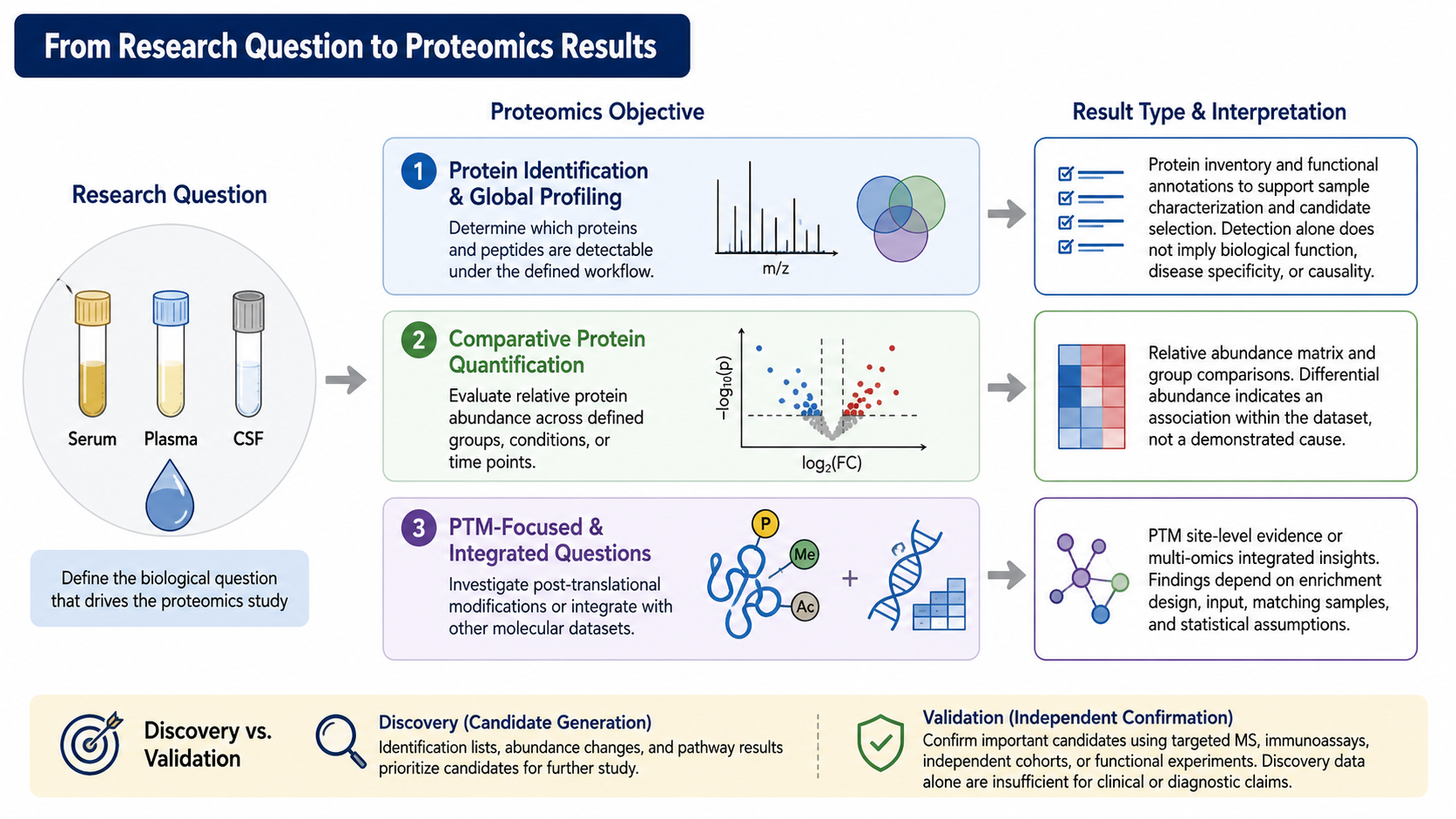
Figure 1. Proteomics objectives, expected result types, and the distinction between discovery-stage evidence and independent validation.
Selecting the Appropriate Biofluid Matrix
1. Serum and Plasma as Related but Distinct Samples
(1) Collection and Anticoagulant Effects
Serum is obtained after coagulation, whereas plasma is collected with an anticoagulant. Coagulation alters the measurable protein environment, while plasma retains clotting-related components and introduces anticoagulant-dependent variation. Anticoagulant type should be documented and kept consistent across comparison groups. EDTA or citrate is generally preferred for plasma proteomics, whereas heparin is not recommended because it may interfere with downstream sample preparation and LC-MS/MS analysis.
(2) Protein Dynamic Range and High-Abundance Components
A small number of highly abundant proteins account for much of the protein mass in serum and plasma, which can reduce observation of lower-abundance components. Depletion may improve access to some signals, but it adds processing, requires more input, and may co-remove proteins associated with depleted carriers. It should be selected according to the research objective rather than used automatically.
2. CSF as a Limited-Input Biofluid
(1) Available Volume and Protein Abundance
CSF often has lower total protein concentration and more limited available volume than serum or plasma. The planned depth, number of replicates, enrichment needs, and downstream comparisons should therefore be matched to the available input. Limited volume does not automatically exclude analysis, but it narrows the feasible preparation options.
(2) Collection Consistency and Contamination Risk
Blood contamination can markedly alter the apparent CSF protein profile because blood-derived proteins may mask or distort signals from the central nervous system environment. Collection tube, clarification, storage, and freeze-thaw history should be documented, especially when samples come from multiple sites or time periods.
Matching the Workflow to the Study Design
1. Selecting an Identification or Quantification Strategy
(1) Broad Profiling Versus Defined Group Comparison
A broad identification project prioritizes detectable protein diversity, whereas a quantitative project prioritizes consistent measurement across samples. A route optimized for maximum identifications may use more extensive fractionation or acquisition, while comparative studies place greater emphasis on reproducibility, batch control, sample order, and consistent processing.
(2) Label-Free, DIA, and Multiplexed Designs
Label-free quantification offers flexibility for changing sample numbers but requires careful batch management. Data-independent acquisition is often selected when consistent quantitative coverage across a cohort is important. Multiplexed labeling reduces some run-to-run variation but introduces channel design, reference selection, and batch-bridging decisions. Sample number, group structure, missing-data tolerance, and expansion plans should guide the choice.
2. Aligning Acquisition and Data Processing
(1) LC-MS/MS Platform Selection
No single mass spectrometry platform is optimal for every biofluid project. Selection should reflect sample complexity, input, chromatographic strategy, throughput, ion-mobility needs, and whether identification depth or reproducible quantification is the priority. Instrument model alone does not determine data quality.
(2) DDA and DIA Data Processing
Data-dependent acquisition selects precursor ions for fragmentation according to signal intensity and acquisition rules, while data-independent acquisition fragments broader precursor windows systematically. Their data structures require different processing logic. Database composition, false-discovery-rate control, normalization, missing-value handling, and protein summarization should remain consistent with the chosen mode.
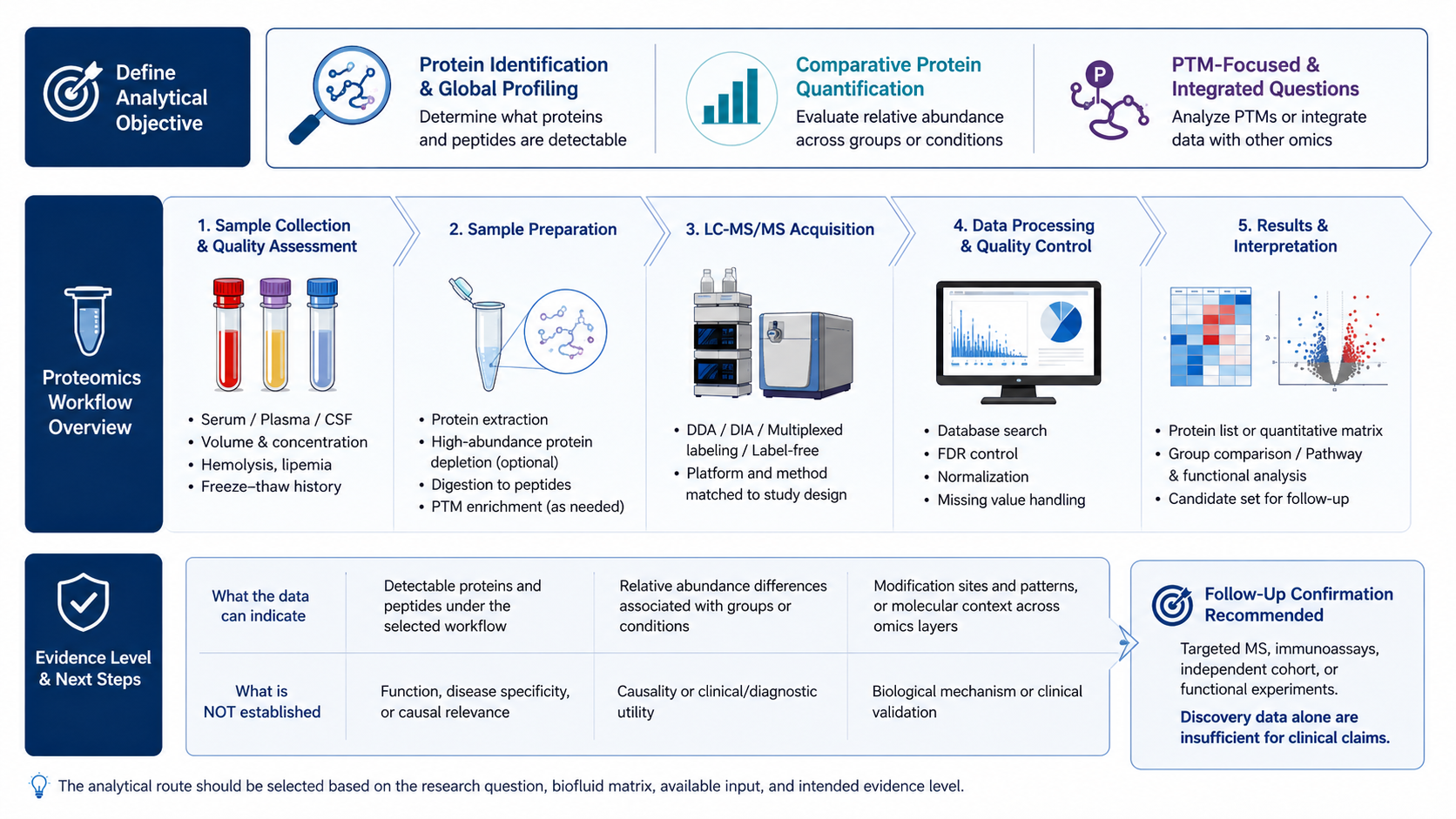
Figure 2. A project-oriented workflow for serum, plasma, and CSF proteomics, linking sample assessment, preparation, LC-MS/MS acquisition, data processing, and evidence-based interpretation.
Evaluating Project Feasibility Before Submission
1. Reviewing Sample Input and Quality
(1) Available Volume and Preparation Requirements
Sample volume should be assessed together with the preparation route. Routine profiling, high-abundance protein depletion, PTM enrichment, fractionation, and technical replication have different input requirements. Feasibility also depends on sample count, concentration variability, container dead volume, and whether material must be retained for repeat preparation.
(2) Hemolysis, Lipemia, and Freeze-Thaw History
Hemolysis introduces intracellular proteins, while lipemia may interfere with extraction, chromatography, and ionization. Visible contamination, precipitates, prolonged handling, and repeated freeze-thaw cycles create additional variability or degradation. These conditions should be documented before comparative analysis and considered during quality review.
2. Preparing Information for Technical Review
(1) Sample Metadata and Group Design
A project summary should include sample type, species, sample count, available volume, group assignment, collection time point, processing batch, storage conditions, and freeze-thaw history. Plasma projects should identify the anticoagulant. Metadata should also show whether biological groups are balanced across collection and preparation batches.
(2) Expected Results and Interpretation Needs
Expected outputs should be defined with the analytical route. A broad protein list, relative quantitative matrix, group comparison, modification-site result, functional annotation, and candidate set for targeted follow-up require different priorities. Clear expectations keep discovery-stage evidence separate from validated biomarkers or confirmed mechanisms.
The suitability of a serum, plasma, or CSF proteomics project depends on the research objective, biofluid matrix, available input, sample quality, group design, and intended evidence level. MtoZ Biolabs supports project-specific serum, plasma, and CSF proteomics planning and LC-MS/MS analysis, with the analytical route defined according to sample type, available volume, group design, and intended output. Submit your inquiry below for project evaluation.
MtoZ Biolabs, an integrated chromatography and mass spectrometry (MS) services provider.
Related Services
How to order?




