






Quantitative Phosphoproteomics with TMT Labeling
Protein phosphorylation represents one of the most prevalent and functionally important post-translational modifications (PTMs) in eukaryotic cells. It regulates essential biological processes, including cell proliferation, apoptosis, metabolism, and stress responses, and is intimately associated with major human diseases such as cancer, autoimmune disorders, and neurodegenerative diseases. However, phosphorylation events are characterized by dynamic turnover, low abundance, and susceptibility to ion interference during detection, which collectively impose substantial challenges on systematic profiling and quantitative analysis. To decipher signaling networks at the molecular level, analytical strategies that simultaneously enable high sensitivity, high accuracy, and high throughput are required. Tandem Mass Tag (TMT) labeling combined with high-resolution mass spectrometry has emerged as a widely adopted strategy in phosphoproteomics research.
What Is TMT Labeling Technology?
TMT is an isobaric chemical labeling reagent that covalently modifies peptide N-termini and lysine residues following proteolytic digestion. Each TMT reagent consists of a reporter ion, a balance group, and a reactive group. Although all tags share identical overall mass, MS/MS fragmentation releases reporter ions of distinct masses, enabling relative quantification of multiple samples within a single mass spectrometric run. Current TMT kits support up to 16-plex or even 18-plex formats, which markedly increase sample throughput and reduce technical variability.
Core Workflow for TMT-Based Phosphoprotein Quantification
To achieve high coverage and sensitive phosphoprotein quantification, the workflow typically includes:
1. Sample Preparation and Protein Extraction
Cells, tissues, or biological fluids are used as starting materials, and total proteins are extracted using lysis buffers with removal of nucleic acids and polysaccharides. Equalization of total protein input across samples is essential for reliable quantification.
2. Trypsin Digestion and TMT Labeling
Proteins are reduced, alkylated, and digested with trypsin. Different experimental groups are individually labeled with TMT reagents and subsequently pooled for unified downstream enrichment.
3. Phosphopeptide Enrichment (IMAC or TiO₂)
Phosphopeptides typically constitute less than 5% of total peptides and are enriched using selective methods such as immobilized metal affinity chromatography (IMAC) or titanium dioxide (TiO₂) microcolumns.
4. High-pH Fractionation and LC-MS/MS Analysis
High-pH reversed-phase fractionation prior to LC-MS improves proteome coverage and increases phosphorylation site identification. High-resolution mass spectrometers (e.g., Orbitrap Exploris, Fusion Lumos) are commonly operated in data-dependent acquisition (DDA) mode.
5. Data Processing and Functional Annotation
Database searching, peptide quantification, and site localization are performed using software such as Proteome Discoverer. Subsequent bioinformatic analyses, including GO/KEGG enrichment and PPI network construction, facilitate investigation of regulatory mechanisms.
Advantages of TMT-Based Phosphoprotein Quantification
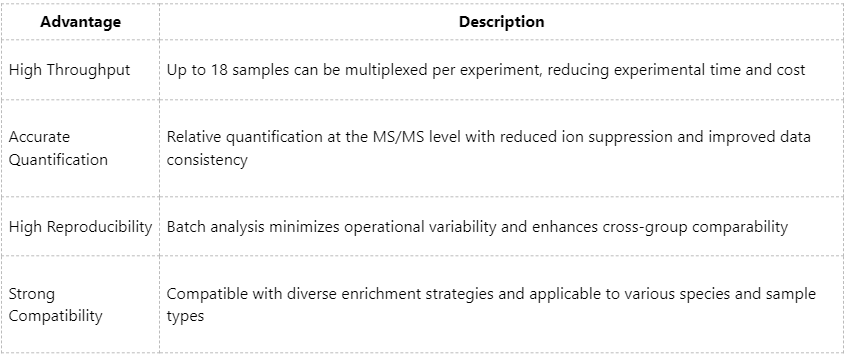
MtoZ Biolabs: Integrated TMT Phosphoproteomics Service Platform
MtoZ Biolabs has established a robust TMT phosphoproteomics workflow on high-resolution Orbitrap platforms, characterized by high sensitivity and high reproducibility. Service features include:
-
Professional phosphopeptide enrichment (IMAC/TiO₂/Ti-IMAC).
-
Up to 18-plex multiplexing for large cohort studies.
-
Comprehensive quality control and bioinformatics support from raw data to biological interpretation.
-
Extensive application experience across oncology, immunology, metabolism, stem cell biology, and other fields.
TMT-based quantitative phosphoproteomics is providing unprecedented analytical throughput and precision for elucidating protein signaling networks. With ongoing advances in mass spectrometry instrumentation and phosphopeptide enrichment strategies, this approach is expected to play an increasingly central role in mechanistic studies of human disease, the identification of novel therapeutic targets, and the development of personalized treatment strategies. For research projects requiring phosphoproteomic analysis, MtoZ Biolabs offers comprehensive technical support, including experimental design consultation and project evaluation.
MtoZ Biolabs, an integrated chromatography and mass spectrometry (MS) services provider.
Related Services
How to order?




