






Pyrolysis Gas Chromatography Mass Spectrometry (Py-GCMS) Analytical Service
- No Complex Pretreatment: Suitable for most solid, powder, and liquid samples, including insoluble and complex systems, usually without additional pretreatment.
- High-Temperature Pyrolysis Capability: Pyrolysis temperatures up to 1000℃ allow comprehensive simulation of the degradation behavior of polymers, coatings, additives, and other materials under extreme conditions.
- Wide Applicability: Effectively analyzes organic components in polymer materials, composites, biomass, as well as environmental or pharmaceutical systems.
- Rich Information Acquisition: By combining the efficient separation of GC with the high sensitivity of MS, the service provides not only qualitative results but also product distribution, structural characteristics, and relative content.
- Application examples of Pyrolysis Gas Chromatography Mass Spectrometry (Py-GCMS) Analytical Service are as follows:
- Polymers and Materials Science: Used for analyzing the thermal degradation products of polymers, coatings, and additives to reveal their monomer composition, structural characteristics, and stability.
- Environmental Science: Detects organic pollutants and degradation byproducts in complex environmental samples, such as plastic residues and recalcitrant organics in soil or water, to support pollution tracing and risk assessment.
- Biomass and Energy Research: Analyzes the pyrolysis products of lignin, cellulose, and other biomass to explore their conversion mechanisms and fuel utilization potential.
- Pharmaceuticals and Life Sciences: Applied to study the stability of pharmaceutical excipients or formulations under high-temperature conditions and to identify potential impurities and degradation products.
Pyrolysis Gas Chromatography Mass Spectrometry (Py-GCMS) Analytical Service is an analytical service that uses a high-temperature pyrolysis unit to break down complex or otherwise difficult-to-analyze samples into smaller molecular fragments, which are then separated and identified through gas chromatography and mass spectrometry. This method can rapidly and effectively reveal the chemical composition and structural characteristics of polymer materials, biomass, organic pollutants, and pharmaceutical impurities, often without requiring additional sample pretreatment. With the growing research on novel polymers, biodegradable materials, and environmental samples, Py-GCMS has become a key tool for studying material thermal stability, degradation mechanisms, and component analysis of complex systems, and it has broad application value in materials science, environmental monitoring, and pharmaceutical quality control.
Technical Principles
The principle of Py-GCMS is to rapidly heat the sample to high temperatures in an oxygen-free or inert atmosphere, causing macromolecular materials to undergo pyrolysis reactions and break down into representative volatile and semi-volatile small molecular fragments. These fragments are immediately carried by a carrier gas into the gas chromatography system, where they are separated based on polarity and boiling point differences. Subsequently, each component enters the mass spectrometer, where molecular ions and characteristic fragment ion signals are used for molecular weight determination and structural analysis. By analyzing the chromatograms of the pyrolysis products, it is possible to infer the chemical composition of the sample, the structural features of polymers, and potential degradation pathways, thereby enabling rapid and comprehensive characterization of complex polymers and organic substances.
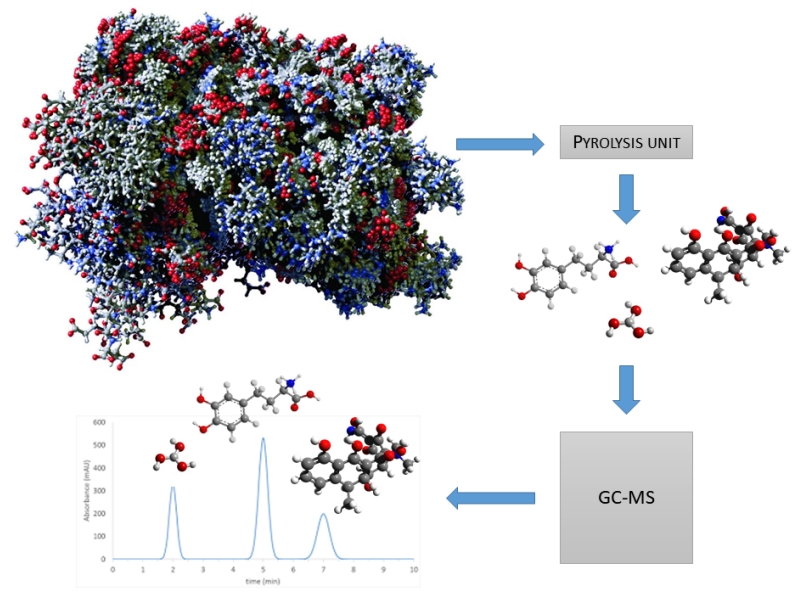
Picó Y. et al. TrAC Trends Anal Chem. 2020.
Figure 1. Fundamentals of Py-GC-MS
Analysis Workflow
The general process of Pyrolysis Gas Chromatography Mass Spectrometry (Py-GCMS) Analytical Service is as follows:
1. Sample Preparation
Weigh an appropriate amount of sample, usually without complex pretreatment. For special samples, drying or simple pretreatment may be performed as needed to remove interferences.
2. Pyrolysis
Place the sample in the pyrolysis unit and rapidly heat it to the set temperature under an inert gas atmosphere such as helium or argon to generate gaseous or semi-volatile small molecular products.
3. GC Separation
The pyrolysis products are immediately introduced into the gas chromatography system, where they are efficiently separated in a capillary column.
4. MS Detection
The separated components enter the mass spectrometer for molecular weight and fragment ion determination, followed by comparison with databases.
5. Data Processing and Interpretation
A complete chromatogram–mass spectrum is generated, with peak identification, relative content analysis, and interpretation of characteristic fragments used to infer sample composition and structural information.
6. Report Generation
A complete report is provided, including experimental conditions, raw spectra, and detailed result analysis.
Services at MtoZ Biolabs
MtoZ Biolabs provides Pyrolysis Gas Chromatography Mass Spectrometry (Py-GCMS) Analytical Service that enables rapid pyrolysis of samples under inert atmosphere and high-temperature conditions, followed by separation and identification of their thermal degradation products. We offer compositional and structural analysis of polymer materials, coatings, additives, and other samples to help clients gain deeper insight into the chemical composition, stability, and potential degradation mechanisms of materials, thereby providing data support for new material development, performance optimization, and quality control.
Service Advantages
Sample Submission Suggestions
MtoZ Biolabs accepts a wide range of samples, including polymer materials, coatings, and additives. It is recommended to contact our technical support team before submission to assess sample suitability and obtain tailored submission guidance.
Applications
How to order?




