






Pyridine Infrared Spectroscopy Analytical Service
Pyridine infrared spectroscopy is an analytical method that uses pyridine molecules as probes to study the types and strengths of acidic sites on material surfaces through their characteristic absorption peaks in the infrared spectrum. The basic principle is that pyridine molecules can interact with Lewis acid sites or Bronsted acid sites on the material surface, producing characteristic absorption signals in the infrared region, thereby enabling qualitative and semi-quantitative analysis of acidity. Due to its high sensitivity and strong specificity, this technique is widely applied in the characterization of acidic sites on the surfaces of drug carriers, functional materials, and biomedical catalysts, helping to elucidate molecular interaction mechanisms and evaluate formulation performance.

Maronna, M. et al. Physical Chemistry Chemical Physics, 2016.
Figure 1. The FT-IR Spectra of Pyridine Adsorption of Different Materials under Constant Pyridine Saturated Nitrogen Flow Followed by Increasing Cell Temperature
Services at MtoZ Biolabs
Based on an advanced infrared spectroscopy platform, MtoZ Biolabs has launched a pyridine infrared spectroscopy analytical service to accurately distinguish different types of acidic centers and to provide in-depth analysis of their distribution characteristics. This service is applicable to drug delivery systems, functional materials, and catalysis research, offering key data support for the surface chemical properties of complex samples. The results include complete spectral curves and quantitative analysis parameters, helping researchers systematically evaluate the activity performance of materials and their potential applications in biomedicine.
Analysis Workflow
1. Sample Preparation
Perform necessary treatments on the sample, such as drying and fixing, to ensure surface stability and facilitate the binding and detection of pyridine molecules.
2. Pyridine Adsorption
Introduce pyridine to the sample surface, allowing it to specifically interact with Brønsted acid sites or Lewis acid sites.
3. Desorption Treatment
Remove weakly bound pyridine molecules through heating or inert gas purging. Differences in binding strength at acid sites lead to different desorption temperatures, thereby reflecting acidity strength.
4. Spectral Acquisition
Use a high-resolution infrared spectrometer to collect characteristic infrared signals before and after pyridine adsorption and desorption, focusing on pyridine-related absorption peaks.
5. Data Analysis
Process spectral data with baseline correction and peak identification, distinguish Brønsted and Lewis acid characteristic peaks, and perform semi-quantitative or quantitative evaluation based on peak intensity changes.
6. Result Output
Generate complete infrared spectral curves and analysis reports, providing the types, quantities, and strength distribution of acidic sites to support scientific and applied research.
Sample Submission Suggestions
1. Sample Type
Suitable for powders, catalyst particles, films, and functional materials. The sample surface should be uniform and free from obvious cracks or contamination to facilitate the adsorption and detection of pyridine molecules.
2. Sample Purity
It is recommended to remove impurities and moisture to avoid interference from foreign components or adsorbed water that may affect the spectral analysis of acidic sites.
3. Sample Storage
Samples should be stored under dry, dark, and low-temperature conditions to prevent moisture absorption, oxidation, or structural changes that may distort surface active sites.
4. Sample Transport
Samples should be transported in sealed containers. If necessary, desiccants or cold-chain conditions should be used to ensure stability and integrity before reaching the analytical platform.
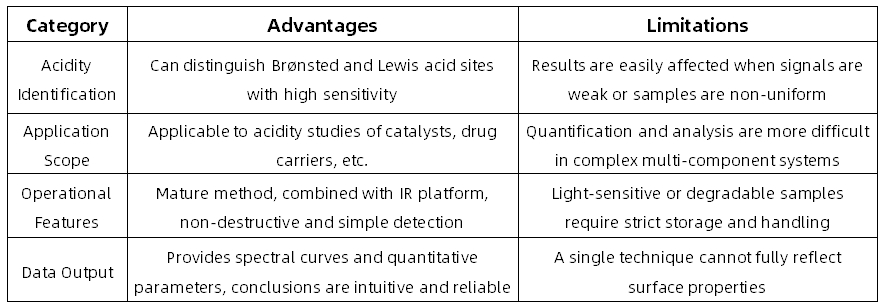
Advantages and Limitations
Applications
1. Catalyst Characterization
The pyridine infrared spectroscopy analytical service can be used to identify Brønsted and Lewis acid sites on catalyst surfaces and to evaluate their acidity types and strengths.
2. Drug Carrier Research
Helps analyze the acidic characteristics of material surfaces in drug delivery systems and optimize drug binding and release performance.
3. Functional Material Development
Pyridine infrared spectroscopy analytical service can be applied to analyze the surface active sites of functional materials, supporting the design of new materials and improvement of their performance.
4. Biomedical Catalysts
Suitable for evaluating the surface acidity of biomedical-related catalysts and promoting their applications in drug synthesis and reactions.
FAQs
Q1: Will the Detection Cause Damage to the Sample?
A1: This method is generally considered non-destructive; however, the desorption stage may involve heating, which could affect some heat-sensitive or easily degradable materials. Therefore, it is recommended to evaluate sample stability in advance.
Q2: What Factors May Affect the Accuracy of the Results?
A2: Uneven sample thickness, excessive surface roughness, high impurity content, or background interference can all affect spectral interpretation. Thus, strict sample preparation and appropriate storage conditions are essential to ensure the reliability.
How to order?




