






Planning a PhIP-Seq Project: Sample Requirements, Controls, Library Choice, and Deliverables
Before ordering PhIP-Seq, a study team should settle five decisions: the input matrix and handling rules, the cohort and control structure, the scope of the phage-displayed peptide library, the sequencing depth plan, and the reporting outputs needed for hit calling and follow-up validation. If any of those stay vague, the project can come back with a long hit list but not enough context to sort true antibody reactivity from background binding or design noise.
The best planning usually starts with the biological question and then moves into sample eligibility, control layers, library complexity, analysis expectations, and validation handoff. PhIP-Seq works best when the team treats it as peptide-level antibody repertoire profiling through immunoprecipitation and sequencing-based peptide enrichment, not as a stand-alone diagnostic test or a replacement for downstream confirmation.
Why PhIP-Seq Projects Fail at the Planning Stage
Most PhIP-Seq problems start before sequencing. Teams may have archived serum or plasma and a reasonable disease hypothesis, yet still miss the details that make peptide-level signal readable. Common warning signs are mixed matrix types in one comparison, no mock IP or blank control, a proteome-wide screen tied to a very small pilot budget, or a request for “full analysis” without a defined output list.
Those gaps show up directly in the data. Weak controls make background harder to separate from peptide enrichment. A poorly matched library can miss the antigen space that matters. Sequencing that is too shallow for the chosen library complexity can leave lower-abundance binders with thin read support. And if the final report does not explain normalization, enrichment score logic, hit calling, and antigen mapping, follow-up assays get harder to prioritize.
For planning, four categories account for most avoidable failures:
1. Sample inputs are too loosely defined
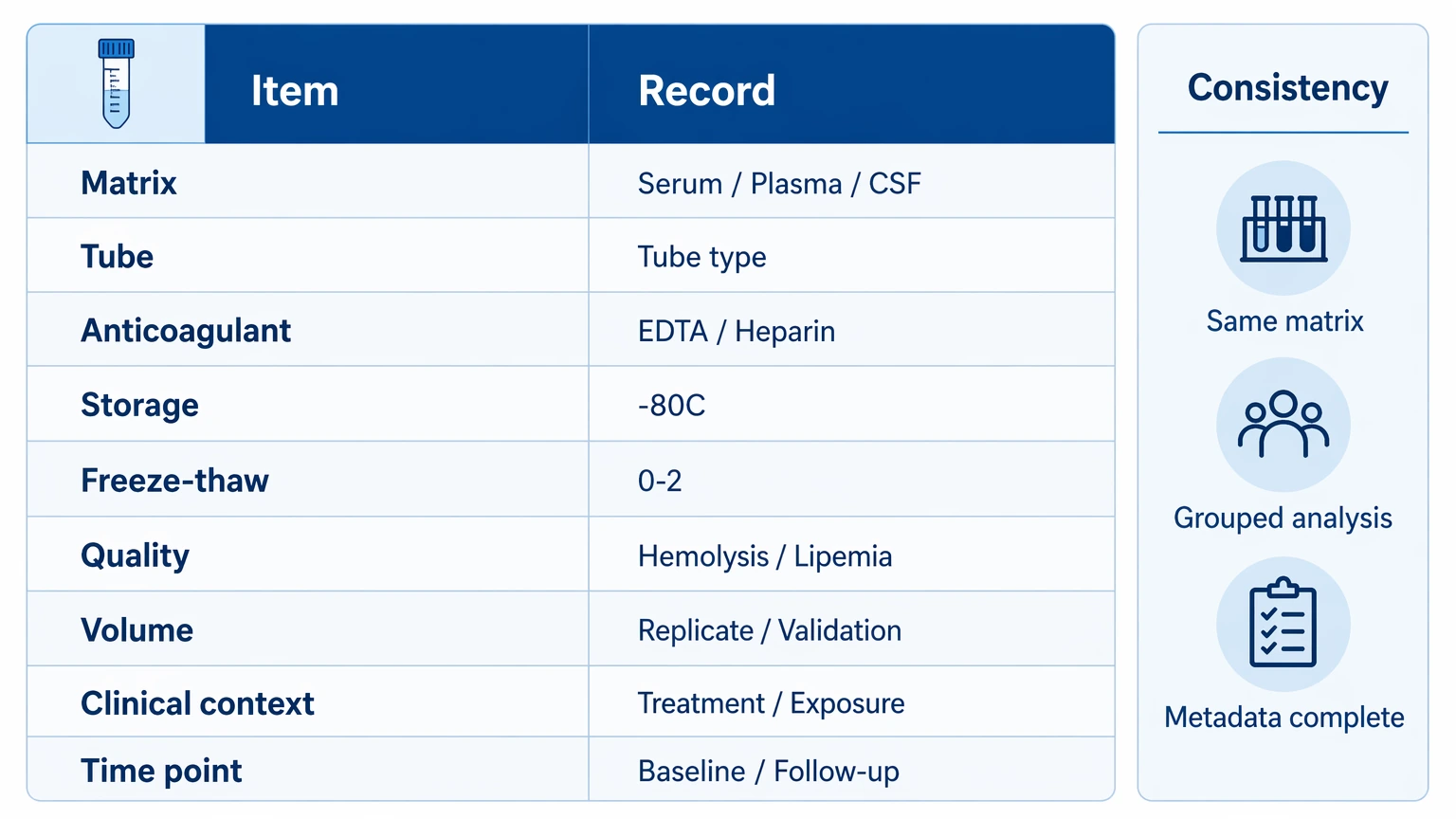
“Antibody-containing samples” is not enough. Teams should specify serum, plasma, CSF, or another matrix; collection tube type; anticoagulant for plasma; storage history; freeze-thaw count; visible hemolysis or lipemia; and whether enough material remains for a technical replicate or orthogonal validation.
2. Controls are treated as optional
PhIP-Seq readouts depend on immunoprecipitation-driven peptide enrichment. Without negative control, healthy control, disease control, mock IP, and repeat planning, the dataset may show binders but still leave open whether those binders are cohort-associated, nonspecific, or batch-related.
3. Library choice is disconnected from the question
A proteome-wide phage-displayed peptide library supports broad discovery, but it also adds complexity. In a small exploratory study, a focused pathogen, autoimmune, tumor antigen, or custom library may give a cleaner first-pass dataset.
4. Deliverables are requested too vaguely
“Raw data plus report” rarely gives a team what it actually needs. The project request should state whether the team needs peptide-level tables, normalized read count summaries, enrichment score outputs, overlap clustering, antigen mapping, group comparisons, and validation recommendations.
A Project-Planning Framework for PhIP-Seq
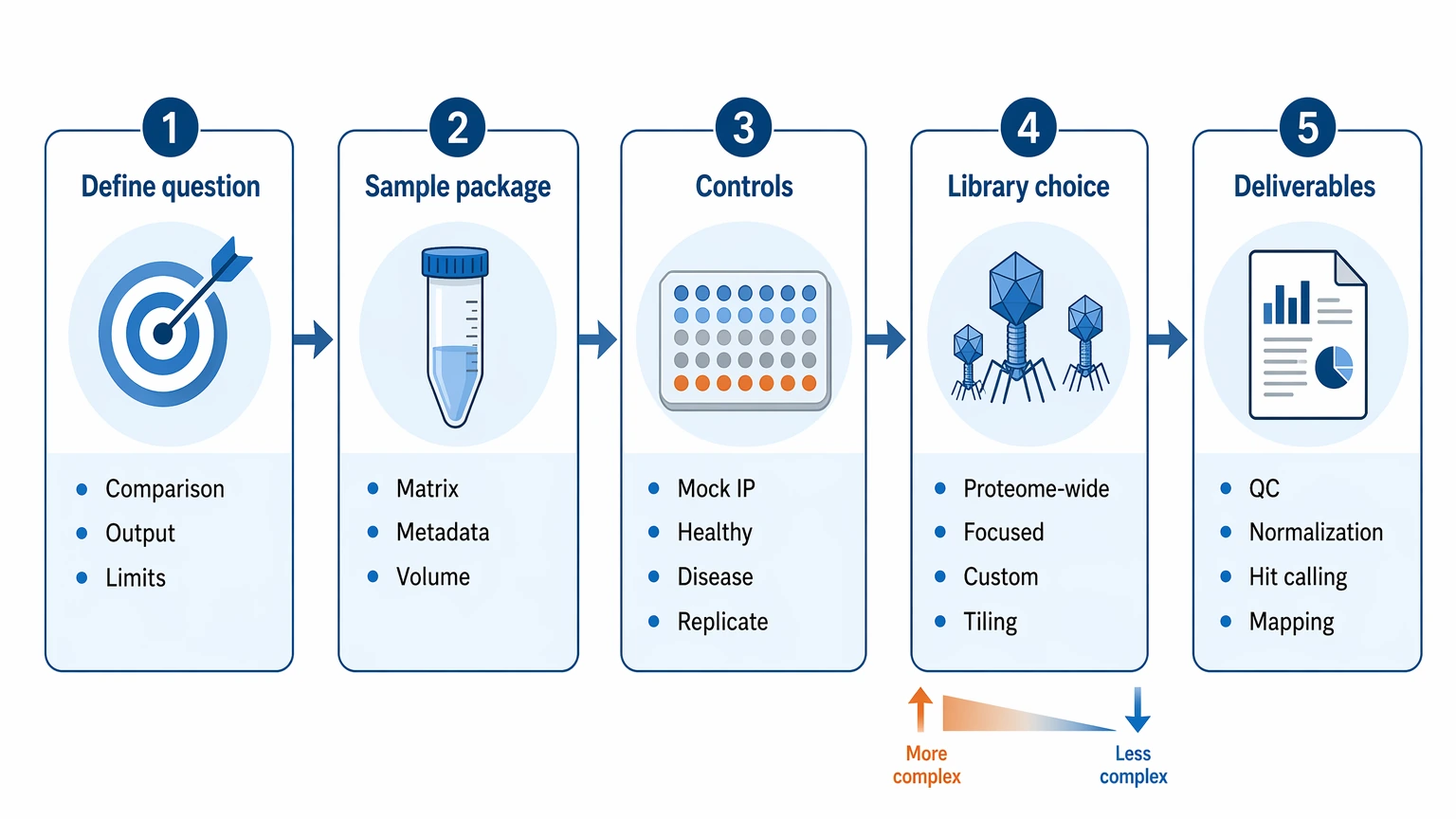
Step 1: Define the decision the dataset must support
Start with the decision, not the assay name. Are you looking for unknown linear epitope patterns, comparing cases with controls, screening viral exposure signatures, or testing a narrowed antigen hypothesis? That choice shapes whether broad discovery justifies a large library or whether a targeted panel is the better fit.
A useful planning statement has three parts: the primary comparison, the main output needed, and the interpretation limits. Enriched peptides may nominate candidate antigens, but they do not by themselves prove conformational binding, neutralizing activity, disease causality, or clinical specificity.
Step 2: Prepare the sample and metadata package before shipment
Next, define sample eligibility. Keep one input matrix across a comparison whenever possible. If the cohort includes both serum and plasma, either separate the groups analytically or redesign the comparison so matrix effects do not bury the biology. Record collection date, storage temperature, anticoagulant, freeze-thaw history, treatment status, infection or vaccination context, and longitudinal time point when relevant.
Metadata matters because PhIP-Seq interpretation depends on grouping, background assessment, and batch review. A provider should know whether samples came from treatment-naive subjects, exposed controls, autoimmune comparators, or serial follow-up visits. The team should also say whether spare volume is available for repeat pull-downs or orthogonal validation. If volume is tight, that constraint should shape the pilot design early, not appear after sequencing.
Step 3: Build controls that explain background binding
Controls should be layered, not added at the end. A mock IP or blank control helps estimate nonspecific phage recovery and bead- or protein A/G-associated carryover. Healthy control samples support disease-linked comparison. Disease control samples become especially useful when the main question is specificity against a related inflammatory, infectious, or oncologic background.
Technical replicate planning also needs a clear purpose. Not every project needs duplicate pull-downs for every sample, but replicates can make sense when the cohort is small, the input matrix is unusual, or the first screen will drive expensive follow-up work. Batch planning belongs here too. Cases and controls should be randomized across plates or runs rather than processed as separate blocks.
If your team is ready to turn these choices into a request, submit your requirements to MtoZ Biolabs with the cohort structure, available control types, repeat policy, and sample metadata so the assay scope and reporting plan can be reviewed before shipment.
Step 4: Choose the library by what the study must be able to detect
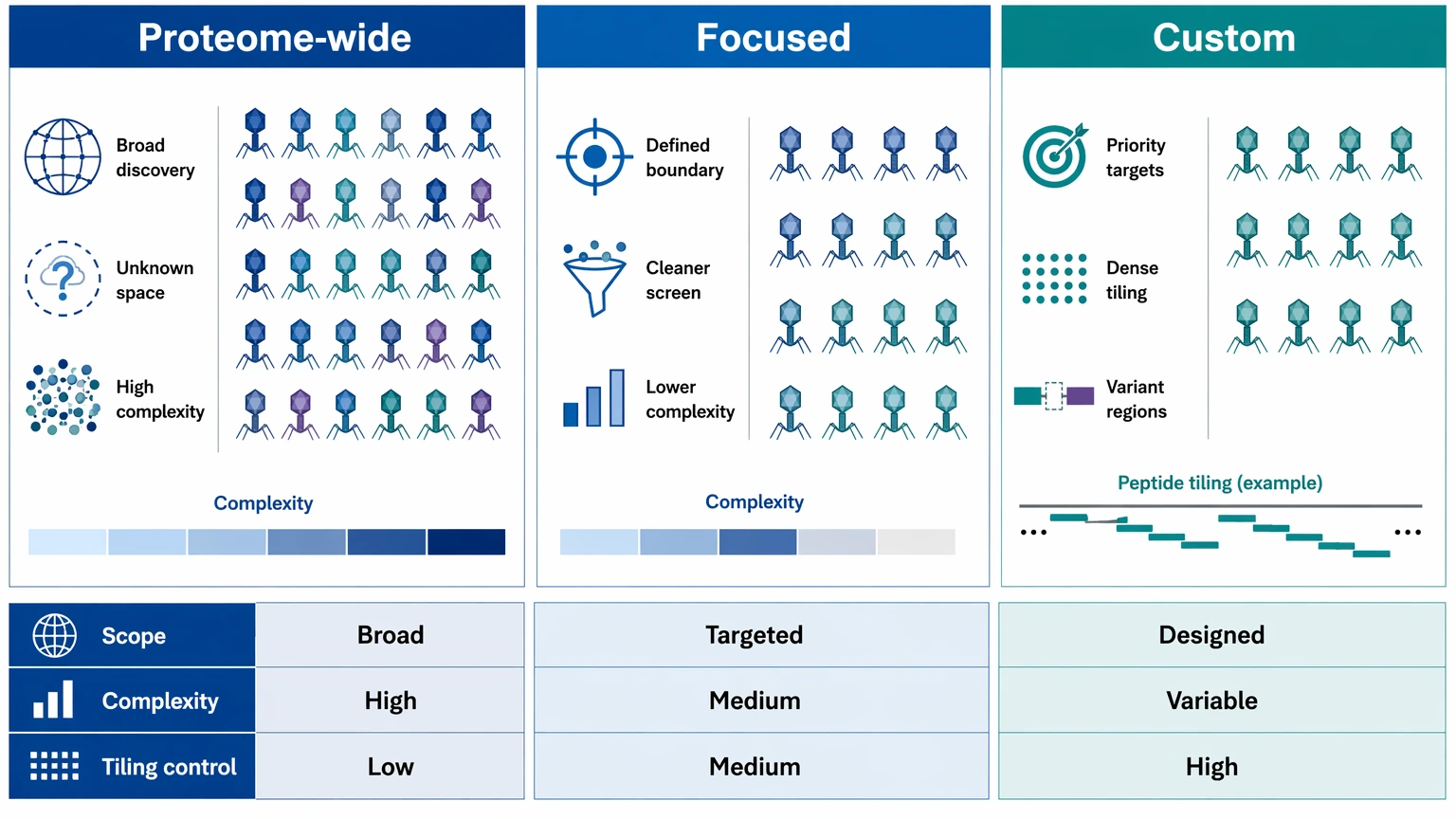
Library selection changes what PhIP-Seq can find. A proteome-wide library makes sense when the antigen space is mostly unknown and the study can absorb the added sequencing burden. A focused library is often better when the biological boundary is already clear, such as a virome, autoimmune panel, tumor antigen set, or pathogen program. A custom library is useful when the study needs tiled peptides across priority proteins, variant regions, fusion junctions, or other sequence-defined targets that standard content may not cover well.
Peptide tiling deserves an early conversation. If the goal is linear epitope localization, ask how peptide length, overlap, and representation density will affect antigen mapping. Denser tiling can sharpen positional interpretation, but it also increases library complexity and changes the sequencing depth discussion. That tradeoff should be explicit before kickoff.
Library choice also sets the interpretation limit. Because PhIP-Seq uses peptide display rather than full native proteins, it is strongest for linear epitope questions and may not fully capture conformational or post-translationally dependent binding.
Step 5: Lock sequencing and analysis deliverables before kickoff
Even when the provider manages sequencing, the study team should still define what enough means for the project. Sequencing depth should be planned against library complexity, number of pull-downs, and whether the study is exploratory or comparison-focused. If the sample count grows while the library stays broad, the design may need to shift toward a pilot phase, a narrower library, or fewer comparison groups.
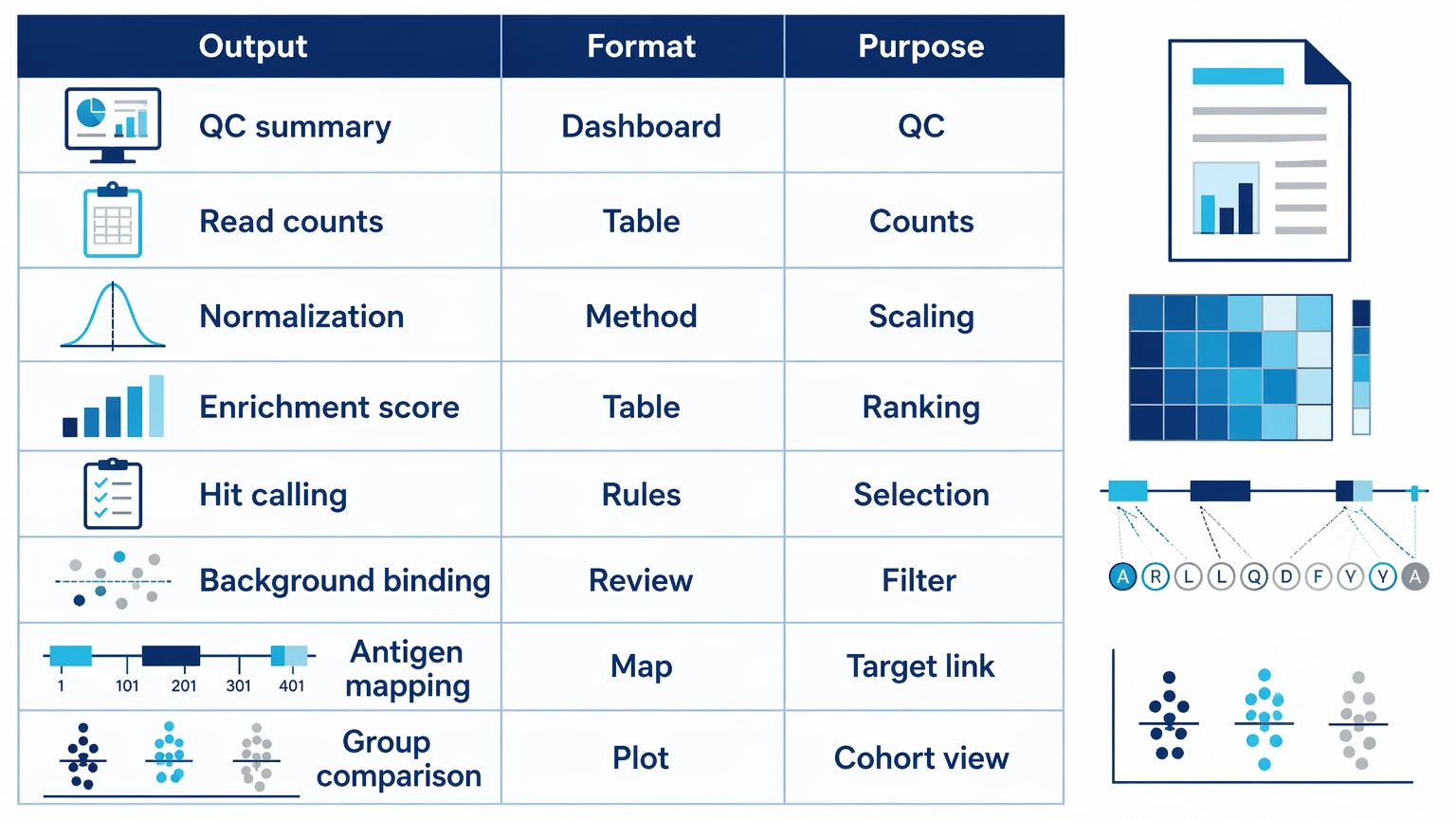
The analysis plan should be just as specific. Ask for QC summaries, read count tables, normalization methods, enrichment score outputs, hit calling rules, background binding assessment, antigen mapping, clustered views of overlapping peptides, and group comparison plots. It also helps to know whether the report separates peptide-level signal from antigen-level rollup and whether low-count or control-overlapping hits are flagged for cautious interpretation.
What a Good Final Report Should Make Easy
A useful PhIP-Seq report should help a team make decisions, not just store data. At minimum, the team should be able to see whether controls behaved as expected, whether technical replicates agreed, how normalization changed hit ranking, and whether enriched regions map to coherent tiled peptides or isolated signals.
The report should also smooth the validation handoff. Common next steps include peptide ELISA, targeted epitope mapping, or another orthogonal validation method tied to the biological question. In some projects, antigen-specific confirmation on a narrowed candidate set is more informative than trying to interpret every enriched peptide the same way.
Practical Pre-Submission Checklist
Before sending a PhIP-Seq inquiry, confirm the following:
- the exact input matrix for each sample
- sample metadata, including storage and freeze-thaw history
- case, healthy control, and disease control counts
- whether a mock IP or blank control will be included
- whether any samples need a technical replicate
- whether the goal is broad discovery, focused screening, or custom peptide tiling
- how much library complexity the budget and timeline can support
- what sequencing depth discussion is needed for the chosen design
- what outputs must appear in the final report
- which orthogonal validation path is expected after hit discovery
When archived material is limited or the cohort design is still unsettled, contact MtoZ Biolabs to evaluate your project and align the sample plan, library strategy, and report outputs with the antibody discovery question before the study starts.
Final Planning Takeaway
The most useful way to plan a PhIP-Seq study is to define the interpretation framework before the assay begins: choose a consistent input matrix, build controls that expose background binding, match the phage-displayed peptide library to the biological question, and request analysis outputs that support hit calling, antigen mapping, and orthogonal validation. That planning model fits translational discovery cohorts, immunogenicity exploration, and focused antigen-screening programs where peptide-level signal needs to lead to a practical next experiment. If you are preparing a new study or reviewing archived samples, a provider discussion is far more productive when sample constraints, control strategy, library scope, and reporting needs are already spelled out.
FAQ
Which sample types are commonly accepted for PhIP-Seq?
Serum and plasma are the most common, and CSF may also be suitable when antibody content matches the study question. The main point is not only sample type, but whether the matrix stays consistent within comparison groups and comes with usable handling metadata.
How many controls should an exploratory cohort include?
There is no universal fixed number. For planning, include enough healthy control and disease control samples to test whether enriched peptide calls track with the biological comparison rather than general inflammation, prior exposure, or background binding. A small pilot often works better with fewer study arms and tighter control definitions.
When should a team request a custom library instead of a standard panel?
Request a custom library when the project centers on defined proteins, sequence variants, fusion regions, or dense peptide tiling across priority antigens. Standard libraries fit broader discovery, while custom content is better when the question already has clear sequence boundaries.
What analysis terms should the team understand before kickoff?
At minimum, the team should be comfortable with read count, normalization, enrichment score, hit calling, background binding, antigen mapping, and peptide-level signal. Those terms shape how the report is read and how candidates are chosen for follow-up.
Can PhIP-Seq results be interpreted at the antigen level only?
Not safely in every case. Antigen-level rollup is useful, but it should be traceable back to the underlying peptide enrichment pattern. A strong antigen summary usually comes from multiple supported peptides or coherent tiled regions rather than one isolated hit.
What is the best follow-up after promising peptide hits are found?
That depends on the biological question. Peptide ELISA, targeted epitope mapping, and other orthogonal validation assays are common next steps. If the question involves full-length protein conformation or functional activity, the follow-up method should test those properties directly rather than expecting PhIP-Seq alone to answer them.
How to order?




