






PhIP-Seq for Cohort Studies: Designing Case-Control Comparisons and Antibody Signature Discovery
PhIP-Seq is a good fit for cohort-based antibody discovery when the study question is straightforward: do defined groups differ in linear epitope recognition or motif-level reactivity? It also works best when the cohort has usable metadata and controls, and when the intended output is a candidate antibody signature for follow-up rather than a stand-alone clinical claim. If the biology mainly depends on conformational epitopes, calibrated antibody quantitation, or immediate biomarker confirmation, PhIP-Seq should be paired with, or replaced by, more targeted assays.
For many translational teams, the real choice is not whether to profile antibodies. It is whether a phage-displayed peptide library combined with immunoprecipitation and next-generation sequencing can support a defensible case-control comparison, responder vs non-responder comparison, exposure-stratified cohort, or longitudinal sampling design. In practice, that choice gets easier when four pieces line up: the cohort can support the comparison, the library matches the biological question, the analysis can keep false positives under control, and an orthogonal validation plan is already on the table.
When a Cohort Question Is a Good Fit for PhIP-Seq
PhIP-Seq is most useful when the study needs broad, discovery-phase comparison across many peptide features. A typical project might include 80 serum or plasma samples split between cases and controls, treatment responders and non-responders, exposed and unexposed participants, or repeated collections from the same individuals. In that setting, the goal is rarely descriptive serology alone. The team usually wants to know whether group-associated antibody patterns are strong enough to justify downstream validation.
The fit weakens when the expected signal is poorly represented in peptide display. Because PhIP-Seq measures antibody binding to displayed peptides, it is biased toward linear epitope detection and tiled region mapping. It can pick up motif-sharing responses and region-specific reactivity, but it does not routinely capture the full structural context of native proteins or post-translational modifications. That difference matters when translational claims are being planned. A peptide-resolved discovery signal may be biologically useful without being a final biomarker.
A practical readiness check is simple: can the study team define the primary comparison, name the likely confounders, and state how the top hits will be validated? If the answer is no, the project often ends with a long ranked list and not much decision value.
What Makes a Comparison Interpretable
Cohort definition must come before sequencing
A workable case-control comparison needs more than labels. Age, sex, disease stage, treatment exposure, collection site, infection history, and collection timing can all shift antibody landscapes. If those variables are unevenly distributed, the analysis may end up detecting cohort composition instead of disease-associated biology.
For responder vs non-responder comparison, pretreatment status matters even more. If baseline samples are unavailable, or treatment timing is vague, therapy-driven immune exposure can blur the line between predictive reactivity and treatment-induced reactivity. For longitudinal sampling, paired analysis is usually stronger than treating repeated measurements as unrelated observations.
Matrix and batch planning affect downstream statistics
Serum and plasma should not be mixed casually. Even when both matrices are available, consistency across groups matters more than convenience. The same logic applies to plate layout, sequencing runs, and sample processing order. Poor allocation raises the risk of batch effect, and that can distort apparent group differences before formal modeling even starts.
At minimum, a cohort design should include negative controls, mock IP or bead-only controls where appropriate, and a bridge control or reference control carried across runs. Those references help monitor drift and make it easier to check whether observed differences still hold after technical alignment.
Library scope is not a cosmetic choice. A broad library supports exploratory screening across viral, microbial, autoantigen, or host targets, while a focused library can make interpretation easier in a narrower disease setting. Tiling density, peptide redundancy, and representation uniformity all shape how well enriched regions can be mapped and summarized later. If the study centers on exposure-linked serology or a restricted antigen family, a custom content strategy may produce a cleaner readout than an unrestricted screen.
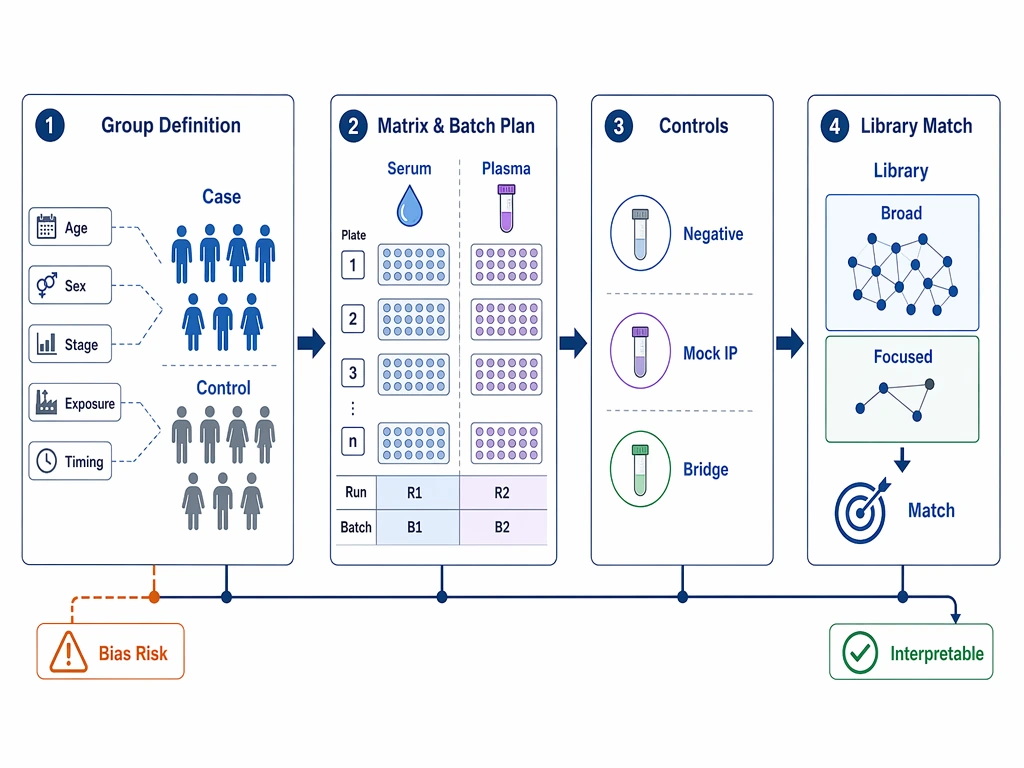
The Four Decision Dimensions
1. Cohort balance and metadata quality
The first question is whether the comparison is statistically and biologically interpretable. Balanced group sizes, clear inclusion rules, and prespecified covariates usually matter more than adding extra exploratory subgroups. In many studies, a smaller and cleaner primary contrast is better than a fragmented design with several underpowered arms.
2. Detectable signal type
PhIP-Seq performs best when the expected biology can show up as peptide enrichment, shared motifs, or repeated signal across tiled regions. If the anticipated antibody response depends on native folding, multimeric assembly, or glycosylation-dependent presentation, discovery should not rely on peptide display alone.
3. Analytical defensibility
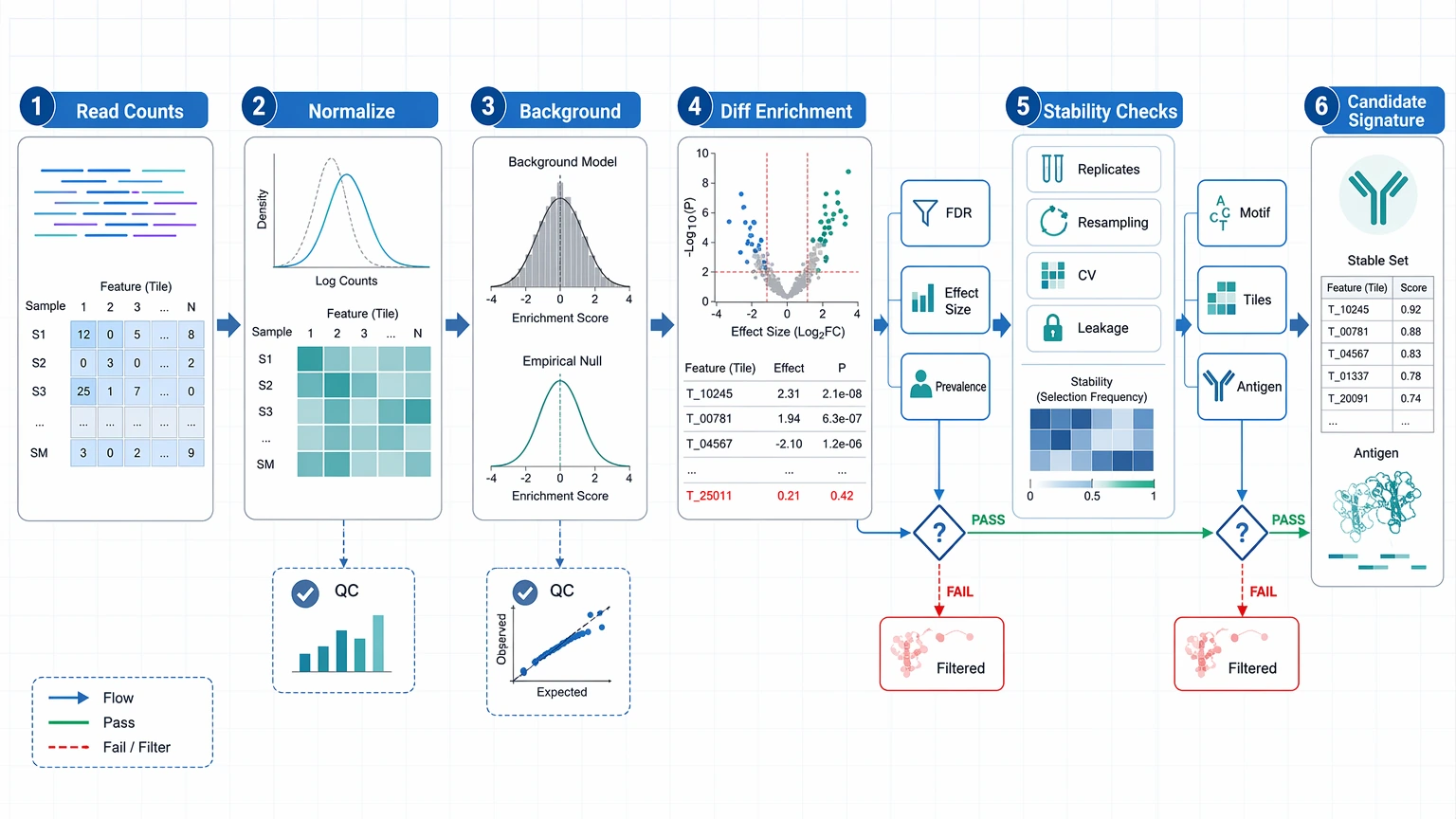
Useful cohort studies need more than within-sample hit calling. They need read count normalization, a suitable background model, and statistics for differential enrichment across groups with false discovery rate control. It also helps to look past nominal significance and inspect effect size, prevalence difference, replicate behavior, and consistency under resampling. That is where many weak signatures start to fall apart.
4. Follow-up path
The intended output should shape the analysis plan from the start. Some studies need peptide-level ranking for epitope mapping. Others need antigen-level summarization or a reduced panel for classifier development. If the next experiment is still vague, discovery results become harder to prioritize and easier to overread.
A useful checkpoint here is to submit your requirements for technical review. For cohort projects that need help aligning library scope, bridge controls, and comparative analysis rules, MtoZ Biolabs can evaluate your project before sample submission and flag design issues that would limit interpretation later.
Related Services
Main Service
Supporting Service
Validation Service
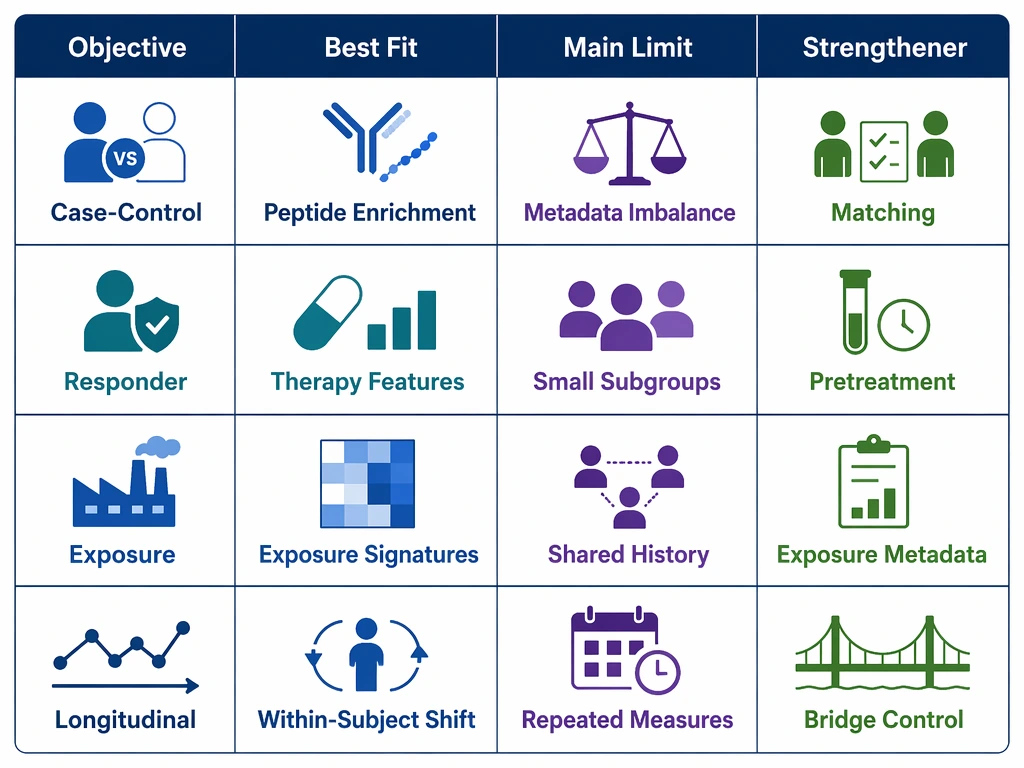
Comparing Common Cohort Objectives
| Cohort objective | Where PhIP-Seq fits well | Main limitation | What strengthens interpretation |
|---|---|---|---|
| Case-control comparison | Detecting group-associated peptide enrichment and motif patterns across many candidate antigens | Unmatched metadata can inflate apparent separation | Matching, balanced batch allocation, prespecified covariates |
| Responder vs non-responder comparison | Finding therapy-associated antibody features when treatment timing is known | Small subgroups and exposure effects can destabilize feature selection | Pretreatment samples, strict response criteria, resampling checks |
| Exposure-stratified cohort | Mapping signatures linked to infection, vaccination, or environmental exposure | Shared prior exposure may blur boundaries | Exposure metadata, relevant library content, motif review |
| Longitudinal sampling | Tracking within-subject shifts in motif-level reactivity or antigen targeting | Repeated measures need paired models and stable references | Matched time points, subject-level analysis, bridge controls |
A second comparison concerns output level:
| Output level | Best use | Main risk |
|---|---|---|
| Peptide level | Early discovery and fine mapping | Sparse counts can generate unstable hit lists |
| Motif cluster level | Cross-reactive pattern discovery | Similar motifs may originate from different biological sources |
| Antigen-level summarization | Translational communication and prioritization | Early collapsing can hide regional specificity |
| Candidate antibody signature panel | Shortlist generation or classifier building | Separation may fail without holdout testing or stability checks |
How to Frame Candidate Antibody Signature Discovery
A candidate antibody signature should be more than a list of enriched peptides. The strongest discovery sets have internal coherence and technical stability. In practice, that usually means several checks:
- features survive false discovery rate control;
- enriched peptides are supported by related tiles, motif clusters, or convergent antigens;
- feature selection remains reasonably stable under resampling or cross-validation;
- the training and evaluation strategy avoids obvious information leakage;
- biological interpretation remains plausible after antigen-level summarization.
This is also the point where overstatement becomes risky. Apparent separation between groups does not prove causality, clinical utility, or assay transferability. In a discovery workflow, PhIP-Seq is better treated as a nomination platform. It identifies group-associated reactivities that can then be checked with peptide assays, antigen-specific immunoassays, protein arrays, or functional follow-up.
When to Launch, Pair, or Avoid the Platform
Launch a PhIP-Seq cohort study when the primary contrast is clear, metadata are strong enough to model confounding, matrix handling is consistent, and the expected signal is likely to be visible at peptide or motif level. Pair it with orthogonal methods when top findings need confirmation in a more native antigen context or in a targeted assay format. Avoid relying on it alone when the project demands absolute quantitation, conformational epitope coverage, or immediate translational claims.
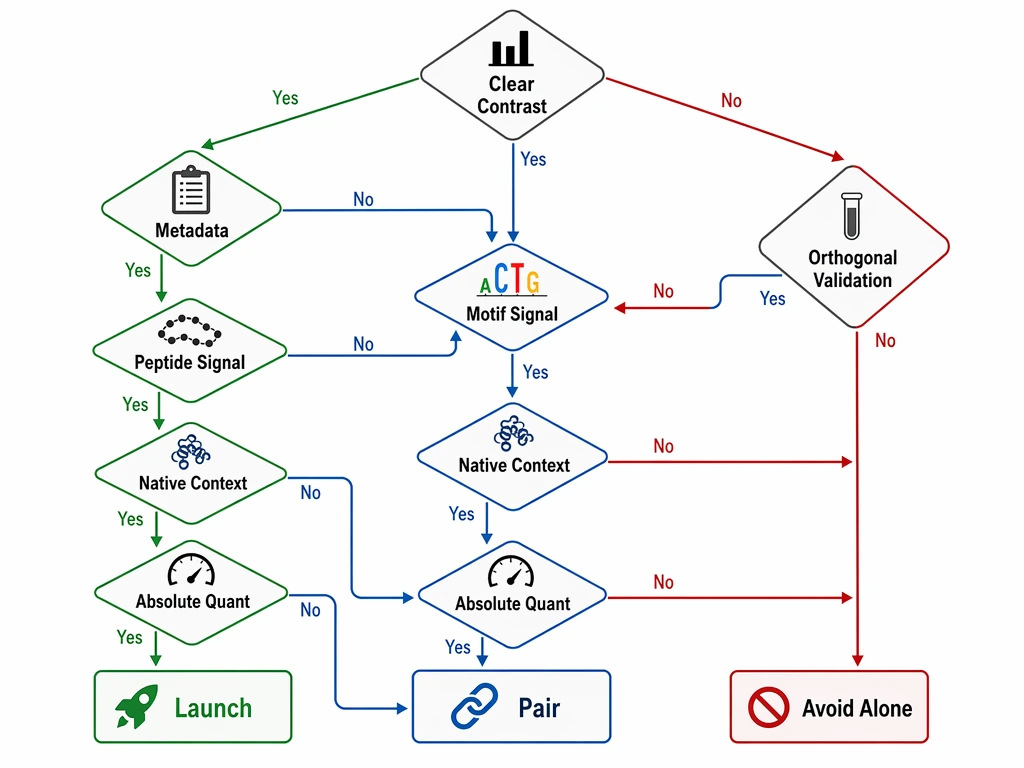
The platform is especially useful for discovery-stage projects that need ranked enriched peptides, group-associated antigens, motif clusters, and a disciplined path toward validation. It is less suitable when the study design cannot separate biology from technical structure, or when the validation plan remains undefined.
FAQ
What sample size is usually reasonable for a discovery-phase PhIP-Seq cohort?
There is no universal cutoff, but balanced groups with a clearly defined primary contrast are usually more informative than larger, fragmented cohorts. A study with 40 cases and 40 controls may be easier to interpret than one with several small subgroups split across batches.
Should peptide hits be reported individually or collapsed to antigens?
Start at the peptide level, then collapse only after checking whether multiple peptides support the same region, motif, or antigen. Early collapsing can simplify the report, but it can also erase the pattern that made the signal worth noticing.
How should prior infection or vaccination history be handled?
Treat exposure history as part of the core study design, not as a footnote. If exposure differs across groups, it should be captured as metadata and considered in covariate modeling or subgroup analysis before claiming disease-associated reactivity.
What is the purpose of a bridge control in multi-batch studies?
A bridge control or reference control helps align runs, monitor drift, and test whether a between-group pattern persists after technical variation is considered. It will not fix every batch problem, but it makes cross-run interpretation more defensible.
When is orthogonal validation most urgent?
Validation becomes especially important when the top features are intended for downstream panel building, when biological interpretation depends on antigen context, or when the strongest signals come from motifs with known cross-reactivity risk.
Can PhIP-Seq support both discovery and follow-up in the same project?
Yes, but the roles should stay separate. The discovery phase can nominate candidate features, while follow-up should test those features in a more targeted format with a clear analytical question and a predefined decision rule.
Comparison Summary and Consultation Guidance
For teams deciding whether a cohort is ready, the summary is fairly direct: PhIP-Seq is most informative when the comparison is well defined, the expected immune signal fits peptide display, and the analysis plan can support differential enrichment testing plus orthogonal validation. That combination fits discovery-stage case-control, responder, exposure-stratified, and longitudinal projects better than studies centered on conformational binding or absolute quantitation.
If you are preparing a cohort submission, gather the primary contrast, sample matrix, batch plan, metadata fields, expected output level, and follow-up assay needs before kickoff. For practical discussion of library choice, control layout, batch allocation, and report outputs, contact us at MtoZ Biolabs to discuss the study design and validation path for your sample set.
How to order?




