






How PhIP-Seq Supports Antibody Signature Screening for Biomarker Discovery
Antibody biomarker discovery is increasingly moving beyond the search for a single dominant marker. In many disease-focused studies, the biologically informative signal is not confined to one analyte, one peptide, or one protein. Instead, it may appear as a coordinated pattern of antibody reactivity distributed across related peptide regions or protein groups. This shift has important consequences for study design. When disease-associated differences are signature-like rather than target-like, single-marker logic can be too narrow to capture the structure of the underlying immune signal.
Phage Immunoprecipitation Sequencing (PhIP-Seq) is particularly relevant in this context because it allows antibody reactivity to be examined at scale before confirmation begins. In biomarker-oriented research, its value lies in helping investigators detect candidate antibody signatures, examine how those signatures differ across structured groups, and determine whether the observed patterns are better interpreted as isolated events or as coherent biomarker candidates. The method is therefore most useful as a discovery-stage tool for feature-level comparison and signature definition, rather than as a standalone confirmation assay.
Why Antibody Signature Screening Matters in Biomarker Discovery
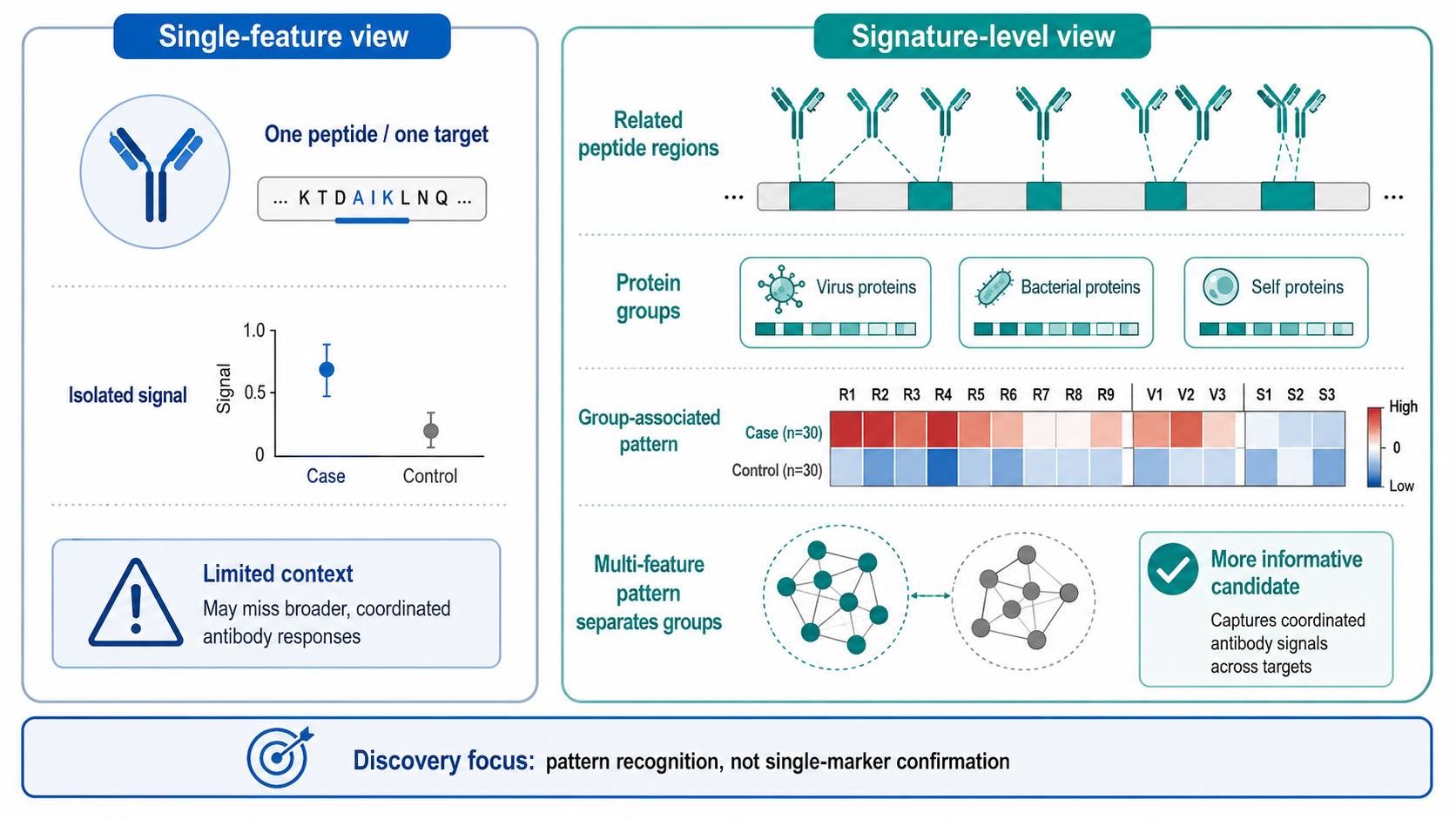
Figure 1. Single-feature and signature-level perspectives in antibody biomarker discovery
1. Biomarker Signals Are Not Always Single-Feature Signals
(1) Disease-associated antibody changes may be distributed
In many discovery-stage studies, case-control differences do not map cleanly to one predefined antigen. Instead, the relevant information may be distributed across several peptide regions, multiple proteins, or a broader pattern of coordinated antibody features. In that setting, a single-feature strategy can miss the signal structure that actually distinguishes one group from another.
(2) A strong individual feature may still be incomplete
Even when one antibody feature appears more prominent in cases than in controls, that feature alone may not fully represent the biological difference. Its meaning often depends on whether related features point in the same direction, whether the pattern is reproducible across samples, and whether the signal is part of a broader antibody signature rather than an isolated observation.
2. Signature-Level Interpretation Better Matches Discovery-Stage Questions
(1) Early biomarker discovery often asks pattern-based questions
Many studies do not begin with a confident shortlist of validated biomarker candidates. Instead, they begin with a more open question: what kind of antibody reactivity pattern distinguishes cases from controls, or one disease state from another? That is a pattern-recognition problem rather than a single-target confirmation problem.
(2) Signature screening helps define biologically meaningful structure
The value of signature screening lies in its ability to identify relationships among candidate features. Rather than treating every detectable signal as independent, it asks whether several features together define a more coherent disease-associated pattern. This makes the resulting candidates more interpretable at the discovery stage.
Why PhIP-Seq Is Well Suited to Antibody Signature Discovery
1. It Supports Broad Antibody Reactivity Profiling
(1) PhIP-Seq expands the observable feature space
PhIP-Seq is useful when the relevant antibody features are not yet clearly defined. By enabling broad antibody reactivity profiling, it gives researchers a way to examine a wider range of candidate features before narrowing the field. This is particularly important when the biological signal may not be confined to previously expected targets.
(2) Peptide-level resolution helps identify signature components
A major advantage of PhIP-Seq is that antibody reactivity can be observed at the peptide level. For signature-oriented biomarker studies, this matters because it helps distinguish scattered reactivity from recurring, structured patterns. Peptide-level information can show whether disease-associated differences are concentrated within related regions or distributed more broadly across the candidate space.
2. It Helps Organize Signals Into Interpretable Patterns
(1) Related peptide signals can be evaluated together
The most informative output in this setting is not simply a list of positive features. More often, it is the ability to determine whether several related peptide signals move together in a biologically interpretable way. That makes it easier to decide whether the data support an antibody signature rather than a set of disconnected observations.
(2) Protein-level interpretation can strengthen signature meaning
Although peptide-level features are central to discovery, signature interpretation becomes more useful when those features can also be related back to proteins or protein groups. That step can clarify whether multiple peptide signals converge on the same biological target space and whether the emerging signature has enough coherence to justify follow-up work.
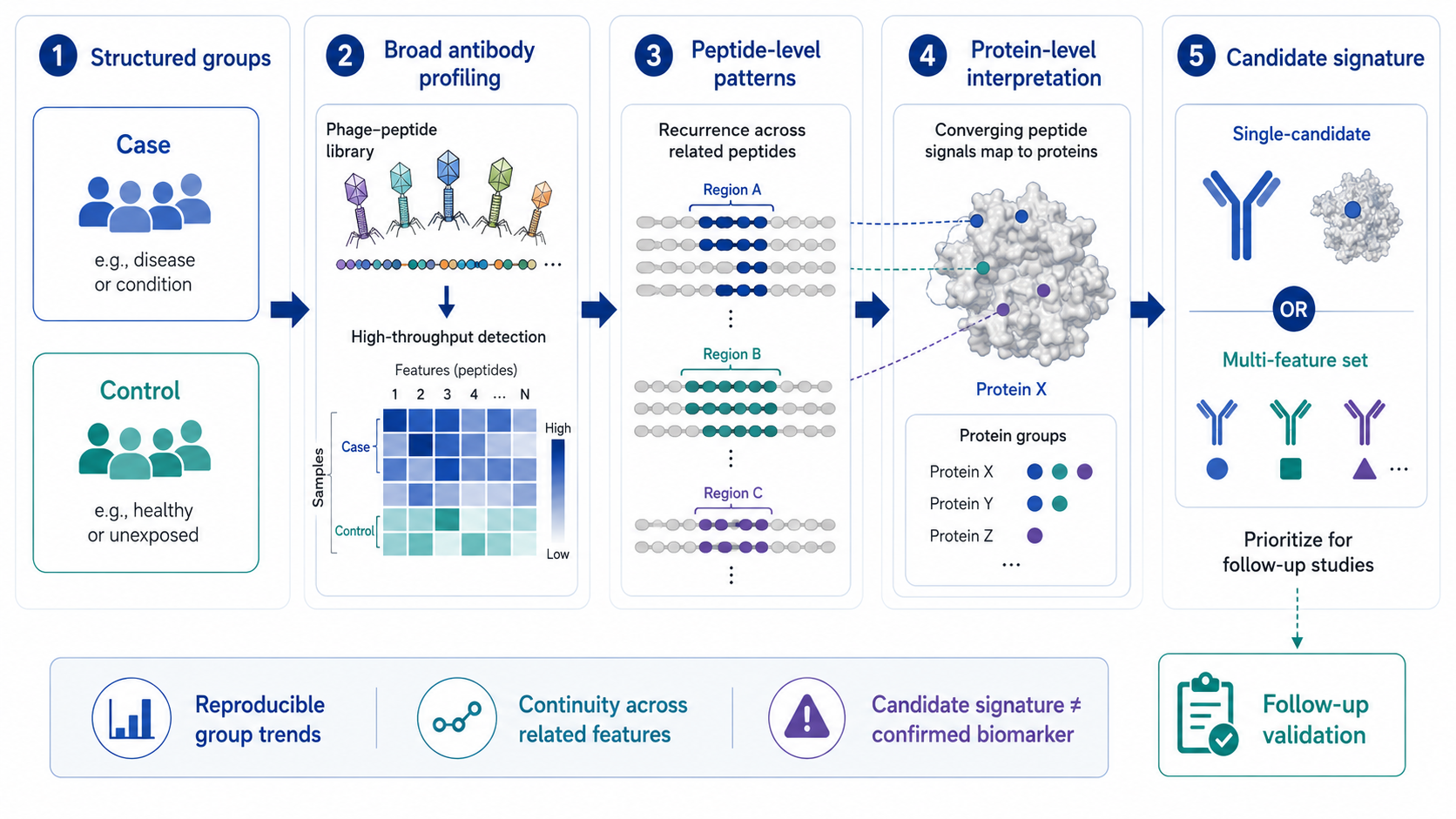
Figure 2. Discovery-stage workflow for defining candidate antibody signatures using PhIP-Seq
Why Case-Control Design Is Important for Signature Screening
1. Group Structure Determines Interpretability
(1) The comparison must match the biological question
A useful antibody biomarker study depends on a comparison structure that reflects the actual research question. Disease versus control, early versus late stage, and responder versus non-responder comparisons do not ask the same biological question, and antibody signatures derived from these designs should not be interpreted in the same way.
(2) Poorly matched groups weaken signature interpretation
Signature screening becomes less informative when comparison groups differ substantially in sample background, collection context, or handling conditions. In discovery-stage biomarker research, a broad profiling method cannot compensate for weak group design. The meaning of any signature depends on the quality and comparability of the groups being compared.
2. The Strongest Signatures Usually Reflect Group-Level Patterns
(1) Reproducible group trends are more informative than isolated extremes
A signal that appears strongly in only one or two samples may be interesting, but it rarely defines a useful biomarker signature by itself. Group-level reproducibility matters more. Candidate signatures become more convincing when their component features separate groups in a way that is consistent across multiple samples.
(2) Continuity across related features adds confidence
When several related peptide features support the same group distinction, the resulting signal is easier to interpret as a meaningful antibody signature. This type of continuity suggests that the observed difference reflects a broader reactivity pattern rather than a single disconnected event.
How Candidate Antibody Signatures Should Be Interpreted
1. Detectable Signals Need Pattern-Level Context
(1) Detectability alone does not define a useful candidate
Many antibody features may be detectable in a discovery dataset, but not all of them carry the same value. A useful candidate signature depends on more than presence or absence. It depends on whether the pattern is reproducible, whether related features support it, and whether it can be interpreted coherently in the context of the case-control question.
(2) Signature-level interpretation reduces ambiguity
Single-feature results can be difficult to interpret in isolation, especially when immune variation is broad. Signature-level interpretation helps reduce that ambiguity by showing whether several features together form a more stable pattern. This is often more informative than evaluating one feature at a time.
2. Discovery-Stage Signatures Must Be Kept Distinct From Confirmed Biomarkers
(1) Candidate signatures are still candidate findings
Even when a set of antibody features separates groups well in a discovery dataset, it remains a candidate signature rather than a confirmed biomarker. This distinction is essential in research-use biomarker discovery and should remain explicit throughout study interpretation.
(2) Signature discovery does not establish mechanism
A disease-associated antibody signature may point toward biologically interesting follow-up questions, but it does not by itself establish mechanism. Its immediate value lies in defining which features or feature sets are worth examining further, not in proving why they occur.
Scientific Implications for Biomarker Research
1. When Signature Screening Is Most Informative
(1) When the biological signal is broader than a single target
Signature screening is particularly informative when disease-associated antibody differences are unlikely to be captured by one analyte alone. In such cases, a broader feature-level view provides a better foundation for identifying meaningful candidates than a narrow target-first workflow.
(2) When case-control differences need pattern-level interpretation
It is also highly informative when group differences appear to reflect coordinated antibody reactivity rather than isolated feature changes. Under those conditions, signature-level screening can provide a more realistic picture of how antibody biomarkers are organized in early-stage discovery.
2. What PhIP-Seq Contributes to Biomarker Discovery
(1) A broader basis for defining candidate signatures
The main contribution of PhIP-Seq in this context is not simply breadth for its own sake. Its value lies in giving researchers enough peptide-level and protein-level information to define candidate antibody signatures with more confidence and greater interpretability.
(2) A stronger starting point for downstream studies
When the immediate goal is to understand which antibody features move together, which differences are group-associated, and which patterns deserve follow-up, PhIP-Seq provides a useful discovery-stage framework. It helps establish what should be examined next before orthogonal confirmation begins.
For studies that require case-control antibody signature screening and disease-associated candidate discovery before follow-up testing, MtoZ Biolabs provides PhIP-Seq services for antibody biomarker research. If your project requires broader antibody profiling to define candidate signatures before targeted validation, contact MtoZ Biolabs for project evaluation and service support.
How to order?




