






Normalization and Internal Standards in Quantitative Phosphoproteomics
In quantitative phosphoproteomics, analyses commonly emphasize differential phosphorylation at specific sites, directional changes (up- or down-regulation), and downstream functional or pathway enrichment. Nevertheless, inappropriate selection of internal references and suboptimal normalization can introduce spurious differences, systematic quantification bias, and, ultimately, misleading biological interpretations. Because phosphopeptides are often low in abundance and exhibit substantial variability, normalization strategies routinely adopted in conventional (global) proteomics are not directly transferable to phosphoproteomic datasets. Accordingly, in quantitative phosphoproteomics, well-justified internal standards and normalization procedures constitute a prerequisite for data credibility, improved comparability across experimental groups, and reliable identification of genuine biological changes.
Principles and Challenges of Internal Standard Selection
1. Why Is It Difficult for Quantitative Phosphoproteomics to Directly Use Total Protein Normalization?
In proteomics, total protein amount or the mean intensity across all peptides is frequently used as a normalization reference. In phosphoproteomics, however, this approach is constrained by two technical obstacles:
(1) The Enrichment Step Disrupts the Uniformity of Peptide Composition
Following phosphopeptide enrichment (e.g., IMAC or TiO₂), a large fraction of non-phosphorylated peptides is removed. As a result, the total measured signal no longer faithfully reflects underlying protein abundance.
(2) Phosphorylation Dynamics Can Be Decoupled From Protein Expression
Upon activation of certain signaling pathways, phosphorylation levels may increase markedly even when the corresponding proteins exhibit no appreciable change in expression/abundance. Under such circumstances, normalization to protein amount can obscure the true phosphorylation-related signal.
2. Three Criteria That an Excellent Internal Standard Should Meet
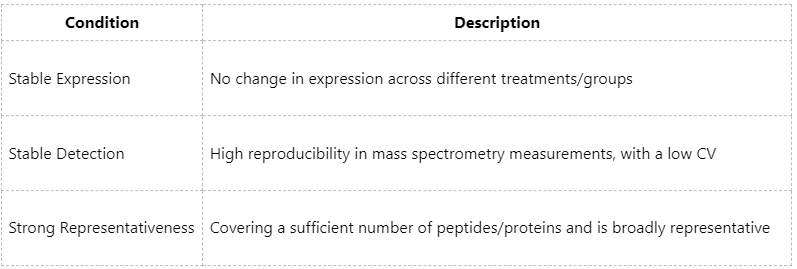
Only peptides/proteins that satisfy all three criteria can serve as a reliable quantitative baseline.
Comparison of Common Normalization Strategies in Quantitative Phosphoproteomics
1. Normalization Based on the Total Signal of Phosphopeptides (Global Scaling)
(1) Principle: This approach assumes that the overall phosphorylation level is comparable among samples. For each sample, the signal intensities of all quantified phosphopeptides are summed, and the dataset is rescaled accordingly.
(2) Advantages:
- Straightforward to implement and applicable to most TMT- or LFQ-based datasets.
- Does not require additional quantification steps beyond the primary workflow.
(3) Limitations:
- When the global phosphorylation level changes substantially (e.g., under drug perturbation), this method may misattribute true biological shifts.
- It is unsuitable for models characterized by strong kinase activation and a broad, global increase in phosphorylation.
2. Using Non-Phosphopeptides as Internal Standards
(1) Principle: Phosphopeptides and their corresponding non-phosphorylated counterparts are measured in parallel, and the non-phosphopeptides are used as internal references to approximate protein expression/abundance.
(2) Advantages:
- Enables discrimination between phosphorylation-driven regulation and protein expression changes.
- Particularly useful for site-specific investigations.
(3) Limitations:
- Requires high-quality unenriched samples to support parallel measurement.
- Involves large data volumes and complex analyses, making it less suitable for large-scale screening studies.
3. Normalization Based on Specific Stable Proteins
(1) Principle: Housekeeping proteins (e.g., GAPDH, ACTB, HSP90) or proteins whose phosphorylation is relatively insensitive under the studied conditions are selected as internal references based on their stable expression across samples.
(2) Advantages:
- Simple and intuitive, and suitable for calibration in small-sample settings
- Facilitates interpretation in biological terms.
(3) Limitations:
- Housekeeping proteins themselves may also be subject to phosphorylation-dependent regulation.
- The applicability is limited and typically requires prior validation of stability.
4. Statistical Normalization Based on Tools Such as MSstats and NormalyzerDE
(1) Principle: Statistical algorithms (e.g., LOESS or quantile normalization) are applied to adjust systematic biases in an automated manner.
(2) Advantages:
- Highly automated and scalable, enabling high-throughput processing
- Suitable for large-scale comparisons and datasets with multiple replicates
(3) Limitations:
- Black-box adjustments may inadvertently attenuate or mask genuine biological variation.
- Performance depends on an appropriate data structure and the absence of outlier/aberrant samples.
After Normalization, What Quality Assessments Are Still Needed?
(1) CV (Coefficient of Variation) Evaluation: Determine whether CVs across technical/biological replicates are below 20%.
(2) PCA (Principal Component Analysis): Assess whether experimental groups separate clearly and whether within-group samples cluster.
(3) Volcano Plot/Heatmap Visualization: Examine whether observed changes align with biological expectations.
(4) Kinase Pathway Enrichment Trends: Evaluate whether apparent pathway-wide “upregulation” reflects spurious shifts or collective biases.
In quantitative phosphoproteomics, normalization is not merely a technical step for data formatting; rather, it is a critical variable that can shape downstream interpretation and conclusions. An inappropriate internal reference or normalization strategy may obscure authentic regulatory networks and even produce false-positive findings. Therefore, we recommend incorporating internal standard selection and normalization planning early in the experimental design stage, and communicating thoroughly with data analysts to establish a scientifically grounded quantification scheme. If you have questions regarding normalization in quantitative phosphoproteomic projects, you are welcome to consult MtoZ Biolabs at any time. In addition to providing a high-quality experimental platform, we are committed to supporting customers in constructing reliable biological conclusions.
MtoZ Biolabs, an integrated chromatography and mass spectrometry (MS) services provider.
Related Services
How to order?




