






MS-based proteomics: A short introduction to the core concepts of proteomics and mass spectrometry
Introduction
Researchers new to protein analysis often encounter two overlapping fields at once: proteomics and mass spectrometry. A grant proposal may mention quantitative proteomics without defining how protein abundance is measured. A collaborator may request LC-MS/MS data when the team is more familiar with western blot or ELISA. A biologics group may receive a peptide-spectrum match table and need to understand how those entries support protein-level conclusions.
MS-based proteomics is the use of mass spectrometry to measure peptides and proteins and convert those measurements into identification and quantitation results. Proteomics is the broader study of the protein complement in a sample, including identity, abundance, modifications, and interaction context. Mass spectrometry provides the analytical engine that makes large-scale protein measurement practical in complex biological matrices.
This article introduces the core concepts that connect proteomics and mass spectrometry. It explains what proteomics aims to measure, how mass spectrometry generates peptide evidence, and why identification and quantitation are related but distinct outputs in the same workflow.
What Proteomics Studies
Proteomics is the large-scale analysis of proteins in a biological system. Unlike single-protein assays that target one analyte at a time, proteomics workflows aim to measure many proteins across a sample set in one analytical program.
Common proteomics questions include which proteins are present in a sample, how protein abundance changes between conditions, where post-translational modifications occur, and how protein profiles differ across tissues, time points, or treatment groups. In biopharmaceutical research, proteomics may also support protein identity confirmation, comparability review, and characterization of product-related variants.
The protein state measured in proteomics reflects biology more directly than transcript abundance alone because proteins include abundance, isoforms, processing, and modifications that are not always predictable from mRNA data. This is one reason MS-based proteomics is widely used in discovery research, biomarker programs, and protein product characterization.
Why Mass Spectrometry Is Central to Proteomics
Mass spectrometry measures the mass-to-charge ratio (m/z) of ions in the gas phase and records signal intensity for those ions. In proteomics, the instrument typically measures peptides rather than intact proteins in bottom-up workflows, although intact protein analysis is also used in selected applications.
Mass spectrometry is central to proteomics for three main reasons. It provides sequence-level evidence through peptide fragment ions. It supports multiplexed measurement of many peptides in one LC-MS run. It enables both unbiased discovery and targeted monitoring of selected proteins using the same analytical platform.
Other protein methods such as western blot, ELISA, or gel electrophoresis remain valuable, but they usually require prior knowledge of the target protein and antibodies or stains matched to that target. MS-based proteomics can identify proteins from sequence database matching even when no antibody exists, which is important in discovery settings.
Core Mass Spectrometry Concepts in Proteomics
Several mass spectrometry concepts appear repeatedly in proteomics reports and methods sections.
Mass-to-charge ratio (m/z).
Peptides acquire charge in the ion source and are detected as m/z values rather than neutral mass alone. Charge state affects how precursor and fragment ions are interpreted.
Precursor ions and MS survey scans.
An MS scan records precursor ions eluting from liquid chromatography. Each precursor represents a peptide entering the mass spectrometer at a specific retention time.
Tandem mass spectrometry (MS/MS).
In MS/MS, selected precursor ions are fragmented to generate product ions that support peptide sequence assignment. Protein identification in standard bottom-up proteomics depends on these fragment patterns.
Resolution and mass accuracy.
Higher resolving power helps distinguish nearby peptide signals and improves confidence in assignment, especially in complex mixtures.
Ion intensity and quantitation.
Signal intensity for peptide ions is the basis for label-free and targeted quantitation strategies that compare abundance across samples.
These concepts explain why proteomics reports refer to precursor m/z, fragment ions, peptide-spectrum matches, and extracted ion chromatograms rather than only protein names.
Core Proteomics Workflow Concepts
Most introductory MS-based proteomics projects use a bottom-up workflow. Proteins are extracted from the sample, digested into peptides, separated by liquid chromatography, and analyzed by LC-MS/MS.
Peptide-spectrum match (PSM).
A PSM is an assignment between an experimental MS/MS spectrum and a peptide sequence from a database search. PSM quality scores and false discovery rate filtering determine which identifications are reported.
Protein inference.
Proteins are inferred from shared peptide evidence. One reported protein group may represent multiple database entries or proteoforms grouped by the analysis software.
False discovery rate (FDR).
FDR control reduces false positive identifications by filtering low-confidence PSMs before protein reporting.
Quantitation at the peptide level.
Protein quantitation is usually calculated from peptide ion intensities or spectral counts and then summarized at the protein level using defined rollup rules.
Understanding these concepts helps readers interpret proteomics tables and evaluate whether a dataset supports identification, quantitation, or both.
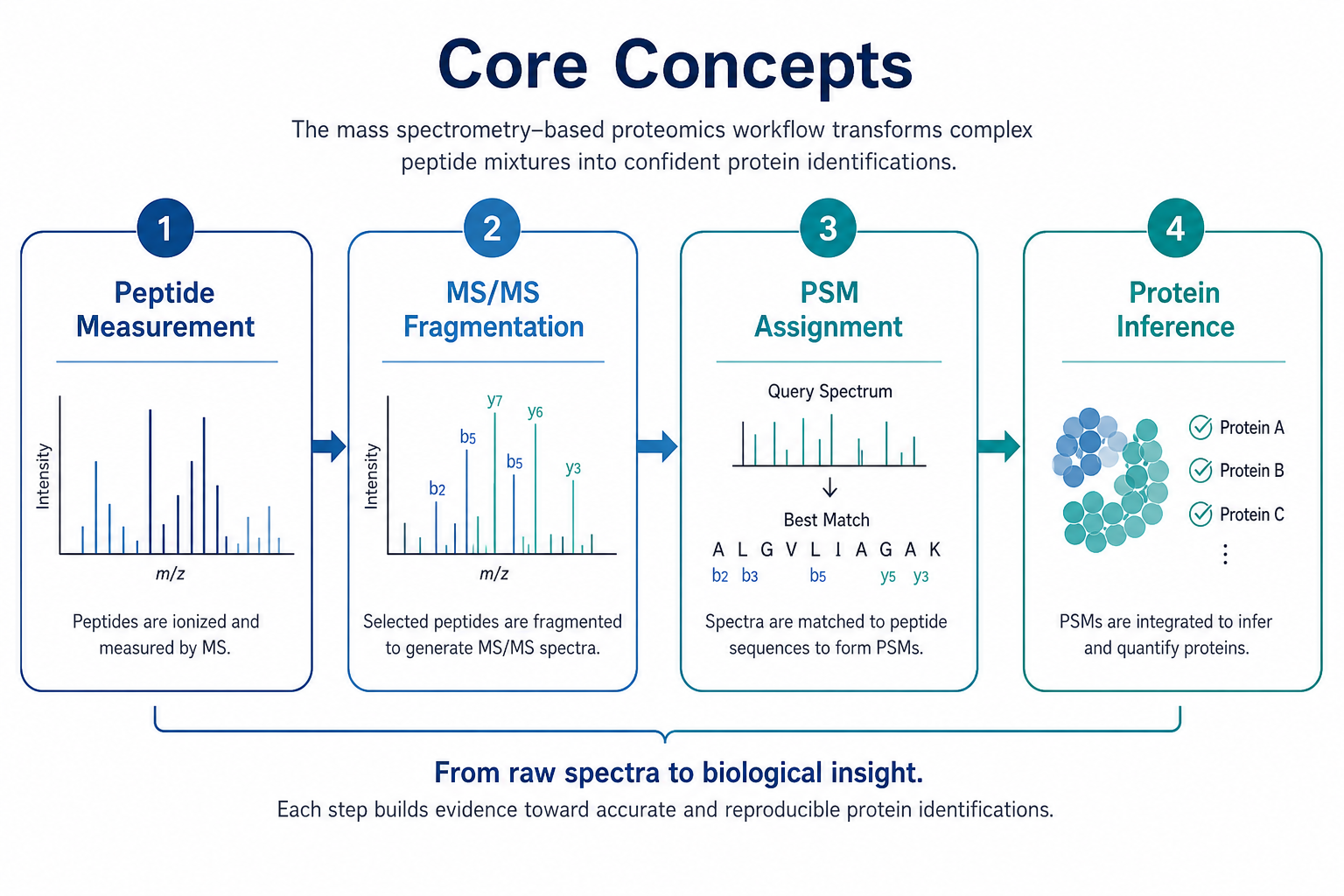
Figure 1. MS-based proteomics connects peptide measurement, MS/MS fragmentation, PSM assignment, and protein inference in a bottom-up workflow.
Related Services
Protein Identification Service
Quantitative Proteomics Service
Proteomics Bioinformatic Analysis Service
Researchers new to MS-based proteomics can consult MtoZ Biolabs to review sample type, project goals, and the workflow best suited to identification, quantitation, or both.
Identification and Quantitation Are Related but Different
A common source of confusion is treating protein identification and protein quantitation as the same output. They are linked in one experiment but answer different questions.
|
Concept |
What It Answers |
Typical Output |
|---|---|---|
|
Protein identification |
Which proteins are detected in the sample? |
Protein list with PSM support |
|
Peptide identification |
Which peptide sequences match observed spectra? |
PSM table with scores |
|
Relative quantitation |
How does abundance change between groups? |
Fold-change tables across conditions |
|
Targeted quantitation |
How reproducibly can selected proteins be monitored? |
PRM or MRM peptide panel results |
|
Modification mapping |
Where are PTMs localized? |
Modified peptide assignments |
A protein may be identified with only one high-quality PSM yet still receive a quantitative value if its peptides were detected with measurable intensity across runs. Conversely, a highly abundant peptide signal does not by itself prove identity without acceptable spectral match evidence.
Main Strategy Families in MS-Based Proteomics
Three strategy families cover most introductory project designs.
Bottom-up proteomics digests proteins into peptides before LC-MS/MS analysis. It is the most common route for discovery, PTM studies, and biologics peptide mapping because complex mixtures can be analyzed at high throughput.
Top-down proteomics analyzes intact proteins or large fragments with minimal digestion. It is used when proteoform information is required and sample complexity is controlled.
Targeted proteomics measures selected peptides by PRM or MRM after discovery or when a defined protein panel must be monitored repeatedly with assay-style reproducibility.
Most laboratories begin with bottom-up discovery and move to targeted follow-up when a smaller set of proteins becomes the focus.
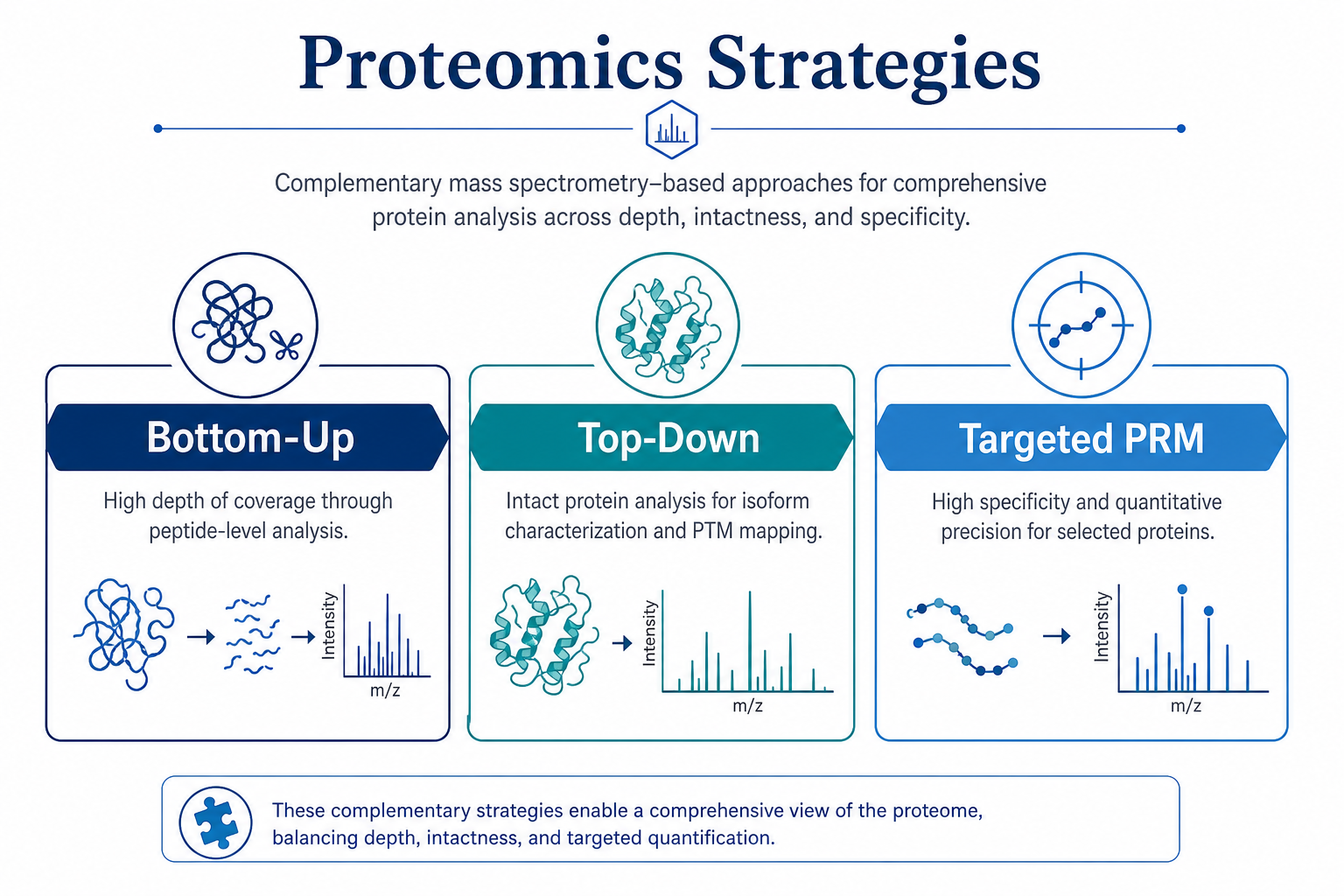
Figure 2. MS-based proteomics commonly uses bottom-up, top-down, or targeted LC-MS/MS strategies depending on project goals.
Core Technical Value and Practical Limits
Core Technical Value
Broad protein coverage in complex samples.
MS-based proteomics can measure many proteins in cell lysates, tissues, and biofluids in one workflow.
Sequence-level evidence.
MS/MS fragmentation supports peptide sequence assignment rather than indirect detection alone.
Flexible scale from discovery to targeted assays.
The same platform can support exploratory surveys and focused protein panel monitoring.
Modification-aware analysis.
Database searches can include post-translational modifications when fragment evidence supports localization.
Practical Limits
Workflow complexity.
Sample preparation, acquisition mode, and search settings all affect results.
Inference in bottom-up analysis.
Protein-level conclusions are built from peptides, not direct intact protein readout.
Missing values in quantitation.
Not every protein is quantified in every sample, especially at low abundance.
Validation is still required.
Discovery proteomics data often need targeted or orthogonal confirmation before routine use.
Where MS-Based Proteomics Is Commonly Used
MS-based proteomics appears across several research and development settings.
Discovery biology uses LC-MS/MS to compare protein profiles across treatment conditions. Biomarker research uses plasma or tissue proteomics to identify candidate proteins for follow-up assays. Biopharmaceutical characterization uses peptide-level MS to confirm protein identity and review product heterogeneity. PTM research uses enrichment and LC-MS/MS to map modified peptides. Targeted follow-up uses PRM assays to monitor selected proteins identified in earlier discovery runs.
These uses share the same core concepts even when sample type and reporting depth differ.
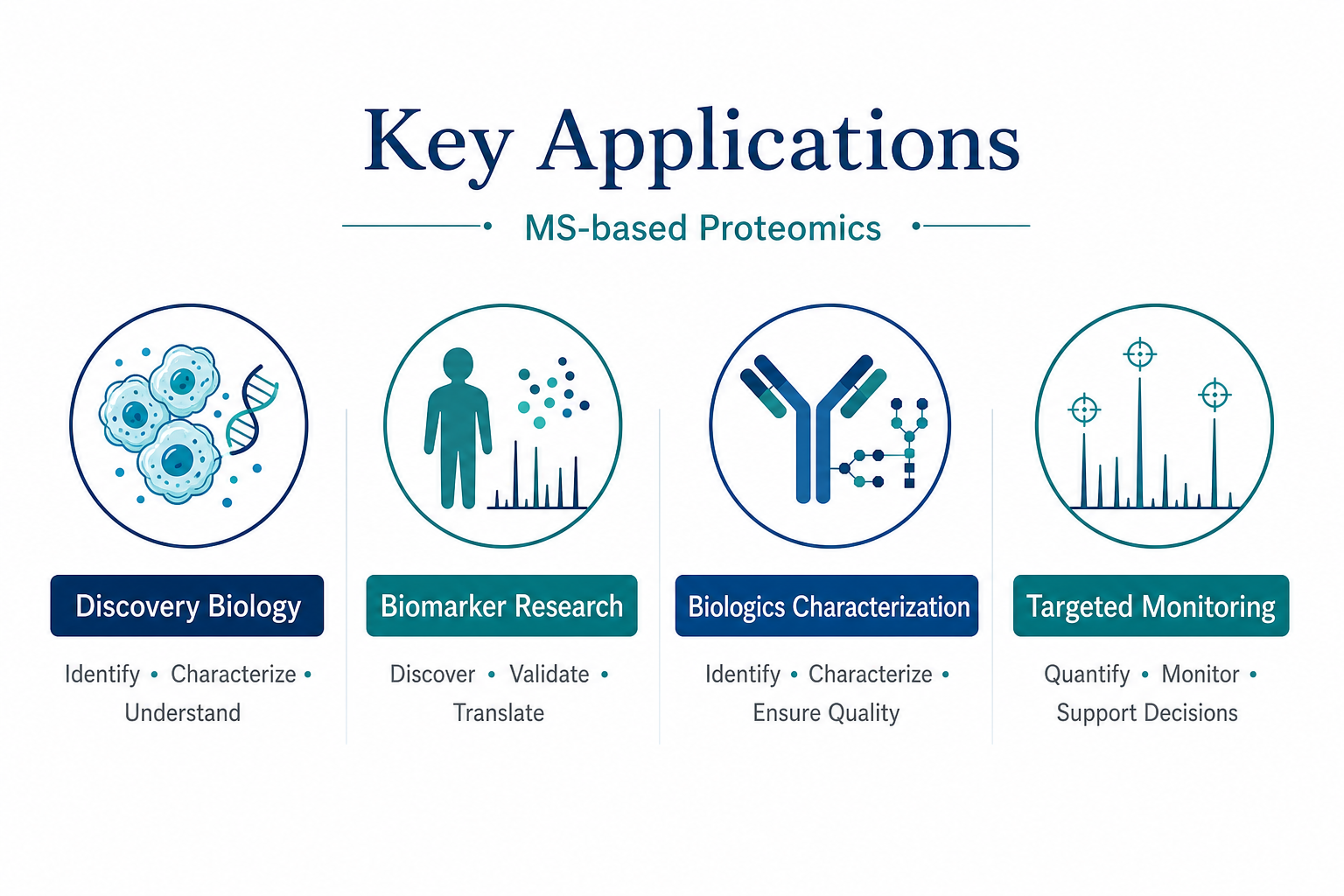
Figure 3. MS-based proteomics supports discovery biology, biomarker research, biopharmaceutical characterization, and targeted protein monitoring.
Frequently Asked Questions
1. What is MS-based proteomics?
MS-based proteomics uses mass spectrometry to measure peptides and proteins and convert those measurements into identification and quantitation results, usually through a bottom-up LC-MS/MS workflow.
2. What is the difference between proteomics and mass spectrometry?
Proteomics is the study of proteins at scale. Mass spectrometry is the analytical technology that measures peptide and protein ions to generate proteomics data.
3. Why are peptides measured instead of whole proteins in many workflows?
Bottom-up proteomics digests proteins into peptides because peptides are easier to separate, ionize, and fragment efficiently in complex mixtures.
4. What is a peptide-spectrum match?
A peptide-spectrum match is an assignment between an experimental MS/MS spectrum and a peptide sequence from a database search.
5. Can MS-based proteomics both identify and quantify proteins?
Yes. The same LC-MS/MS experiment can support identification through PSMs and quantitation through peptide ion intensities or targeted monitoring strategies.
Conclusion
MS-based proteomics combines the biological scope of proteomics with the analytical power of mass spectrometry. Core concepts include peptide measurement, precursor and fragment ion interpretation, PSM assignment, protein inference, and peptide-level quantitation summarized at the protein level. Bottom-up, top-down, and targeted strategies apply these concepts to different project goals ranging from discovery to focused monitoring.
Researchers who understand these fundamentals can read proteomics reports more critically, plan better experiments, and choose follow-up workflows with fewer repeat runs. Teams beginning an MS-based proteomics project can contact MtoZ Biolabs to review sample type, identification goals, and the quantitation strategy best suited to the study.
How to order?




