






Mitochondrial Proteomics Service for Protein Identification and Quantitative Comparison
Choosing a mitochondrial proteomics service should begin with the evidence the study is expected to generate. Protein identification, quantitative comparison, and combined workflows differ in sample requirements, replicate design, acquisition strategy, data processing, and expected deliverables. Clarifying whether the project aims to characterize detectable proteins, compare relative protein abundance, or address both objectives is therefore the first step in workflow selection.
Instrument specifications alone are not sufficient for evaluating service suitability. Starting material, mitochondrial enrichment quality, batch structure, quality-control criteria, statistical comparisons, and evidence boundaries all affect whether the resulting data can answer the intended biological question. Workflow suitability should therefore be evaluated across the full project, from the analytical objective and sample condition to quantitative design, data analysis, and result interpretation.
MtoZ Biolabs supports identification-focused and quantitative mitochondrial proteomics projects using high-resolution LC-MS/MS workflows. Researchers can submit the sample type, mitochondrial preparation status, group design, and primary analytical objective through our Mitochondrial Proteomics Project Inquiry Form for an initial feasibility assessment and discussion of an appropriate workflow.
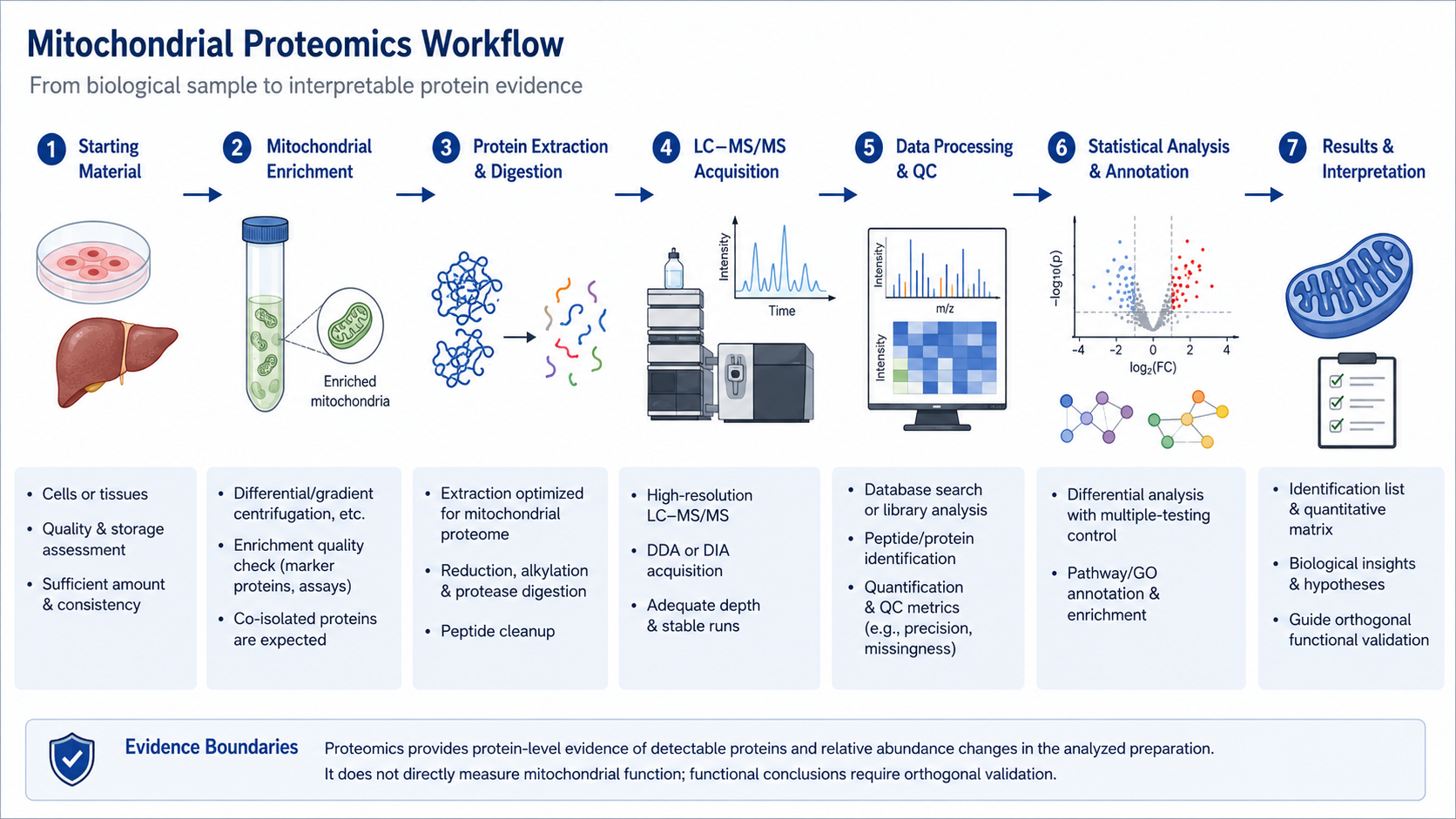
Figure 1. Overview of the mitochondrial proteomics workflow from starting material and mitochondrial enrichment to LC-MS/MS analysis, data processing, statistical interpretation, and protein-level evidence reporting.
Define the Analytical Objective
1. Mitochondrial Protein Identification
(1) Establishing the Detectable Protein Composition
Protein identification determines which peptides and proteins are supported by the acquired LC-MS/MS data. In a mitochondrial preparation, the resulting protein list can describe detectable components of the enriched fraction and support downstream annotation of mitochondrial pathways, complexes, and biological processes. Identification depth depends on sample complexity, protein abundance, extraction efficiency, digestion performance, chromatography, acquisition settings, and database-search criteria.
A protein list should not be interpreted as a complete inventory of all mitochondrial proteins. Hydrophobic membrane proteins, low-abundance regulatory proteins, short proteins, and proteins producing poorly detectable peptides may be underrepresented. The absence of a protein from the final table therefore does not necessarily demonstrate its biological absence.
(2) Separating Detection from Localization Evidence
Detection in a mitochondrial-enriched sample is not equivalent to independent confirmation of mitochondrial localization. Cytosolic proteins and proteins associated with the endoplasmic reticulum, nucleus, lysosome, or other cellular structures may co-isolate during mitochondrial enrichment. Some proteins may also associate with mitochondria only under particular biological conditions.
Localization claims should integrate the enrichment method, sample quality assessment, known protein annotations, relative enrichment patterns, and orthogonal evidence when needed. Proteomics provides molecular evidence from the analyzed preparation, while definitive localization generally requires additional experimental support.
2. Quantitative Protein Comparison
(1) Comparing Protein Abundance Across Conditions
Quantitative mitochondrial proteomics evaluates relative protein abundance across treatments, disease models, genetic backgrounds, time points, or other predefined conditions. The analysis may identify proteins showing statistically supported and consistent group-associated abundance changes and organize them into pathways or functional categories.
A quantitative difference does not by itself explain why a protein changed. The result may reflect altered expression, import, degradation, organelle abundance, mitochondrial remodeling, enrichment efficiency, or differences in sample composition. Biological interpretation should therefore consider both the experimental model and the preparation process.
(2) Defining Comparisons and Biological Replicates
Group structure should be determined before sample processing. Biological replicates capture variation among independently generated samples, whereas repeated injections mainly assess technical consistency. Treating technical replicates as biological replicates can overstate statistical confidence.
Controls should match the study question and sample-processing history. Randomized preparation and acquisition order, balanced batches, documented covariates, and predefined statistical contrasts reduce avoidable bias. Projects with several groups also require a clear plan for reference conditions, pairwise comparisons, and multiple-testing control.
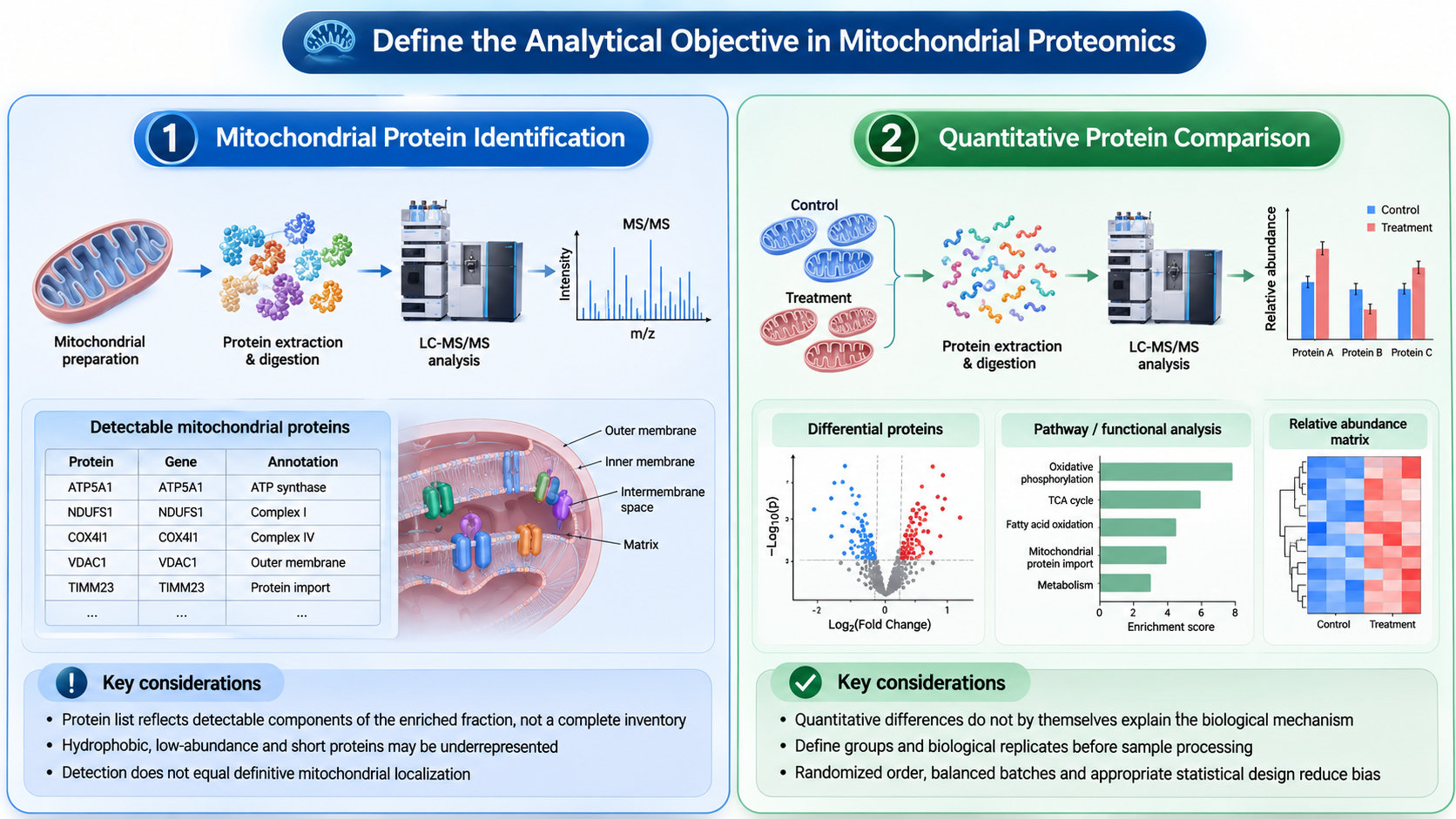
Figure 2. Comparison of mitochondrial protein identification and quantitative protein comparison.
Match the Sample to the Workflow
1. Starting Material and Preparation Status
(1) Cells and Tissues as Starting Materials
Projects may begin with cultured cells or animal tissues when mitochondrial enrichment has not yet been completed. Feasibility depends on the available amount, cell or tissue condition, collection consistency, storage history, biological composition, and expected mitochondrial abundance.
Tissues differ substantially in extracellular matrix content, lipid composition, blood contamination, cellular heterogeneity, and mitochondrial density. A preparation strategy suitable for one tissue may not perform identically with another. Before outsourcing, the supplier should receive enough information to evaluate whether the available input is compatible with mitochondrial enrichment, protein extraction, and the proposed analytical workflow.
(2) Isolated Mitochondria and Enriched Fractions
Customer-prepared mitochondrial fractions require detailed documentation. Relevant information includes the starting material, isolation method, buffer composition, use of detergents or inhibitors, protein concentration, storage temperature, freeze-thaw history, and whether all samples were prepared using the same procedure.
Buffer components that interfere with protein extraction, digestion, labeling, chromatography, or electrospray ionization may require removal or method adjustment. Differences in preparation timing or operator technique can also introduce quantitative variation that cannot be fully corrected during data analysis.
2. Sample Quality and Proteome Accessibility
(1) Mitochondrial Enrichment and Co-Isolated Proteins
Mitochondrial enrichment increases access to organelle-associated proteins but does not produce an absolutely isolated biological compartment. Enrichment quality can be evaluated through marker proteins, protein-distribution patterns, complementary assays, or comparison with expected subcellular annotations.
The acceptable level of co-enrichment depends on the research objective. A broad discovery study may tolerate some background while still identifying useful biological patterns. A project focused on mitochondrial localization or subtle organelle-specific changes requires stronger evidence that group differences are not driven by inconsistent preparation quality.
(2) Membrane Proteins and Low-Abundance Components
The mitochondrial proteome includes soluble matrix proteins, membrane-associated proteins, respiratory-chain components, transporters, and regulatory proteins across a wide abundance range. Hydrophobicity and membrane embedding can reduce extraction and digestion efficiency, while high-abundance proteins may suppress signals from less abundant peptides.
Coverage should therefore be evaluated as an outcome of the complete workflow rather than as a fixed instrument property. Extraction chemistry, reduction and alkylation, digestion strategy, peptide cleanup, chromatographic separation, acquisition depth, and data-analysis criteria all contribute to the detectable protein population.
Select the Quantitative Strategy
1. Label-Free and DIA-Based Quantification
(1) Label-Free Comparison for Flexible Study Designs
Label-free quantification is suitable for projects requiring flexible sample numbers or the addition of samples without predefined labeling channels. Each sample is generally prepared and analyzed separately, so consistency across extraction, digestion, chromatography, and mass spectrometry runs is central to quantitative quality.
The approach can support both exploratory and comparative studies, but batch structure and missing values require attention. Randomized run order, pooled quality-control samples, retention-time monitoring, and appropriate normalization improve the reliability of comparisons across a large sample set.
(2) DIA for Consistent Multi-Sample Measurement
Data-independent acquisition records fragment-ion data across systematically defined precursor ranges. DIA is frequently selected when consistent peptide measurement across multiple samples is a priority and, under an appropriate acquisition and processing workflow, may reduce missingness relative to some data-dependent approaches.
Its performance still depends on chromatographic stability, spectral complexity, acquisition settings, library or library-free analysis strategy, identification thresholds, and data-processing software. A DIA result should be assessed through identification consistency, quantitative precision, signal distribution, missingness, and quality-control behavior rather than by protein count alone.
2. Isobaric Labeling and LC-MS/MS Acquisition
(1) Multiplexed Comparison and Channel Design
Isobaric labeling allows peptides from several samples to be combined and analyzed within a multiplexed experiment. Analyzing several labeled samples within the same multiplex can reduce some sources of between-run variation and support efficient comparison of multiple conditions.
Experimental design remains important. Channel allocation, pooled reference channels, batch bridging, sample balance, labeling efficiency, interference, and ratio compression can affect the quantitative output. Studies exceeding the capacity of one multiplex require a plan for cross-batch normalization and reference consistency.
(2) Instrumentation, Acquisition Depth, and Quality Control
A high-resolution mass spectrometer is an important component of mitochondrial proteomics, but the model name alone does not determine data quality. Acquisition mode, chromatography, gradient length, sample loading, ion-sampling strategy, maintenance status, and method optimization affect identification and quantification.
Supplier evaluation should include the proposed acquisition strategy, peptide and protein identification criteria, quantitative quality-control metrics, replicate assessment, missing-value handling, and procedures for reviewing analytical outliers. These details are more informative than a platform list without a study-specific workflow.
Evaluate Results and Supplier Fit
1. Expected Data and Deliverables
(1) Identification Tables and Quantitative Matrices
A protein identification table should allow the reader to trace reported proteins to supporting peptide or protein-group evidence and relevant confidence criteria. A quantitative matrix organizes abundance values across samples and forms the basis for statistical comparison.
The two outputs serve different purposes. Identification indicates that evidence for a protein was detected, while quantification estimates relative abundance under the selected analytical model. Missing values, shared peptides, protein grouping, normalization, and imputation decisions can influence downstream comparisons and should be documented.
(2) Differential Results and Functional Annotation
Differential analysis prioritizes proteins whose quantitative patterns meet predefined statistical and biological criteria. Fold change, variance, replicate consistency, multiple-testing correction, and missing-data behavior should be considered together rather than relying on one threshold.
Functional annotation and enrichment analysis can organize differential proteins into mitochondrial processes, complexes, pathways, or broader cellular functions. Enrichment indicates that an annotation is represented more strongly than expected in the selected protein set. It does not independently establish pathway activation, inhibition, or causal mechanism.
2. Evidence Boundaries and Project Review
(1) Protein-Level Evidence Versus Functional Validation
Mitochondrial proteomics measures protein-level evidence. It can reveal detectable proteins, relative abundance changes, and candidate pathways associated with an experimental condition. It does not directly measure mitochondrial respiration, ATP production, membrane potential, reactive oxygen species, calcium handling, mitochondrial morphology, or mitophagy flux.
Protein abundance changes may be used to formulate functional hypotheses, but those hypotheses require appropriately selected orthogonal experiments. A mechanistic conclusion should integrate proteomic results with the biological model, temporal evidence, perturbation experiments, and functional measurements.
(2) Information Needed Before Outsourcing
A meaningful supplier comparison requires more than a request for “mitochondrial proteomics.” Researchers should define the sample type, preparation status, available amount, storage condition, number of groups, biological replicates, primary comparison, and whether the main goal is identification, quantification, or both.
The review should also address the preferred quantitative strategy, batch structure, desired data files, statistical comparisons, annotation requirements, and downstream validation plans. Clear project information allows the supplier to identify limitations before sample submission and align the workflow with the intended evidence level.
The value of a mitochondrial proteomics project depends on the alignment among the biological question, sample quality, quantitative design, LC-MS/MS strategy, and interpretation plan. MtoZ Biolabs supports mitochondrial protein identification and quantitative comparison using high-resolution LC-MS/MS workflows. Submit your inquiry below for project evaluation.
MtoZ Biolabs, an integrated chromatography and mass spectrometry (MS) services provider.
Related Services
How to order?




