






Microscale Thermophoresis (MST) Service
Microscale Thermophoresis (MST) is a solution-based technique for analyzing molecular interactions under near-physiological conditions. It enables precise measurements of protein–protein, protein–nucleic acid, protein–small molecule, antibody–antigen, and lipid–ligand binding. With minimal sample requirements, fast operation, and high sensitivity, MST is widely applied in drug discovery, antibody affinity evaluation, signaling pathway analysis, and biomarker research.
MtoZ Biolabs provides high-quality Microscale Thermophoresis (MST) Service powered by the NanoTemper platform and expert scientific support. Our Microscale Thermophoresis (MST) Service delivers key binding parameters, including dissociation constants (Kd), affinity, and kinetics, helping researchers accelerate basic and translational studies.
Technical Principles
Microscale Thermophoresis is based on the thermophoretic effect. When a temperature gradient exists in solution, molecules migrate along the gradient depending on physical and chemical properties such as size, shape, surface charge distribution, hydrophobicity, and solvation layer. Binding between two molecules may alter these characteristics and the surrounding hydration shell, resulting in detectable changes in migration patterns under a temperature gradient. By monitoring these differences through extrinsic fluorescent labels or intrinsic fluorescence signals, and by designing titration experiments to generate complete concentration–response curves, quantitative parameters such as equilibrium affinity can be obtained. The entire process is performed in solution with low sample consumption under mild conditions, making it a reliable approach for quantifying molecular interactions.
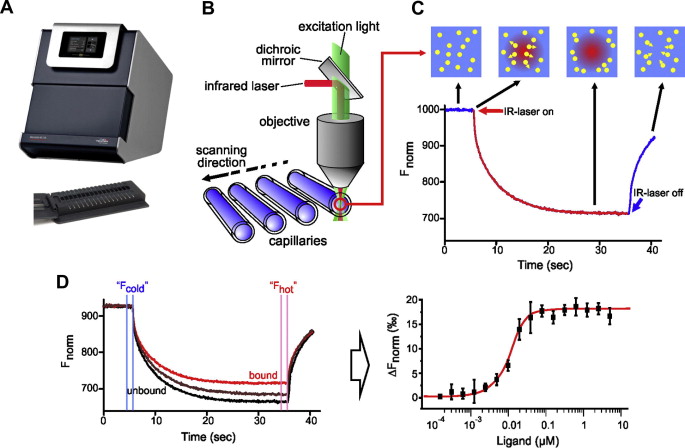
Jerabek-Willemsen, M. et al. J. Mol. Struct. 2014.
Figure 1. MST Setup and Experiments
Analysis Workflow
1. Sample Preparation
Clients provide molecular samples and basic information, and conditions are optimized according to experimental needs.
2. Labeling Strategy
Fluorescent labeling or label-free detection is selected based on research objectives.
3. Concentration Gradient Design
Binding reactions are established across multiple concentrations.
4. MST Measurement
Capillaries are exposed to a microscale temperature gradient, and molecular movement is monitored in real time.
5. Data Analysis
Binding constants and interaction parameters are calculated with professional software.
6. Result Output
Detailed reports are delivered, including binding curves, quality control, and scientific interpretation.
Why Choose MtoZ Biolabs?
✔ Advanced MST instrumentation supporting both label-free and labeled assays with high sensitivity and reliability.
✔ Minimal sample consumption with experiments performed in microliter volumes, saving precious resources.
✔ Measurements in conditions close to physiological environments, including serum and cell lysates, for biologically relevant results.
✔ Broad applicability covering proteins, nucleic acids, small molecules, and complex biological systems.
✔ End-to-end solutions from experimental design to execution and data interpretation.
Sample Submission Suggestions
MtoZ Biolabs accepts a wide variety of samples, including proteins such as antibodies, enzymes, and receptors, as well as small molecules, nucleic acids, liposomes, complexes, and biological samples such as serum, plasma, or cell lysates. To ensure data quality, we recommend that clients:
- Provide basic information such as molecular type, concentration range, and buffer composition to facilitate condition optimization.
- Avoid particles or strong autofluorescent substances in samples to reduce signal interference.
- For hydrophobic or aggregation-prone samples, consult with our team to design appropriate stabilization strategies.
- Prepare sufficient sample volume to support replicate experiments and controls.
A detailed sample submission guide is available upon request.
What Could be Included in the Report?
1. Comprehensive Experimental Details
2. Materials, Instruments, and Methods
3. Binding Curves & Affinity Results
4. Data Analysis, Preprocessing, and Estimation
5. Optional Bioinformatics Insights
6. Raw Data Files
MtoZ Biolabs provides Microscale Thermophoresis (MST) Service with a professional platform, flexible experimental strategies, and high-quality data delivery, supporting both academic research and drug development. If you are seeking efficient and accurate molecular interaction analysis, our expert team is ready to provide tailored solutions.
FAQ
Q1: What advantages does MST offer compared with SPR or ITC?
The main advantage of MST is that it does not require immobilization, thus avoiding conformational changes caused by fixation. It also consumes very little sample and allows detection in complex systems, providing results closer to real physiological environments. Compared with SPR and ITC, MST offers broader flexibility and faster experimental cycles, making it suitable for early-stage drug screening and mechanism studies.
Q2: Can MST detect weak interactions?
Yes. MST covers binding ranges from pM to mM. By optimizing experimental conditions, it can reliably detect weak affinity interactions.
Q3: Is fluorescence labeling always required for MST?
No. MST can use fluorescent labeling strategies but can also rely on intrinsic tryptophan fluorescence for label-free detection. We will recommend the most appropriate option according to research objectives.
Q4: What are the applications of MST in drug development?
Our Microscale Thermophoresis (MST) Service can be applied to study interactions such as small molecule–protein, substrate–enzyme, and ligand–receptor. It provides valuable data for drug screening, affinity evaluation, and mechanism studies, accelerating the drug development process.
Related Services
How to order?




