






Mesopore Measurement Analysis Service
Mesopore measurement is an important technique for measuring and characterizing mesopore structures. Its basic principle is to use methods such as gas adsorption–desorption to record the adsorption behavior of samples under different pressures, thereby calculating key parameters such as pore size, distribution range, specific surface area, and pore volume. Since mesopores play a central role in the processes of adsorption, diffusion, and reaction in materials, this method can reveal their physical properties and functional performance. This technique is characterized by high sensitivity, intuitive results, and a wide application range. It is commonly used to characterize the mesoporous structural features of silicon materials, polymers, and porous carriers, supporting performance research and structural optimization of biomaterials.
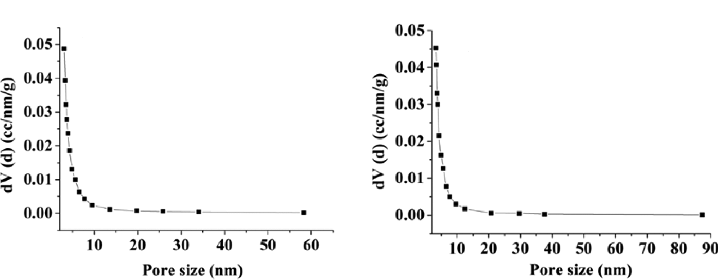
Zhang, H Y. et al. Analytical Chemistry, 2017.
Figure 1. Mesopore Size Distributions of Hybrid Monoliths Based on BJH Analysis of the Adsorption.
Services at MtoZ Biolabs
Based on an advanced mesopore measurement platform, MtoZ Biolabs has launched the mesopore measurement analysis service focuses on precise characterization of pore features in the 2–50 nm range. This service uses high-sensitivity gas adsorption experiments combined with modeling calculations to study the pore structure characteristics of silicon-based materials, polymers, and porous carriers. By analyzing adsorption–desorption isotherms and related parameters, it can obtain information on pore size distribution, specific surface area, and pore volume. The resulting data intuitively present the structural patterns and performance differences of materials, providing reliable support for the structural optimization and functional evaluation of bio-related materials.
Analysis Workflow
1. Sample Preparation
Clean and pretreat the sample to ensure a uniform surface and avoid impurities that may interfere with pore size measurement.
2. Gas Adsorption Experiment
Use nitrogen or other suitable gases to perform adsorption and desorption operations under different relative pressures, recording the isotherms.
3. Data Collection
Monitor gas volume changes in real time with a high-sensitivity sensor system to obtain raw data related to pore structure.
4. Model Analysis
Fit the adsorption–desorption curves using classical models such as BET and BJH to calculate pore size distribution, specific surface area, and pore volume.
5. Result Output
Generate pore size distribution plots and reports on specific surface area and pore volume parameters, providing intuitive data support for material structure and performance studies.
Sample Submission Suggestions
1. Sample Type
Applicable to silicon-based materials, polymers, filtration media, and porous carriers. Samples should be representative and uniform to ensure accurate mesopore structure measurement.
2. Sample Purity
It is recommended to remove impurities and moisture to avoid affecting the stability of gas adsorption–desorption signals and the accuracy of pore size distribution analysis.
3. Sample Storage
Samples should be stored under dry, dark, and appropriate temperature conditions to prevent moisture, oxidation, or light from altering the pore structure.
4. Sample Transportation
Use sealed containers during transportation, and when necessary, include desiccants or cold-chain conditions to ensure the integrity and stability of the samples before they reach the testing platform.
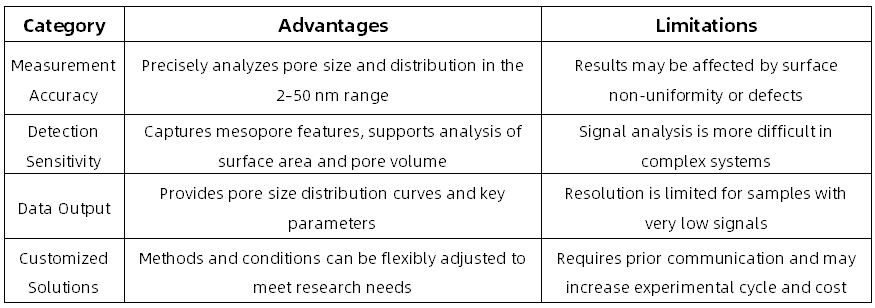
Advantages and Limitations
Applications
1. Cell Scaffold Research
Mesopore measurement analysis service can be used to analyze the pore characteristics of cell culture scaffolds or matrices, supporting studies on adhesion, migration, and proliferation.
2. Drug Delivery Systems
By evaluating the mesopore distribution and structure of carrier materials, it provides reference data for drug loading and release performance.
3. Biomembrane Characterization
Mesopore measurement analysis service can be applied to pore size and permeability detection of natural or artificial biomembranes, revealing their material exchange characteristics.
4. Biomaterial Performance Evaluation
It is suitable for structural analysis of porous biomaterials, supporting performance studies in tissue engineering and functional materials.
FAQ
Q1: Will This Method Damage the Sample?
A1: In general, it is considered a non-destructive testing method and does not alter the overall structure of the sample. However, some fragile or extremely thin samples may be slightly affected during testing due to pressurization or adsorption–desorption cycles.
Q2: Can the Test Results Be Used for Quantitative Research?
A2: Yes. It can provide quantitative data such as pore size, distribution, specific surface area, and pore volume. However, in complex porous systems, model fitting is required, and some results may be semi-quantitative.
Q3: Does It Support Customized Testing Conditions?
A3: Yes. Depending on research needs, different adsorption gases can be selected, and the pressure and temperature ranges can be adjusted to accommodate different sample types and experimental objectives.
How to order?




