






Mercury Porosimetry Based Porosity and Pore Size Distribution Analytical Service
Porosity and pore structure play vital roles in determining the physical and functional properties of materials. They influence mechanical strength, permeability, adsorption capacity, catalytic performance, and overall material stability. Understanding the pore characteristics of solids is therefore essential in fields such as pharmaceuticals, catalysis, filtration, construction materials, and energy storage.
Mercury intrusion porosimetry (MIP) is a widely used and powerful technique for measuring pore size distribution, total porosity, pore volume, and specific surface area of porous materials. The method relies on the ability of mercury to penetrate void spaces under controlled pressure. Since mercury is non-wetting, it does not enter pores spontaneously but requires external pressure to overcome surface tension. The applied pressure and resulting volume of mercury intrusion are used to calculate pore size according to the Washburn equation. The pressure required to force mercury into a pore is inversely proportional to the pore diameter. Low pressures correspond to larger pores, while high pressures fill progressively smaller pores. By incrementally increasing the pressure and measuring the volume of mercury intruded into the sample, the instrument constructs a pore size distribution profile.
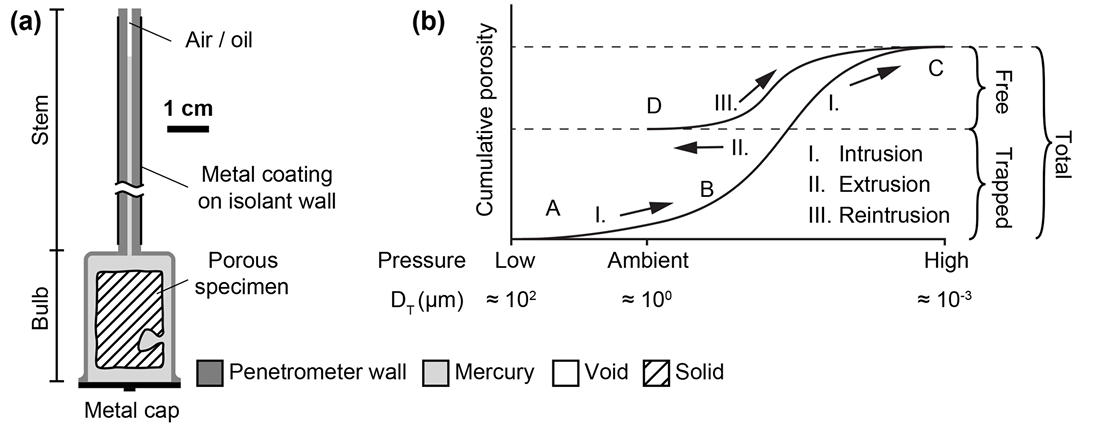
Stanek, M. et al. Solid Earth Discussions. 2018.
Figure 1. Mercury Porosimetry
(a) Schematic Drawing of a Penetrometer (Specimen Holder)
(b) Plot of an Idealised Cumulative Porosimetric Curve
Service at MtoZ Biolabs
MtoZ Biolabs provides a comprehensive Mercury Porosimetry Based Porosity and Pore Size Distribution Analytical Service designed to accurately characterize porous structures across micropore ranges. Utilizing high-precision instrumentation and advanced data modeling, our service enables clients to obtain detailed pore structural parameters, helping them correlate porosity with material performance, mechanical behavior, and processing efficiency.
Our Mercury Porosimetry Based Porosity and Pore Size Distribution Analytical Service includes:
🔸Porosity and Pore Volume Measurement: Determination of open and total porosity, pore volume, and skeletal density of powdered, granular, or bulk materials.
🔸Pore Size Distribution Analysis: Pore Size Distribution Analysis: High-resolution mapping of pore size across microporous ranges for structure–property correlation.
🔸Specific Surface Area Calculation: Estimation of total internal surface area derived from intrusion–extrusion data.
🔸Material Integrity and Compaction Evaluation: Analysis of mechanical compression and pore collapse behavior under applied pressure.
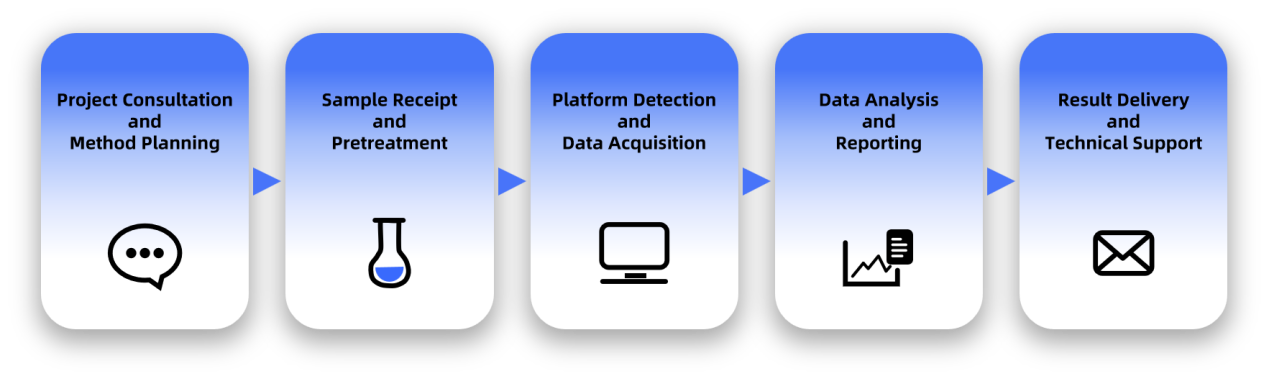
Analysis Workflow
Service Advantages
☑️Advanced Analytical Platform: Equipped with high-precision mercury porosimeters offering wide pressure and pore size detection ranges.
☑️High Data Accuracy: Automated pressure control and real-time volume sensing ensure superior measurement reliability.
☑️Comprehensive and Customizable: Full-scope porosity characterization tailored to material type and application requirements.
☑️Professional Expertise: A multidisciplinary team specializing in materials science, catalysis, and pharmaceutical formulation analysis.
Applications
1. Catalyst Development
Evaluate pore structure to optimize surface area and accessibility for catalytic reactions.
2. Pharmaceuticals and Excipients
Characterize tablet compaction behavior, powder flowability, and porosity affecting dissolution and stability.
3. Filtration and Membrane Materials
Determine pore size uniformity and flow resistance for membranes and filter media.
4. Building and Ceramic Materials
Analyze pore networks in cement, ceramics, and composites to predict mechanical strength and permeability.
5. Battery and Energy Materials
Study electrode and separator porosity to enhance ion transport and energy efficiency.
6. Polymeric and Biomaterials
Characterize scaffold porosity and interconnectivity for tissue engineering and controlled-release applications.
Sample Submission Suggestions
1. Sample Type: Suitable for powders, pellets, monoliths, ceramics, polymers, and composites.
2. Sample Quantity: Provide at least 2–3 g of solid material for analysis.
3. Sample Dimensions: The size should not exceed 15 mm × 15 mm × 15 mm.
*Note: For other sample types or low-yield materials, please contact us before preparation.
Deliverables
1. Detailed Experimental Records
Complete documentation of instrumentation, analytical parameters, and test conditions.
2. Raw Data Files
Pressure–volume intrusion and extrusion datasets.
3. Graphical Outputs
Cumulative and differential pore size distribution curves, porosity plots, and surface area calculations.
4. Comprehensive Analytical Report
Summarized results, interpretation of pore structure, and correlations to material performance.
Whether optimizing a catalyst, designing a pharmaceutical excipient, or developing next-generation materials, MtoZ Biolabs' Mercury Porosimetry Based Porosity and Pore Size Distribution Analytical Service offers the analytical precision and technical insight you can trust. Contact us today to explore tailored solutions for your research.
How to order?




