






Mass Spectrometry-Based Host Cell Protein Analysis: Principles, Workflow, and Benefits
In the biopharmaceutical field, recombinant protein therapeutics, such as monoclonal antibodies and fusion proteins, expressed and purified in mammalian cells, for example CHO cells, often contain a significant impurity: host cell proteins (HCPs). If HCPs are not thoroughly removed during downstream purification, they can induce immunogenic responses, compromise drug stability, and even pose safety risks to patients. Consequently, accurate identification and quantification of HCPs is a critical step in ensuring the quality and safety of biopharmaceutical products.
Why Choose Mass Spectrometry for HCP Analysis?
Traditional HCP detection primarily relies on ELISA, enzyme-linked immunosorbent assay. While ELISA offers high throughput and low cost, it has several limitations:
-
Limited Antibody Coverage: ELISA relies on antibody recognition, which may fail to detect HCPs not targeted by the antibodies.
-
Qualitative Rather Than Comprehensive Quantitative Information: ELISA cannot provide specific data for individual HCPs.
-
Lack of Species-Specific Information: ELISA cannot reliably determine the species origin of host proteins.
In contrast, mass spectrometry (MS) provides a more forward-looking approach, offering comprehensive and high-resolution data.
Principles of MS-Based HCP Analysis
Mass spectrometry is a high-throughput technology that identifies and quantifies molecules by measuring the mass-to-charge ratio, m/z, of ions. For HCP analysis, the LC-MS/MS, liquid chromatography-tandem mass spectrometry, platform is commonly employed, consisting of the following key steps:
1. Protein Digestion
Proteins in the sample are typically digested using trypsin to generate peptides suitable for mass spectrometry analysis. This step is essential for the subsequent identification of HCPs.
2. Liquid Chromatography Separation
The digested peptides are separated by high-performance liquid chromatography (HPLC) to reduce sample complexity and enhance MS detection sensitivity.
3. Tandem Mass Spectrometry Detection
MS/MS analysis is performed on high-resolution mass spectrometers, such as Orbitrap or Q-TOF instruments. Protein identification and quantification are achieved by interpreting peptide fragment spectra.
4. Data Analysis and Database Matching
Specialized software, for example MaxQuant or Proteome Discoverer, is employed to match acquired MS/MS data against the host species database, enabling accurate identification and quantification of individual HCPs.
Standardized HCP-MS Workflow
To ensure high reproducibility and comparability, MtoZ Biolabs follows a rigorously standardized HCP-MS workflow comprising the following critical steps:
1. Sample Pre-Treatment
-
Denaturation and Unfolding: Disrupts protein tertiary and quaternary structures to enhance enzymatic digestion efficiency.
-
Reduction and Alkylation: Eliminates interference from disulfide bonds and preserves peptide integrity.
2. Protein Digestion
Optimized digestion conditions are applied to achieve simultaneous digestion of host and therapeutic proteins, improving overall detection coverage.
3. High-Resolution MS Detection
Advanced instruments, such as the Orbitrap Exploris 480, enable detection with ppb-level sensitivity. Both DDA, data-dependent acquisition, and DIA, data-independent acquisition, modes are supported to accommodate diverse research requirements.
4. Data Processing and Annotation
Using built-in database matching, host-species-specific proteins are identified. Dual-level quantification is provided at both the protein and peptide levels.
Advantages of MS-Based HCP Analysis
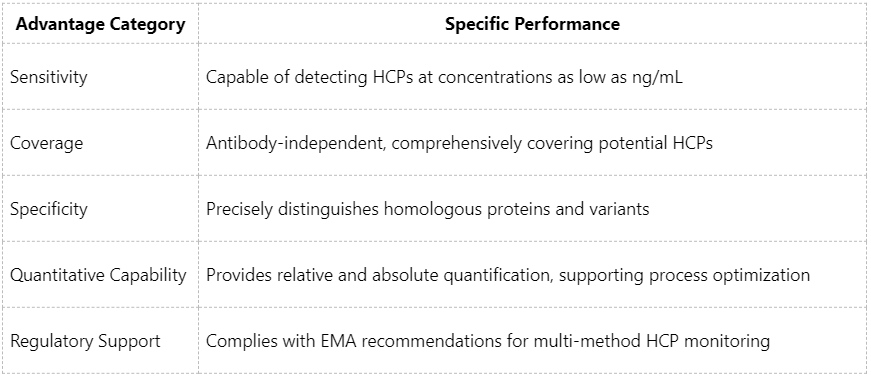
MS also facilitates dynamic monitoring at various production stages, such as:
-
Analysis of HCP profiles in fermentation supernatants.
-
Comparison of HCP residues before and after purification.
-
Assessment of HCP composition stability following process changes.
Application Scenarios: Full-Process Support from R&D to Clinical Development
1. Process Development Stage
Comparing the impact of different expression systems, culture media, or purification processes on HCP profiles.
2. Quality Control Stage
As a complementary tool to ELISA, MS identifies potential risk HCPs in immunologically blind regions.
3. Regulatory Submission Stage
Providing data reports to support regulatory review and enhance approval success.
MtoZ Biolabs: A Trusted Partner for HCP MS Analysis
MtoZ Biolabs leverages extensive proteomics expertise and advanced mass spectrometry platforms to deliver one-stop solutions, including method development, sample testing, and data interpretation. Key advantages include:
-
Ultra-Sensitive MS Platforms: Flagship instruments such as Orbitrap and TripleTOF.
-
Experienced Analytical Team: Over 10 years of proteomics research experience.
-
Customized Reporting: Compliant with regulatory standards, providing clear visualization of key data.
-
Flexible Sample Support: Compatible with fermentation broth, purified intermediates, and final products.
With increasing regulatory emphasis on quality and safety in the biopharmaceutical industry, MS-based HCP analysis has become an essential tool for monitoring HCPs. Its comprehensiveness, sensitivity, and high-resolution capabilities provide unprecedented protein-level insights for developers of biotherapeutics. MtoZ Biolabs is committed to empowering biopharmaceutical R&D and quality control through state-of-the-art proteomics technology. For any needs in HCP detection, mass spectrometry analysis, or proteomics research, inquiries for customized service solutions are welcome.
MtoZ Biolabs, an integrated chromatography and mass spectrometry (MS) services provider.
Related Services
How to order?




