






Liquid NMR Analytical Service | Structure Analytical Service
- Drug molecular structure identification and confirmation: structural elucidation of new drug candidates, chemical modification assessment, and impurity verification.
- Protein and peptide structural studies: analysis of secondary and tertiary structures, conformational dynamics, and non-crystalline biomolecules.
- Drug–target interaction analysis: mapping binding sites, affinities, and binding modes of small molecules with proteins or nucleic acids.
- Impurity and metabolite profiling: characterization of metabolites or impurities in complex systems and formulations.
- Pharmacokinetics and conformational dynamics: real-time tracking of molecular motion, folding, and ligand-binding processes.
- Formulation research: assessment of excipients, polymer carriers, or complex formulations for compatibility and stability.
Liquid nuclear magnetic resonance (liquid NMR) is an analytical technique used to study molecular structure and dynamics in solution. By applying a strong magnetic field and exciting the sample with radiofrequency pulses, certain nuclei (such as ¹H, ¹³C, ¹⁵N, ³¹P) produce characteristic resonance signals. These signals are transformed through Fourier analysis to generate spectra that reflect the chemical environment, spatial conformation, and intermolecular interactions of molecules.
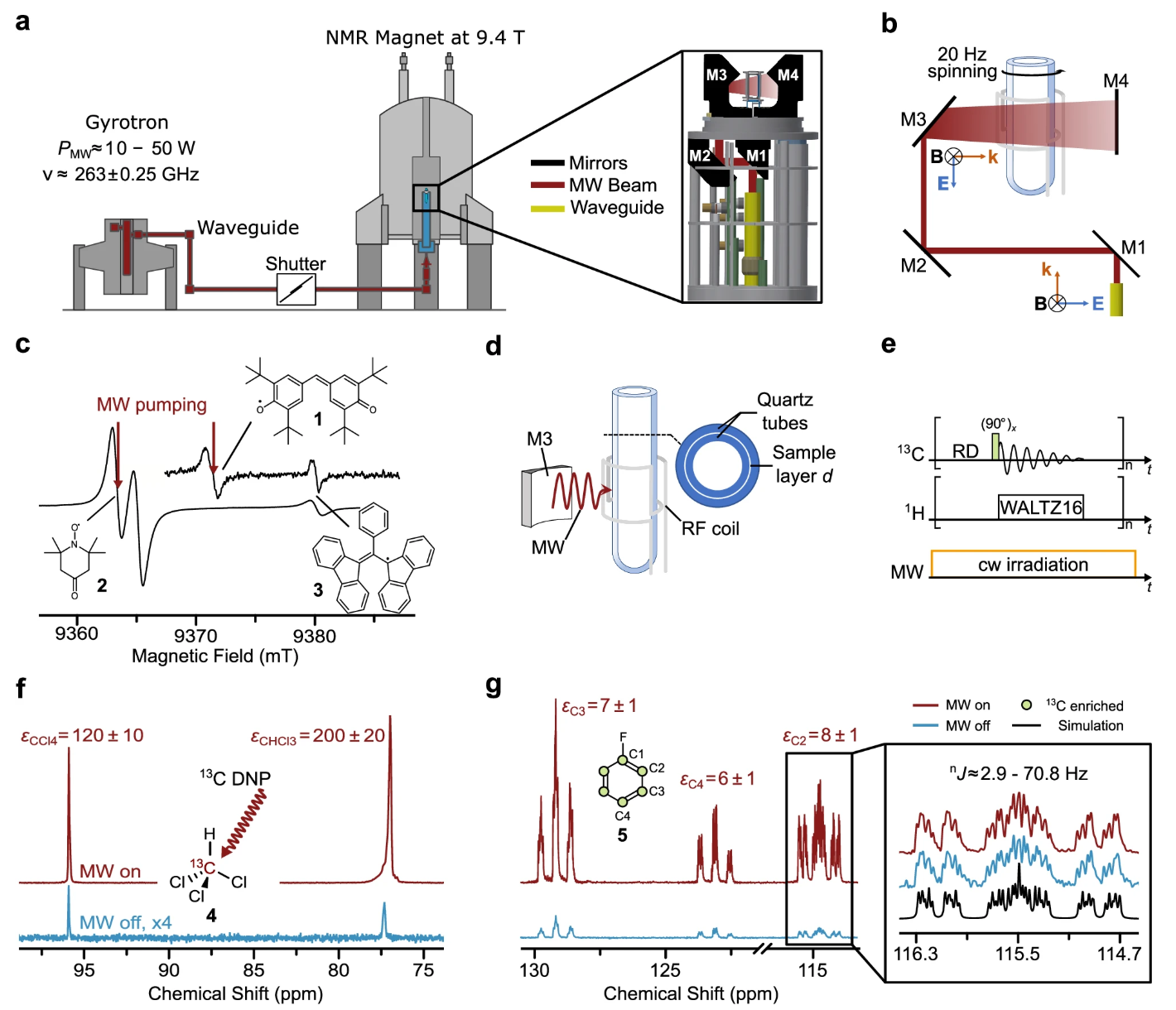
Levien, M. et al. Nat Commun. 2024.
Figure 1. High-field Liquid NMR Spectrometer and Performance
Liquid NMR enables atomic-level resolution of molecular structures, chemical environments, and conformational features, while also revealing dynamic processes. The technique is non-destructive, meaning samples can usually be reused for subsequent experiments, offering greater flexibility in research workflows. Liquid NMR has a wide scope of application: it can be used to confirm and assess the purity of small-molecule drugs, as well as to study the structures of proteins, peptides, and nucleic acids. It provides both qualitative and quantitative information, confirming molecular identity and accurately evaluating composition ratios and purity. Depending on research requirements, Liquid NMR can be divided into several modes, including Single-Nucleus NMR, Two-Dimensional NMR, Dynamics and Relaxation Experiments (T₁, T₂, NOE), and Quantitative NMR (qNMR).
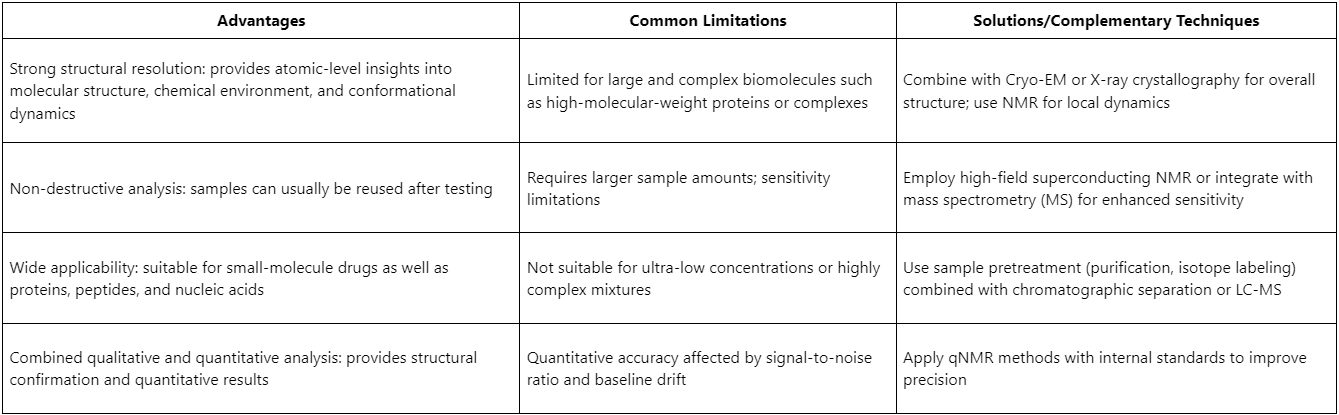
The following table summarizes the major advantages of Liquid NMR, common limitations encountered during application, and corresponding solutions or complementary technologies:
Services at MtoZ Biolabs
Building on advanced NMR instrumentation and an experienced team of specialists, MtoZ Biolabs provides a liquid NMR analytical service to support structural elucidation, quantitative analysis, and dynamic studies in pharmaceutical and life science research. Our service includes, but is not limited to:
1. Single-Nucleus NMR (¹H-NMR, ¹³C-NMR, ³¹P-NMR, etc.)
Provides high-resolution NMR spectra for analyzing chemical shifts, coupling patterns, and functional group environments. Commonly applied in the structural confirmation of small-molecule drugs, purity and impurity profiling, as well as in the compositional analysis of biomolecules such as nucleic acids and phospholipids.
2. Two-Dimensional NMR (COSY, HSQC, HMBC, NOESY)
Establishes correlations between different nuclei to reveal bonding relationships and spatial proximity, supporting three-dimensional structural elucidation of complex molecules. Particularly suitable for the advanced structural and stereochemical analysis of proteins, peptides, and other macromolecules.
3. Quantitative NMR (qNMR)
Combines structural analysis with absolute quantification, using internal or external standards to precisely determine sample purity, impurity levels, and target compound concentration. Widely used for pharmaceutical quantification, reference standard calibration, and formulation quality control.
4. Dynamics and Relaxation Experiments (T₁, T₂, NOE)
Characterizes molecular motion, binding dynamics, and conformational exchange processes. Provides valuable insights into biomolecular flexibility, intermolecular interaction strength, and dynamic behavior in solution, supporting secondary structure and functional studies of proteins and peptides.
Service Advantages
1. High Structural Resolution
Advanced Liquid NMR systems provide atomic-level information on chemical shifts, coupling patterns, and conformational changes, supporting precise molecular structure determination in pharmaceuticals and biomolecules.
2. Versatile Analytical Modes
Our liquid NMR analytical service covers single-nucleus NMR, two-dimensional NMR, qNMR, and relaxation/dynamics studies, ensuring comprehensive characterization of molecular properties.
3. Expert Interpretation and Validation
Our experienced specialists excel in NMR spectral analysis and method development, ensuring accurate signal assignment, robust structural validation, and reliable quantitative conclusions.
4. Tailored, End-to-End Solutions
MtoZ Biolabs provides integrated liquid NMR analytical service covering experimental design, isotope labeling strategies, data acquisition, and comprehensive reporting, offering personalized solutions for diverse research and industrial needs.
Applications
Analysis Workflow
1. Sample Consultation and Preparation
Clients provide sample type, concentration, solvent conditions, and analytical objectives. MtoZ Biolabs offers detailed submission guidelines to ensure sample suitability and stability.
2. Experimental Design
Our specialists design tailored NMR protocols according to research requirements, selecting appropriate nuclei (¹H, ¹³C, ³¹P) or advanced modes (2D NMR, qNMR, relaxation studies).
3. Spectral Acquisition
Samples are analyzed using high-field NMR instruments. Optimized acquisition parameters ensure high sensitivity, resolution, and reproducibility.
4. Data Processing and Analysis
Raw data undergo Fourier transformation, baseline correction, and peak assignment. Comprehensive interpretation delivers structural, quantitative, and dynamic insights.
5. Reporting and Delivery
MtoZ Biolabs provides a full report including spectra, detailed interpretation, experimental methods, and conclusions, ensuring research reproducibility and industrial compliance.
With outstanding capabilities in structural elucidation, quantitative analysis, and dynamic characterization, Liquid NMR has become an indispensable tool in pharmaceutical R&D and quality control. Leveraging advanced NMR platforms and a team of seasoned specialists, MtoZ Biolabs delivers high-resolution, reliable, and reproducible liquid NMR analytical service to accelerate both research and industrial applications. Whether you require small-molecule structure confirmation, protein conformational studies, or quantitative and interaction analyses in complex systems, we provide fully customized, one-stop solutions.
Contact us today to initiate your Liquid NMR testing project.
How to order?




