






Liquid Chromatography Analytical Service
- Life Science Research: Used for the separation and quantification of metabolites, small molecules, and biomacromolecules such as amino acids, peptides, and proteins, supporting mechanism studies and biomarker discovery.
- Pharmaceuticals and Biopharmaceuticals: Applied to impurity detection, purity determination, and residual analysis of active pharmaceutical ingredients, intermediates, and formulations to ensure drug quality and compliance.
- Food and Beverages: Analyzes food additives, contaminants, and nutrients to support food safety monitoring and formulation optimization.
- Environmental Monitoring: Detects organic pollutants and metabolites in water, soil, and air, providing data support for environmental risk assessment.
- Materials Science: Characterizes polymer additives, monomer residues, and surfactants, assisting in new material development and performance validation.
Liquid Chromatography Analytical Service is an analytical service based on liquid chromatography (LC) technology for the separation, identification, and quantification of complex mixtures, particularly suitable for the detection of non-volatile, thermally unstable, and highly polar compounds. Compared with gas chromatography (GC), liquid chromatography does not require high-temperature vaporization, making it more appropriate for the separation and characterization of thermally unstable molecules as well as highly polar and low-volatility substances. In fields such as pharmaceuticals, biomedicine, food safety, environmental monitoring, and materials science, LC has become an essential tool for detecting active pharmaceutical ingredients (APIs), impurities, metabolites, and additives.
Technical Principles
The separation principle of liquid chromatography is based on differences in the partitioning behavior of compounds between the mobile phase and the stationary phase. After being dissolved, the sample enters the chromatographic column with the mobile phase, and different components interact with the stationary phase through polarity, hydrophobicity, charge, or molecular size in varying degrees, leading to different retention times and thus separation. Detectors such as ultraviolet (UV) detectors and fluorescence detectors, as well as systems coupled with mass spectrometry (LC-MS, LC-MS/MS, LC-Q-TOF-MS), can convert the separated signals into interpretable data, enabling both qualitative identification and quantitative analysis of compounds.
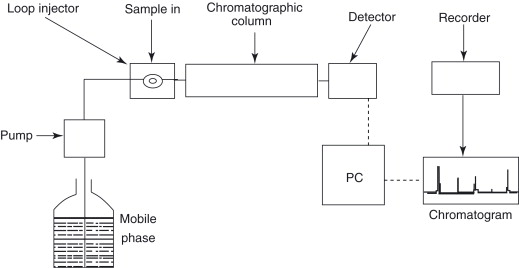
Guerra R. Encyclopedia of Analytical Science (Second Edition). 2005.
Figure 1. Diagram of a Typical LC Setup
Analysis Workflow
The general process of Liquid Chromatography Analytical Service is as follows:
1. Sample Preparation
Depending on the sample properties, perform dissolution, dilution, or derivatization to ensure stability and compatibility with the chromatographic system.
2. Chromatographic Separation
Apply reversed-phase, normal-phase, ion-exchange, size-exclusion, or two-dimensional LC to achieve component separation.
3. Signal Detection
Collect signals of separated components using detectors such as UV, fluorescence, or high-resolution mass spectrometry.
4. Data Analysis
Use specialized software to analyze retention time, peak area, and other data to achieve qualitative and quantitative analysis.
5. Report Generation
Deliver a complete report including experimental conditions, chromatograms, and result interpretation.
Service Advantages
1. Broad Compound Applicability
Effectively analyzes non-volatile, thermally unstable, and highly polar compounds, making it suitable for research in pharmaceuticals, food, environmental science, and other fields.
2. Multi-Mode Separation Capability
Supports a variety of chromatographic modes, including reversed-phase, normal-phase, ion-exchange, and size-exclusion chromatography, enabling flexible adaptation to different sample types.
3. High-Sensitivity Detection Platform
Combines UV, fluorescence, and high-resolution mass spectrometry to achieve precise detection of trace impurities and complex components.
4. High-Data-Quality
Deep data coverage with strict data quality control. An AI-powered bioinformatics platform integrates all Liquid Chromatography Analytical Service data, providing clients with a comprehensive data report.
5. Flexible Customized Solutions
Provides personalized analytical workflows tailored to client objectives, offering full support from method development to validation.
Services at MtoZ Biolabs
Relying on advanced liquid chromatography platforms and multiple types of detectors, MtoZ Biolabs provides Liquid Chromatography Analytical Service covering impurity and residual analysis, quantitative composition determination, protein and small molecule characterization, as well as method development and validation. We design analytical solutions flexibly according to sample properties and client requirements, and deliver complete chromatograms, qualitative and quantitative data, and standardized reports, providing systematic and reliable data support for both research and industry.
Sample Submission Suggestions
Ensure that samples are pure, stable, and have good solubility. If specific solvents are required for dissolution, please indicate this in advance. It is recommended to contact our technical support team before submission to assess sample suitability and obtain tailored submission guidance.
Applications
How to order?




