






LC-MS Metabolomics and Lipidomics: Why Separation Matters
Separation matters in LC-MS metabolomics and LC-MS lipidomics because the molecules being measured are chemically too diverse for a single analytical method to capture them comprehensively. The metabolome and lipidome span highly water-loving compounds, strongly fat-loving lipids, and everything in between. When such different molecules enter the mass spectrometer together, they can interfere with each other through ion suppression and signal overlap, reducing sensitivity and limiting reliable detection of some compounds.
Liquid chromatography (LC) solves this by spreading the molecules out in time before they reach the mass spectrometer (MS). Instead of a crowded, overlapping signal, the detector sees compounds arriving in an orderly sequence, which improves sensitivity, reduces interference, and makes reliable annotation possible.
The implication for experimental design is clear: because no single separation condition captures every molecular class equally well, broad coverage in metabolomics and lipidomics usually relies on more than one complementary LC-MS method rather than a single universal run.
The Core Problem: One Sample, Many Chemistries
A biological sample is not a tidy set of similar molecules. It is a mixture of chemistries that behave in almost opposite ways.
-
Polar metabolites such as sugars, amino acids, and organic acids dissolve readily in water and barely interact with fatty surfaces.
-
Nonpolar lipids such as triglycerides and many membrane lipids are strongly fat-loving and poorly soluble in water.
-
Intermediate compounds sit somewhere between these extremes.
This range is the central challenge of LC-MS metabolomics and LC-MS lipidomics. A method tuned to hold onto water-loving metabolites will let fat-loving lipids rush straight through, while a method built for lipids will fail to retain the polar compounds. Trying to force both types through one condition means measuring neither well.
That is why coverage is fundamentally a chemistry and method-design challenge, not simply an instrument-performance question. Increasing instrument sensitivity alone cannot overcome insufficient separation, because overlapping molecules may still limit detection performance.
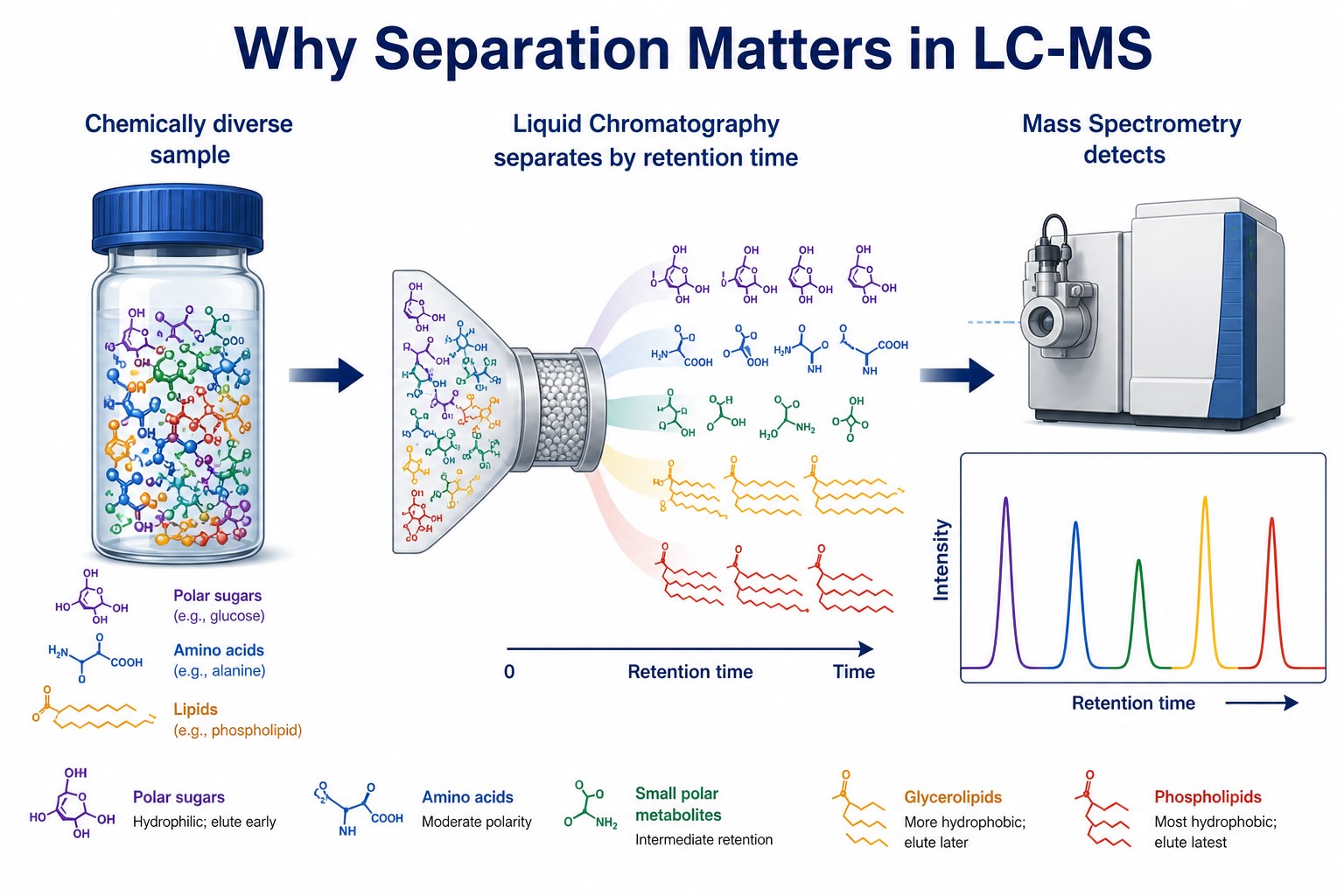
Figure 1. A diverse sample is spread out by liquid chromatography before mass spectrometry detection, so compounds are measured in sequence rather than all at once.
How LC-MS Separation and Detection Work Together
LC-MS integrates two complementary processes: liquid chromatography provides molecular separation, while mass spectrometry provides detection and structural information.
Liquid chromatography does the separating. The sample is pushed through a column packed with a material that interacts with molecules to different degrees. Compounds that stick more strongly move slowly; those that interact weakly move quickly. As a result, molecules leave the column at different times, a property called retention time.
Mass spectrometry provides molecular detection and structural information. As compounds emerge from the column, they are ionized and sorted by their mass-to-charge ratio, giving each a measurable signal. Fragmenting those ions produces MS/MS spectra that carry structural information used for annotation.
Neither half is enough alone. Mass spectrometry without good separation faces too many molecules at once, so signals overlap and weaker compounds are lost. Separation without mass spectrometry cannot identify what each peak is. Together, retention time and mass spectra give both when a molecule appears and what it is likely to be.
Separation Strategies for Different Chemistries
Because molecular chemistries differ, different separation strategies are required to achieve appropriate coverage. Two major approaches are commonly used for LC-MS metabolomics and lipidomics.
-
Reversed-phase separation retains fat-loving and moderately polar molecules well. It is the workhorse for many metabolites and for most lipids, which is why it features heavily in LC-MS lipidomics.
-
Polar-retentive separation (often described as HILIC-type) is designed to retain highly polar metabolites that are poorly retained under reversed-phase conditions, such as sugars, amino acids, and small organic acids.
Ionization adds a second layer of strategy. Molecules are measured in positive or negative ionization mode, and many compounds are only visible, or only visible well, in one of them. Acidic compounds often prefer negative mode, while many others respond better in positive mode.
Together, separation chemistry and ionization mode determine the molecular coverage achievable in a given LC-MS workflow. Rather than one universal setting, LC-MS detection relies on deliberate selection of conditions to capture the molecular classes relevant to a study.
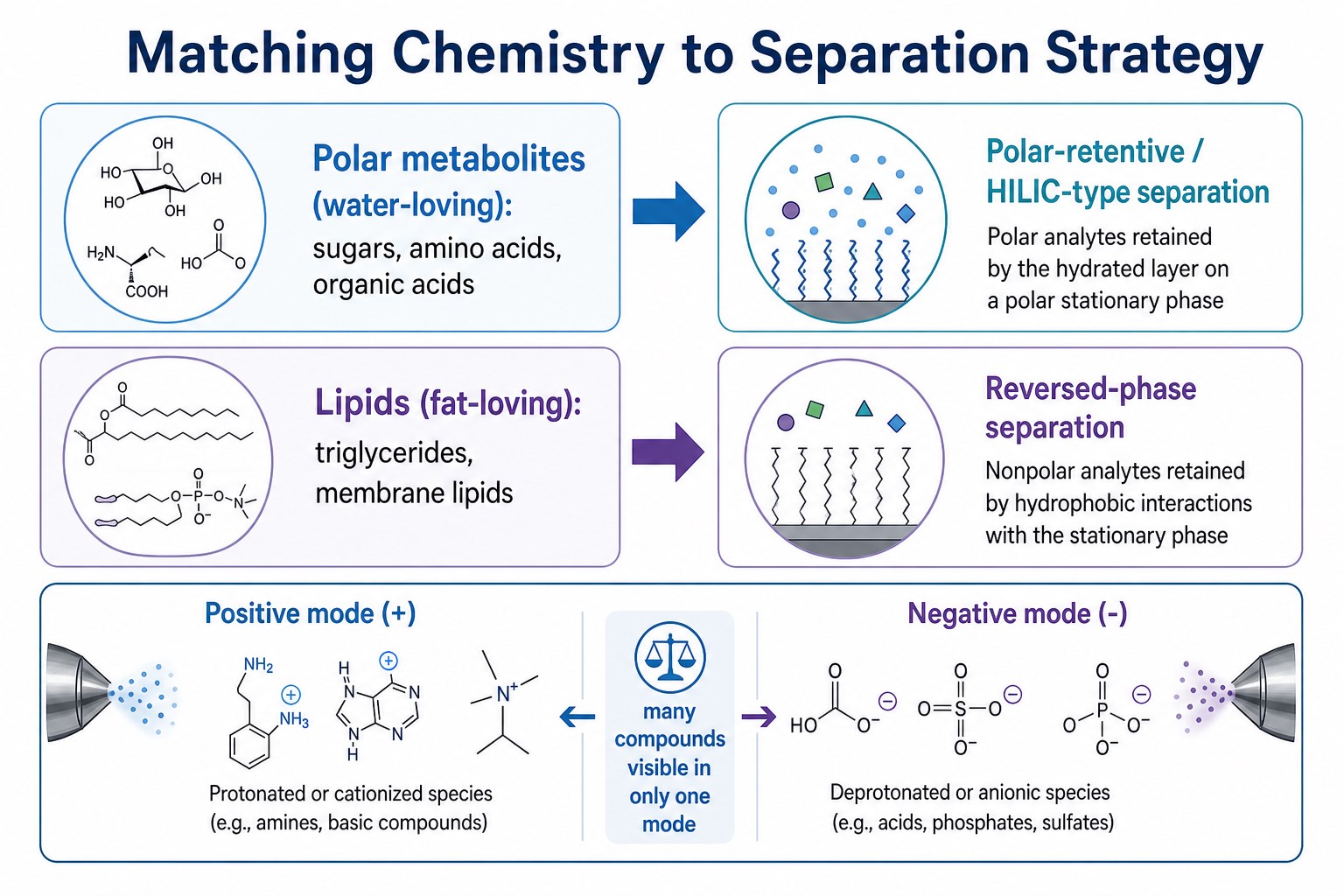
Figure 2. Polar metabolites and nonpolar lipids call for different separation chemistries and ionization modes, so coverage comes from complementary conditions.
Matching Chemistry to Detection Strategy
The table below links common chemical properties to the separation and detection considerations they drive.
|
Molecule type |
Chemical behavior |
Separation approach |
Typical detection note |
|---|---|---|---|
|
Polar metabolites |
Water-loving, poorly retained on nonpolar columns |
Polar-retentive (HILIC-type) |
Often needs a dedicated run |
|
Lipids |
Fat-loving, poorly water-soluble |
Reversed-phase |
Central to LC-MS lipidomics |
|
Intermediate metabolites |
Mixed polarity |
Reversed-phase, sometimes both |
May appear in more than one method |
|
Acidic metabolites |
More readily detected in negative ion mode |
Depends on polarity |
Often favor negative mode |
This table provides a general coverage framework rather than a fixed rule. The point is that a molecule's chemistry determines how it must be separated and detected, which is exactly why one method cannot serve every compound equally.
What This Means for Coverage
The most important takeaway for planning is that coverage is built, not assumed.
Because no single LC-MS condition captures polar metabolites and diverse lipids equally well, broad studies typically combine complementary methods. A metabolomics program may pair a reversed-phase run with a polar-retentive run, and acquire in both ionization modes, so that water-loving and fat-loving molecules are each measured under conditions suited to them.
Lipidomics follows the same logic within lipid space. Lipids themselves range widely in polarity, so LC-MS lipidomics is organized to resolve lipid classes and species rather than squeeze them into a metabolite-oriented method.
Therefore, a single LC-MS run is generally not expected to provide comprehensive coverage of all metabolite and lipid classes. What a well-designed study delivers instead is deliberate, documented coverage of the molecule classes the biology depends on, achieved by matching conditions to chemistry.
Sample Notes for LC-MS Studies
Detection strategy is only half the story; the sample has to support it.
Common sample types, including serum and plasma, urine, feces, tissue, cells, and culture supernatant, can be analyzed using LC-MS workflows, although sample preparation and extraction strategies may vary depending on the matrix. Because polar and lipid analyses may draw on the same material, providing an adequate amount helps ensure both sides of a broad study can be run without compromise.
Less common matrices require project-specific evaluation so that extraction and separation strategies can be matched to sample characteristics rather than forced onto a generic protocol. Teams unsure how their molecules and samples map onto LC-MS coverage can review the plan with MtoZ Biolabs before the study begins.
Related Services
Metabolomics and Lipidomics Analysis Services
Untargeted Metabolomics Service
Targeted Metabolomics Analysis Service
Frequently Asked Questions
1. Why does separation matter so much in LC-MS metabolomics and lipidomics?
Because the molecules are chemically very different. Without separation they overlap and interfere in the mass spectrometer, so many compounds are poorly detected or missed. LC spreads them out so each can be measured cleanly.
2. Can one LC-MS run measure both polar metabolites and lipids well?
Not equally. A condition tuned for water-loving metabolites lets lipids pass through, and vice versa. Broad coverage usually combines complementary methods.
3. What is the difference between reversed-phase and polar-retentive separation?
Reversed-phase retains fat-loving and moderately polar molecules, covering many metabolites and most lipids. Polar-retentive (HILIC-type) separation holds onto very water-loving compounds that reversed-phase does not retain well.
4. Why are positive and negative ionization modes both used?
Many compounds are only well detected in one mode. Acidic molecules often favor negative mode, while others respond better in positive mode, so both are used to widen coverage.
5. Does more coverage mean I always need multiple methods?
Not always. A focused question may need only one method, while broad profiling benefits from complementary runs. The right balance depends on which molecule classes your study relies on.
Conclusion
LC-MS metabolomics and LC-MS lipidomics work because separation solves a problem the detector cannot solve alone. The metabolome and lipidome are too chemically diverse for one condition to measure everything, so liquid chromatography spreads molecules out in time and lets the mass spectrometer see them clearly and in sequence.
That is why detection strategy comes down to matching chemistry to conditions: reversed-phase and polar-retentive separations, positive and negative ionization, combined thoughtfully to cover the molecules a study depends on. Teams planning a metabolomics or lipidomics project can consult MtoZ Biolabs to evaluate method selection, molecular coverage, and sample considerations before project initiation.
How to order?




