






Label-Free Versus Label-Based Phosphoproteomics: Selection Strategies and Comparative Advantages
Phosphorylation is a critical post-translational modification (PTM) that plays central roles in signal transduction, cell cycle regulation, and disease development. To systematically characterize the dynamic phosphorylation landscape in cells, quantitative phosphoproteomics has emerged as an essential tool in modern life science research. Among quantitative strategies, label-based and label-free approaches represent the two principal methodologies.
Overview of Quantitative Phosphoproteomics
Phosphoproteomics focuses on the identification and quantification of phosphorylation sites on proteins, typically achieved through the integration of mass spectrometry (MS) and phosphopeptide enrichment techniques (e.g., TiO₂ and IMAC). This workflow enables sensitive detection of low-abundance and dynamically regulated phosphorylation events.
Quantitative strategies are central to this field, as they directly influence data reliability and the depth of biological interpretation. Current approaches are broadly classified into two categories:
-
Label-based quantification (e.g., TMT, iTRAQ, SILAC)
-
Label-free quantification (LFQ)
Label-Based Quantification: High Precision for Multiplexed Comparison
1. Principle
Label-based approaches introduce isotopic or isobaric tags during sample preparation, enabling multiplexed samples to be combined and analyzed within a single MS run for relative quantification. Representative methods include:
-
TMT/iTRAQ: Chemical labeling approaches commonly applied to tissues and clinical samples
-
SILAC: Metabolic labeling approach primarily used in cell-based experiments
2. Advantages
-
High-throughput multiplexing capability, allowing simultaneous analysis of up to 16 samples (e.g., TMTpro 16plex), with strong inter-sample comparability
-
Improved analytical reproducibility due to co-analysis within a single MS acquisition, reducing systematic variation
-
Enhanced detection of low-abundance modifications such as phosphorylation through improved signal-to-noise performance and increased identification confidence
3. Limitations
-
High experimental cost due to expensive reagents and complex workflows
-
Ratio compression caused by co-isolation interference, which can reduce quantitative accuracy
-
Strict requirements for sample preparation, including accurate quantification and pooling, where procedural variation may affect final results
Label-Free Quantification: Flexible Strategy for Large-Scale Studies
1. Principle
Label-free quantification relies on MS1 signal intensity or spectral counting for relative quantification without the use of external labeling reagents. Each sample is analyzed independently, and quantitative comparison is performed computationally after data acquisition.
2. Advantages
-
Lower cost and simpler workflow, making it suitable for laboratories with limited budgets
-
High scalability, with no inherent limitation on sample number, enabling large cohort studies
-
More direct reflection of biological variation, without ratio compression introduced by labeling strategies
3. Limitations
-
High demand for technical reproducibility, as each sample is analyzed independently and instrument stability is critical
-
Increased susceptibility to batch effects and inter-run variation, requiring careful experimental design and normalization
-
Limited sensitivity for low-abundance phosphorylation events, often requiring deeper MS acquisition and optimized enrichment protocols
Selection Strategy: Matching Method to Experimental Design
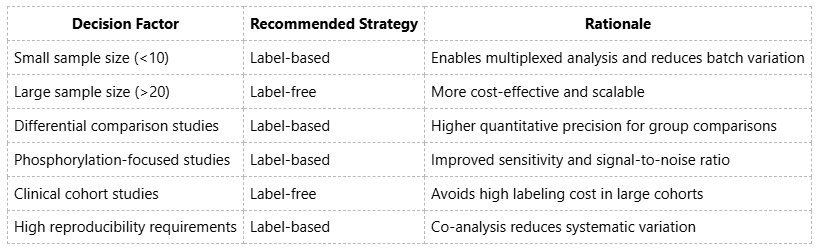
The choice between label-based and label-free strategies should be guided by research objectives and sample characteristics:
Technical Strengths and Solutions of MtoZ Biolabs
In practical applications, phosphoproteomics requires not only an appropriate quantification strategy but also standardized optimization across sample preparation, phosphopeptide enrichment, MS acquisition, and data analysis.
At MtoZ Biolabs, we have established a high-sensitivity and highly reproducible technological platform for phosphorylation analysis:
-
Customized Enrichment Strategies: Integration of TiO₂, Fe-NTA, and IMAC-based approaches to enhance phosphopeptide coverage
-
Multi-Strategy Quantification Support: Compatible with TMT, SILAC, and label-free workflows to meet diverse experimental needs
-
Advanced Data Analysis Platform: Integration of MaxQuant, Perseus, and related software for precise site localization and functional annotation
-
Comprehensive QC Workflow: Including digestion efficiency assessment, pre- and post-enrichment evaluation, and MS performance monitoring to ensure data robustness
Both label-based and label-free strategies have distinct advantages. The optimal choice depends on the balance among research objectives, sample characteristics, and budget constraints. Researchers are advised to clearly define:
-
Sample size and experimental replication design
-
Whether the focus is differential quantification or mechanistic investigation
-
Available budget and project timeline
For further information on phosphoproteomics studies, please contact MtoZ Biolabs. We provide customized technical solutions tailored to specific research needs to support high-quality scientific outcomes.
MtoZ Biolabs, an integrated chromatography and mass spectrometry (MS) services provider.
Related Services
How to order?




